
The Impact of Community Health Workers in a Pre-existing Postpartum Hypertension Program
Abstract Body (Do not enter title and authors here): Background: Maternal mortality in the United States continues to rise, with hypertensive disorders of pregnancy (HDP) playing a significant role in adverse outcomes. Patients of color have worse outcomes compared to their White counterparts. Data in non-pregnant patients suggests community health workers (CHWs) can help mitigate disparities and improve HDP outcomes. Does exposure to a CHW improve patient education about HDP and satisfaction and are these findings different between Black and non-Black patients?
Methods: This was a prospective survey study that enrolled patients delivering at the University of Chicago (UCM). Patients with HDP are automatically enrolled in a standardized postpartum hypertension education program (STAMPP-HTN) where they receive education and a blue tooth compatible blood pressure monitor. Patients who did not record their blood pressures were contacted by a CHW and surveyed about their experience. Results were compared between Black and Non-Black patients using a Wilcoxon Rank Sum, X2 or Fisher’s Exact test, as appropriate.
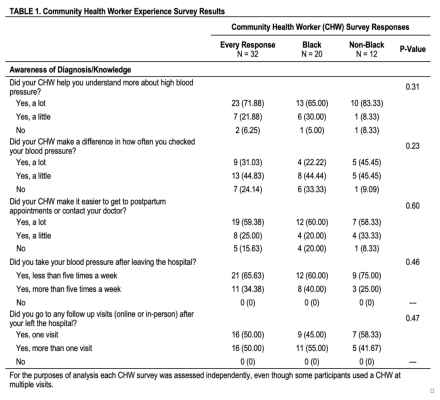
Results: There were 32 survey responses from 22 respondents and 15 patients with complete baseline data, 6 of whom were Black and 9 of whom were non-Black. There were no differences in age, insurance status, or pregnancy outcomes between groups. Additionally, of the 32 survey responses, there were no significant differences in experiences with a CHW between Black and non-Black patients. Table 1 outlines the impact of CHW on patient’s education and attitude towards HDP. Most patients found that CHW involvement increased the amount of time they checked their blood pressure (76%) with no difference between races (p=0.23). Overall, 84% patients (strongly agreed or agreed) that their CHW knows the important issues about their healthcare.
Conclusion: The incorporation of a CHW program into a pre-existing postpartum hypertension program was overall well-received by patients with no racial disparity. The program increased the patient’s understanding of HDP and lead to a better follow up of their blood pressures values. Further work is needed to determine how this program impacts long-term patient’s outcomes.
Azzi, Marly
( University of Chicago
, Chicago
, Illinois
, United States
)
Bisson, Courtney
( University of Chicago
, Chicago
, Illinois
, United States
)
Everett, Arin
( University of Chicago
, Chicago
, Illinois
, United States
)
Potchileev, Sanela
( University of Chicago
, Chicago
, Illinois
, United States
)
Mueller, Ariel
( University of Chicago
, Chicago
, Illinois
, United States
)
Duncan, Colleen
( University of Chicago
, Chicago
, Illinois
, United States
)
Rana, Sarosh
( University of Chicago
, Chicago
, Illinois
, United States
)
Author Disclosures:
Marly Azzi:DO NOT have relevant financial relationships
| Courtney Bisson:No Answer
| Arin Everett:DO NOT have relevant financial relationships
| Sanela Potchileev:DO NOT have relevant financial relationships
| Ariel Mueller:No Answer
| Colleen Duncan:DO NOT have relevant financial relationships
| Sarosh Rana:No Answer