
Circulating Follistatin-like 3 and Risk Prediction of Hypertensive Emergency in Patients with Suspected Preeclampsia
Abstract Body (Do not enter title and authors here): Background: Hypertensive emergency in pregnancy, defined as systolic BP ≥160 and/or diastolic BP ≥110, is a serious complication of hypertensive disorders of pregnancy (HDP). Rapid, aggressive treatment of severe HTN decreases severe Maternal morbidity by 50%. However, few clinical indicators or biomarkers predict the development of severe HTN in pregnancy. Follistatin-like 3 (FSTL3), has been implicated in the development of preeclampsia. We hypothesized that elevated levels of FSTL3 in women for suspected preeclampsia evaluation would predict the development of a hypertensive emergency in pregnancy within two weeks.
Methods: This cohort study included patients with singleton pregnancies who presented in obstetric triage at the University of Chicago between July 2021 and July 2023 for suspected preeclampsia evaluation. We measured plasma levels of FSTL3 at presentation and examined for an association between FSTL3 and subsequent development of a hypertensive emergency within 2 weeks. We excluded women who presented with severe preeclampsia or HTN emergencies on presentation to triage. Logistic regression models with receiver-operating characteristic (ROC) analysis were used to determine the clinical utility of FSTL3 in predicting HTN emergencies.
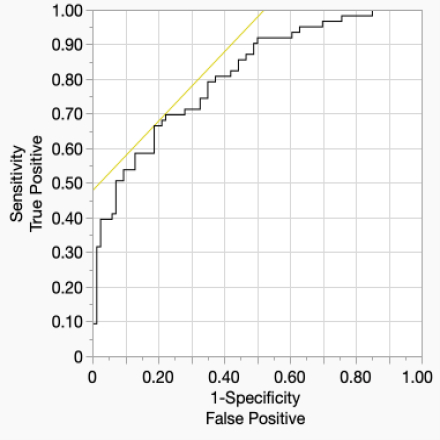
Results: Our study included 208 patients, of which 79 (37.98%) developed severe preeclampsia. The median age was 30 years old (IQR 25.5, 34.5); the median BMI was 36.47 (IQR 30.79, 42.40), and the majority were African American (72.60%). The median FSTL3 at presentation was significantly elevated in participants who experienced HTN emergency compared with those who did not, respectively (Median, IQR) (46.47ng/ml, IQR (33.51–66.10)] versus 31.59ng/ml IQR, 27.35, 43.35], P<0.0001). This association was significant after adjustment for maternal age, race, smoking, HDP, and BMI (P=0.03). Figure 1 outlines ROC analysis for specificity and sensitivity of FSTL3 in predicting HTN emergency within 2 weeks with the area under the curve =0.83.
Conclusion: In women with suspected preeclampsia, circulating FSTL3 predicts a hypertensive emergency occurring within two weeks of triage presentation. This test may be helpful in risk stratification and management in women with HDP.
Azzi, Marly
(
University of Chicago
, Chicago , Illinois , United States )
Potchileev, Sanela
(
University of Chicago
, Chicago , Illinois , United States )
Dreixler, John
(
University of Chicago
, Chicago , Illinois , United States )
Mueller, Ariel
(
University of Chicago
, Chicago , Illinois , United States )
Rana, Sarosh
(
University of Chicago
, Chicago , Illinois , United States )
Shahul, Sajid
(
University of Chicago
, Chicago , Illinois , United States )
Author Disclosures:
Marly Azzi:DO NOT have relevant financial relationships
| Sanela Potchileev:DO NOT have relevant financial relationships
| John Dreixler:No Answer
| Ariel Mueller:No Answer
| Sarosh Rana:No Answer
| Sajid Shahul:No Answer