
Genetically enhanced CHA2DS2VASc score predicts post-ablation ischemic stroke in patients with atrial fibrillation
Abstract Body (Do not enter title and authors here): Introduction: Although atrial fibrillation (AF) catheter ablation (AFCA) may reduce the risk of ischemic stroke (IS), those patients still have some risk. It is unclear whether post-AFCA IS has a genetic background as generally diagnosed IS. We explored the post-AFCA IS-associated single nucleotide polymorphisms (SNPs), and their polygenic risk score (PRS) has an incremental benefit to predict post-AFCA IS in addition to CHA2DS2VASc scores in the two independent cohorts. Methods: We developed PRS for post-AFCA IS from the UK Biobank (N=2,063) and validated from the independent Yonsei AF ablation cohort (N=2,897) after excluding the procedure-related IS (<14 days of the procedure). For sensitivity analysis of oral anticoagulant (OAC), the patients with ≥80% OAC prescriptions during follow-up were considered as OAC treatment patients. We evaluated the incidence and timing of IS after AFCA, comparing the predictive values of CHA2DS2VASc score and CHA2DS2VASc+PRS scores.
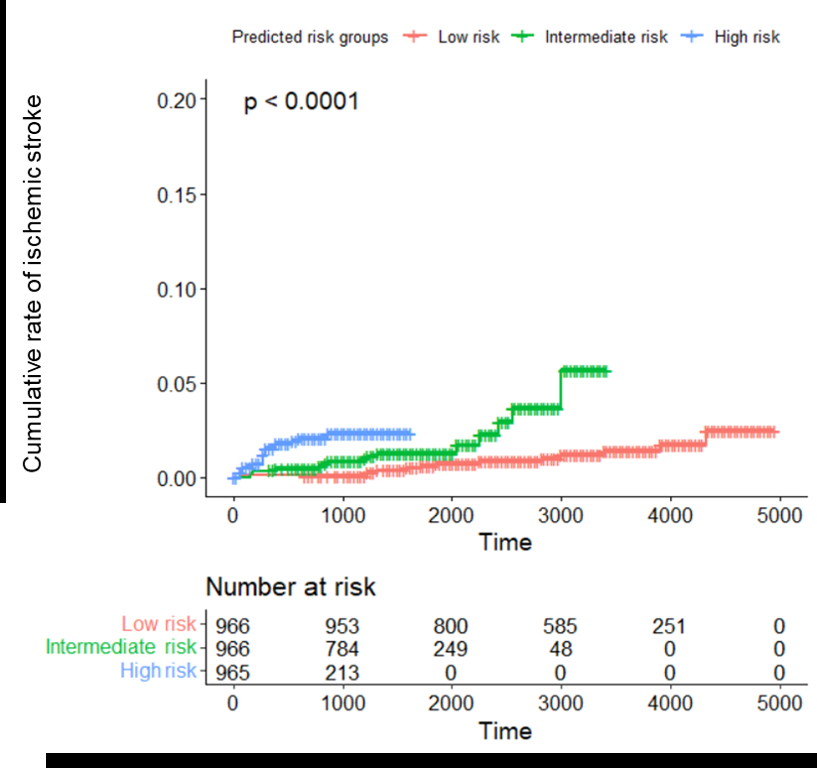
Results: 46 (2.2%) and 48 (1.7%) experienced IS after AFCA in discovery data with a median of 1873 days of follow-up and replication data with a median of 1500 days of follow-up, respectively. Five genome-wide significant loci for post-AFCA IS were identified and replicated in the two independent cohorts’ data. The PRS was higher in patients who experienced post-AFCA IS (1.9±2.2 vs. 0.3±0.7, p<0.001; hazard ratio 1.80 per 1 SD, [95% CI, 1.63-1.99]). CHA2DS2VASc+PRS score showed higher C statistic than CHA2DS2VASc alone (0.754 vs. 0.599, p<0.001). The superiority of CHA2DS2VASc+PRS score over CHA2DS2VASc was consistent in the patients with OAC<80% (C statistic 0.805 vs. 0.648, p<0.001) and those with OAC ≥80% (C statistic 0.720 vs. 0.646, p=0.012). In tertile analysis for CHA2DS2VASc+PRS score, predicted high-risk groups showed early onset overall IS within mean 288 days (p<0.001) after AFCA as compared to intermediate (mean 1231 days) and low (mean 2208 days) risk groups. Conclusions: The CHA2DS2VASc+PRS score improved the IS prediction after AFCA as compared to CHA2DS2VASc alone. The predicted high-risk group suffered from IS in a relatively earler perior (within a year) after AFCA.
Park, Je-wook
(
Yongin SEVERANCE HOSPITAL
, Yongin , Korea (the Republic of) )
Hong, Myunghee
(
Yonsei University Health System
, Seoul , Korea (the Republic of) )
Kim, Moon-hyun
(
Yongin Severance Hospital
, Yongin , Korea (the Republic of) )
Kim, Daehoon
(
Yonsei University Health System
, Seoul , Korea (the Republic of) )
Yu, Hee Tae
(
Yonsei University Health System
, Seoul , Korea (the Republic of) )
Kim, Tae-hoon
(
Yonsei University Health System
, Seoul , Korea (the Republic of) )
Uhm, Jae-sun
(
Yonsei University Health System
, Seoul , Korea (the Republic of) )
Joung, Boyoung
(
Yonsei University Health System
, Seoul , Korea (the Republic of) )
Lee, Moon-hyoung
(
Yonsei University Health System
, Seoul , Korea (the Republic of) )
Pak, Hui-nam
(
Yonsei University Health System
, Seoul , Korea (the Republic of) )
Author Disclosures:
Je-Wook Park:DO NOT have relevant financial relationships
| Hui-Nam Pak:DO NOT have relevant financial relationships
| Myunghee Hong:No Answer
| Moon-Hyun Kim:No Answer
| Daehoon Kim:No Answer
| Hee Tae Yu:DO NOT have relevant financial relationships
| Tae-Hoon Kim:No Answer
| Jae-Sun Uhm:DO NOT have relevant financial relationships
| Boyoung Joung:No Answer
| Moon-Hyoung Lee:DO NOT have relevant financial relationships
Hwang Taehyun, Joung Boyoung, Lee Moon-hyoung, Pak Hui-nam, Kwon Oh-seok, Lim Byounghyun, Kim Moon-hyun, Kim Daehoon, Park Je-wook, Yu Hee Tae, Kim Tae-hoon, Uhm Jae-sun