
Logo

American Heart Association

  164
  0


Final ID: Su4178

Opposing Responses to Oxygen in the Rabbit Ductus Arteriosus and Fetal Pulmonary Arteries: Proteomic Analysis Reveals Significant Metabolic Differences

Abstract Body (Do not enter title and authors here): Introduction: The ductus arteriosus (DA) is a fetal vessel connecting the pulmonary artery (PA) and aorta, diverting oxygenated blood away from the developing lungs to the systemic circulation. Following the first breath, the DA rapidly constricts in response to increased arterial oxygen (O2) which simultaneously induces relaxation of small resistance pulmonary arteries (rPA). These changes, vital for adaptation to neonatal life, separate the pulmonary and systemic circulations (DA vasoconstriction) and enable adequate perfusion of newly ventilated lungs (PA vasodilation). The underlying mechanism of these opposite O2 responses is not fully understood. A failure of either vessel to appropriately respond to O2 results in clinical complications, notably persistent ductus arteriosus or persistent pulmonary hypertension of the newborn. To examine the underlying differences in these fetal vessels, we performed proteomics on fetal rabbit DA and rPA.
Methods: DA and rPA were isolated from male (n=4) and female (n=4) term (30 days gestation) fetal New Zealand white rabbits (protocol #2021-2122). Extracted protein was labelled with TMTpro mass tag labeling. Following HPLC fractionation, samples were run on the ThermoFisher Orbitrap Eclipse Mass Spectrometer. Analysis was completed using ThermoFisher Proteome Discoverer software and DESeq2.
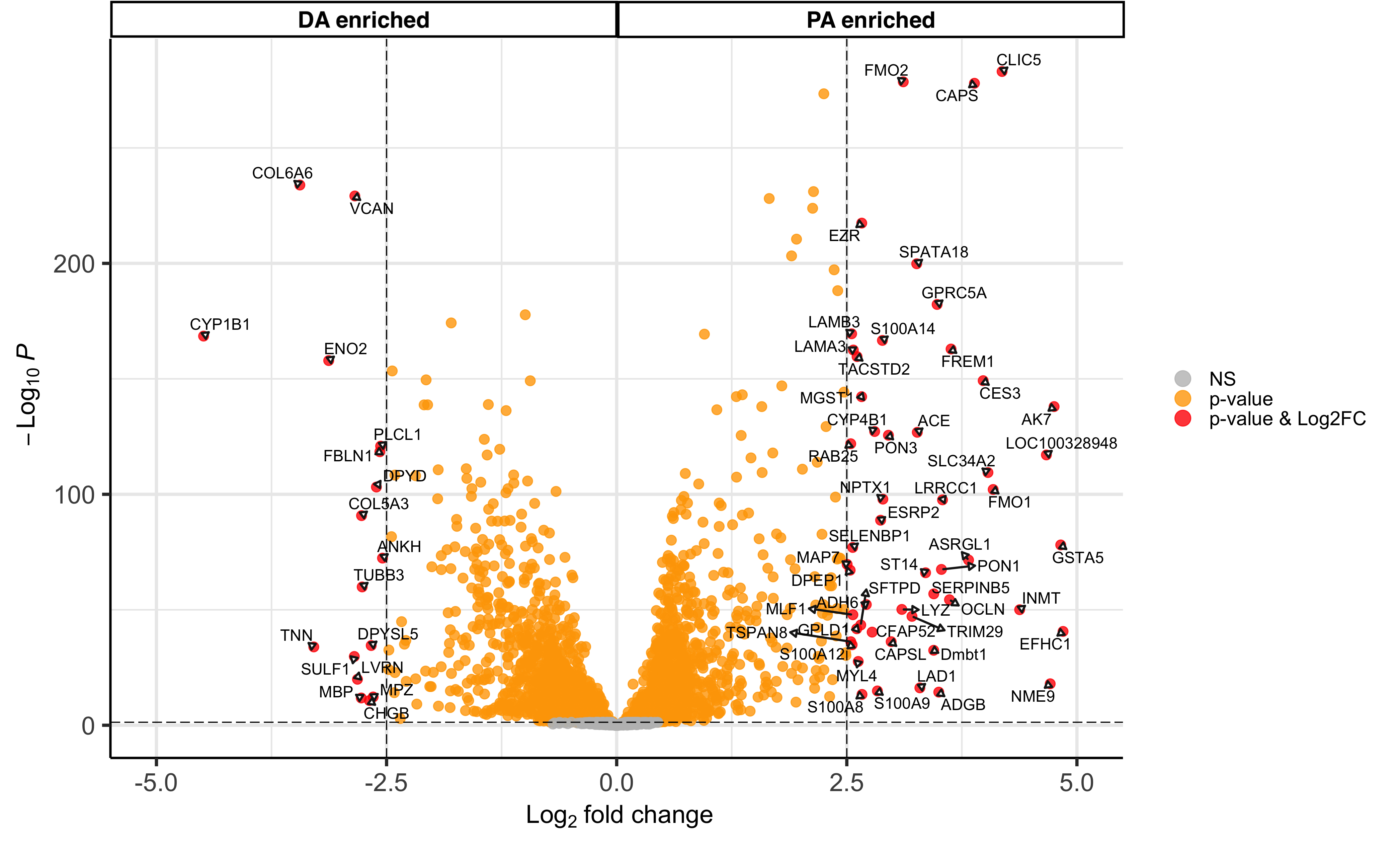
Results: There were 3103 significantly, differentially expressed proteins between the DA and PA(Benjamini Hochberg adjusted p<0.05), 232 of which were ±1.5-fold differentially expressed (Figure 1). Using KEGG pathway analysis the most significantly DA enriched pathway is “Starch and sucrose metabolism” (map00500) and the most significantly rPA enriched pathway is “Sulfur Metabolism” (map00920). There was also rPA enrichment of other metabolic pathways including “Fatty Acid Degradation” (map00071), “Pyruvate Metabolism” (map00620), and “Glycolysis/Gluconeogenesis” (map00010).
Conclusions: This analysis reveals unique mitochondrial metabolic pathways that may contribute to the opposing tissue responses of these specialized blood vessels to O2. Exploration of these pathways may identify potential therapeutic targets and inform future investigations of differential O2 sensing in DA and rPA.
  • Bentley, Rachel  ( Queen's University , Kingston , Ontario , Canada )
  • Prins, Kurt  ( University of Minnesota , Minneapolis , Minnesota , United States )
  • Martin, Ashley  ( Queen's University , Kingston , Ontario , Canada )
  • Emon, Isaac  ( Queen's University , Kingston , Ontario , Canada )
  • Hindmarch, Charles  ( Queen's University , Kingston , Ontario , Canada )
  • Archer, Stephen  ( Queens University , Kingston , Ontario , Canada )
  • Author Disclosures:
    Rachel Bentley: DO NOT have relevant financial relationships | Kurt Prins: DO NOT have relevant financial relationships | Ashley Martin: DO NOT have relevant financial relationships | Isaac Emon: DO NOT have relevant financial relationships | Charles Hindmarch: DO NOT have relevant financial relationships | Stephen Archer: DO NOT have relevant financial relationships
Meeting Info:

Scientific Sessions 2024

2024

Chicago, Illinois

Session Info:

When Cells and Molecules Go Bad: Molecular Mechanisms of Pulmonary Vascular Disease

Sunday, 11/17/2024 , 03:15PM - 04:15PM

Abstract Poster Session

More abstracts on this topic:
A prognostic molecular signature of hepatic steatosis is spatially heterogeneous and dynamic in human liver

Perry Andrew, Huang Shi, Martens Liesbet, Kendall Timothy, Thone Tinne, Amancherla Kaushik, Bailin Samuel, Gabriel Curtis, Koethe John, Carr John, Terry James, Hadad Niran, Vaitinadin Nataraja Sarma, Freedman Jane, Tanriverdi Kahraman, Alsop Eric, Van Keuren-jensen Kendall, Sauld John, Mahajan Gautam, Khan Sadiya, Colangelo Laura, Nayor Matthew, Chatterjee Emeli, Fisher-hoch Susan, Mccormick Joseph B, North Kari, Below Jennifer, Wells Quinn, Abel Dale, Kalhan Ravi, Scott Charlotte, Guilliams Martin, Gamazon Eric, Jimenez Ramos Maria, Fallowfield Jonathan, Banovich Nicholas, Das Saumya, Shah Ravi, Farber-eger Eric, Roshani Rashedeh, Stolze Lindsey, Betti Michael, Zhao Shilin

2 Dimensional Echocardiography versus 3 Dimentional Echocardiography to Assess Right Ventricular Function in Pulmonary Hypertension: A Systematic Review

Chaudhry Waleed Razzaq, Hajj Fatima, Bathula Satyamedha, Meghji Mohammed Askari, Pasupuleti Hemalatha, Kiyani Madiha, Shah Syeda Simrah, Neelakantan Ramaswamy Sanathanan, Mirzaeidizaji Nakisa, St. Jacques Jahnoy, Khan Khalil Ullah, Veluchamy Elakkiya, Jesse Joshanna

More abstracts from these authors:
Network Analysis of Differentially Expressed Genes after Silencing Dynamin 2 in Pulmonary Arterial Hypertension

Wu Danchen, Das Gupta Asish, Chen Kuang-hueih, Hindmarch Charles, Hu Ting, Archer Stephen

Upregulation of Dynamin 2 (DNM2) Increases Mitochondrial Fission and Cell Proliferation in Pulmonary Arterial Hypertension

Das Gupta Asish, Yerramilli Siddartha, Jones Oliver, Hindmarch Charles, Potus Francois, Bonnet Sebastien, Archer Stephen, Chen Kuang-hueih, Wu Danchen, Lima Patricia, Martin Ashley, Mewburn Jeffrey, Al-qazazi Ruaa, Emon Isaac, Colpman Pierce

You have to be authorized to contact abstract author. Please, Login
Not Available