
Second-by-second monitoring of SpO2 by wearable device during the six-minute walk test identifies patients at risk for worsening heart failure.
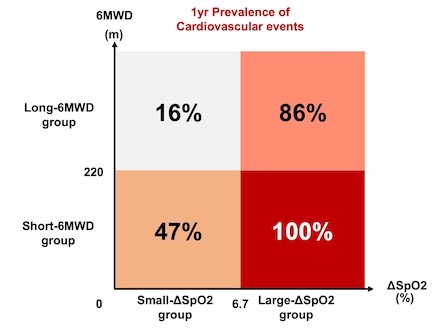
Abstract Body (Do not enter title and authors here): Background: Assessment of exercise tolerance is crucial for risk stratification in patients with heart failure (HF), and the six-minute walk test (6MWT) is widely used. While the six-minute walk distance (6MWD) is an established metric, it shows significant variability among elderly patients due to numerous comorbidities and potential confounding factors, making relative risk assessment challenging. Therefore, a new comprehensive indicator for evaluating exercise tolerance in elderly patients with HF is required. Objective: This study aimed to evaluate the novel prognostic value of desaturation during the 6MWT, defined as the average decrease in peripheral oxygen saturation (ΔSpO2-Ex), in predicting rehospitalization in patients with HF. Methods: We retrospectively analyzed the data of 55 patients with acute HF aged ≥ 65 years who were prospectively registered at our hospital. The mean SpO2 was calculated from data obtained at rest and during the 6MWT using a wearable pulse oximeter designed to record the SpO2 value every second. ΔSpO2-Ex was defined as the difference between the highest SpO2 at rest and average SpO2 during the 6MWT. Patients were followed-up for 1 year for the composite outcome of rehospitalization due to HF exacerbation and cardiovascular death. Results: The mean age was 80.7 years, with 45 % being female. The mean 6MWD was 237.5 m, and the mean ΔSpO2-Ex was 5.8 %. Patients were categorized based on the cut-off values obtained from the ROC curve for both 6MWD and ΔSpO2-Ex. Kaplan-Meier analysis indicated a significantly higher risk of cardiovascular events when ΔSpO2-Ex exceeded 6.7 % compared to when the 6MWD was less than 220 m (HR 6.66, 95 % CI: 2.96-15.01, p<0.001 and HR 2.40, 95 % CI: 1.08-5.32, p=0.031). Additionally, the combination of shorter 6MWD and higher ΔSpO2-Ex was associated with a significantly higher incidence of cardiovascular events. Conclusion: ΔSpO2-Ex is a powerful and independent prognostic marker for cardiovascular events in elderly patients with HF, surpassing the predictive power of 6MWD. These findings suggest that incorporating ΔSpO2-Ex into routine clinical assessments could enhance the risk stratification and management of patients with HF.
Sunayama, Isamu
( Hyogo Medical University
, Nishinomiya-shi
, Japan
)
Min, Kyung-duk
( Hyogo Medical University
, Nishinomiya
, Japan
)
Orihara, Yoshiyuki
( Penn State College of Medicine
, Hummelstown
, Pennsylvania
, United States
)
Asakura, Masanori
( Hyogo Medical University
, Hyogo
, Japan
)
Ishihara, Masaharu
( Hyogo Medical University
, Noshinomiya
, Japan
)
Author Disclosures:
Isamu Sunayama:DO NOT have relevant financial relationships
| Kyung-Duk Min:DO NOT have relevant financial relationships
| Yoshiyuki Orihara:DO NOT have relevant financial relationships
| Masanori Asakura:DO NOT have relevant financial relationships
| Masaharu Ishihara:No Answer