
Logo

American Heart Association

  106
  0


Final ID: Mo2091

Intraoperative indicators depending on QRS morphology are required to narrow QRS width during CRT implantation

Abstract Body (Do not enter title and authors here): Introduction: Various indicators to detect the most delayed electrical or mechanical activation site of left ventricular (LV) have been studied using intracardiac electrocardiogram or speckle tracking echocardiogram to narrow QRS width in patients with cardiac resynchronization therapy (CRT).
Hypothesis: Unusual intraoperative indicators are required to narrow QRS width in patients with non-LBBB (left bundle branch block) during CRT implantation.
Methods: Nineteen patients (14 men, 71±12yrs, 7 with left bundle branch block: LBBB / 10 non-LBBB / 2 pacing-depend, 6 ischemic cardiomyopathy, LVEF 29.6±8.9%, QRS 152±28ms) underwent CRT implantation. Q-LV (an interval from QRS onset to LV potential), RV-LV (from RV to LV), RVp-LV (from RV pacing to LV), and S-QRS (from LV pacing stimulation to QRS onset) were measured in multi-sites of coronary sinus (CS) veins using a 5 mm spacing 2Fr 8-polar catheters. Q-peak strain (an interval from QRS onset to peak radial strain) was evaluated by speckle tracking echocardiogram in each LV segment during sinus rhythm (SR) and RVp. QRS narrowing was defined as the difference between the QRS interval during SR (or RVp) and the QRS interval with biventricular pacing.
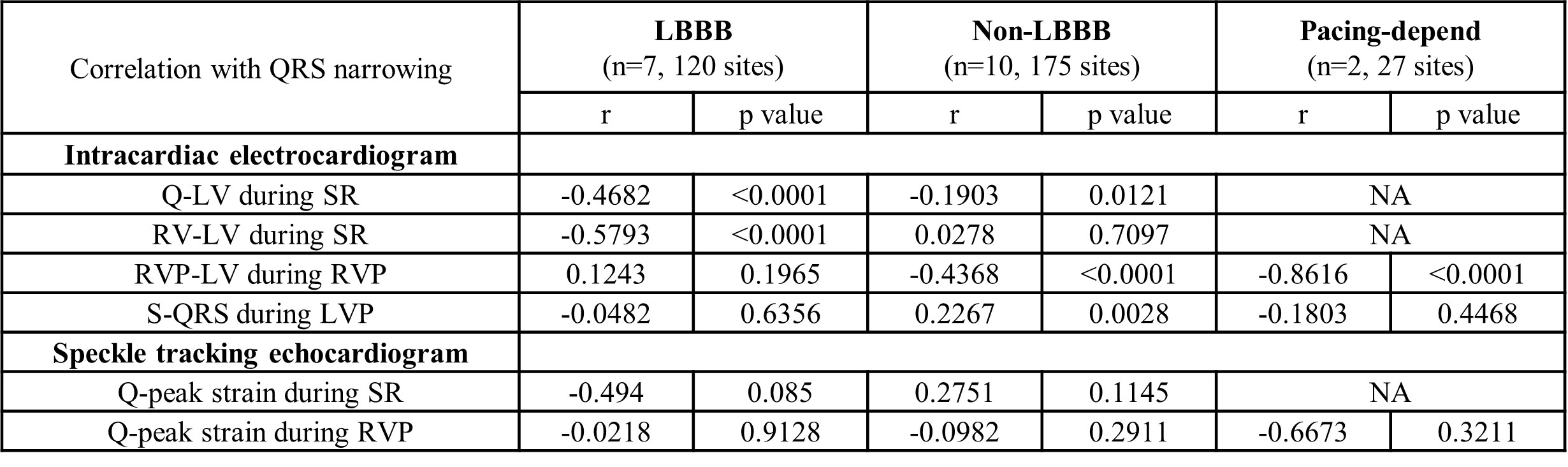
Results: Parameters were evaluated in 17±7 (8-32) sites of 1.9±0.9 (1-4) CS branches in each patient. In LBBB patients, longer Q-LV during SR, extended RV-LV during SR, and lengthy Q-peak strain during SR were associated with QRS narrowing. Shorter S-QRS during LVP and longer RVP-LV during RVP were related to QRS narrowing in non-LBBB patients. (Table)
Conclusion: Suitable indicators depending on QRS morphology are required for QRS narrowing in CRT implantation. The parameters using speckle tracking echocardiogram to detect mechanical LV delay sites might not be useful in patients with non-LBBB.
  • Mine, Takanao  ( Hyogo Medical University , Nishinomiya , Japan )
  • Terao, Soichiro  ( Hyogo Medical University , Nishinomiya , Japan )
  • Sugitani, Miho  ( Hyogo Medical University , Nishinomiya , Japan )
  • Kogame, Takehiro  ( Hyogo Medical University , Nishinomiya , Japan )
  • Ishihara, Masaharu  ( Hyogo Medical University , Nishinomiya , Japan )
  • Author Disclosures:
    Takanao Mine: DO NOT have relevant financial relationships | Soichiro Terao: No Answer | Miho Sugitani: DO NOT have relevant financial relationships | Takehiro Kogame: No Answer | Masaharu Ishihara: No Answer
Meeting Info:

Scientific Sessions 2024

2024

Chicago, Illinois

Session Info:

Magnificent Melange of Electrophysiology

Monday, 11/18/2024 , 10:30AM - 11:30AM

Abstract Poster Session

More abstracts on this topic:
A Bridge from Sweet to Sour: A Case of Recurrent Myocardial Stunning in Diabetic Ketoacidosis

Satish Vikyath, Pargaonkar Sumant, Slipczuk Leandro, Schenone Aldo, Maliha Maisha, Chi Kuan Yu, Sunil Kumar Sriram, Borkowski Pawel, Vyas Rhea, Rodriguez Szaszdi David Jose Javier, Kharawala Amrin, Seo Jiyoung

A large-scale multi-view deep learning-based assessment of left ventricular ejection fraction in echocardiography

Jing Linyuan, Metser Gil, Mawson Thomas, Tat Emily, Jiang Nona, Duffy Eamon, Hahn Rebecca, Homma Shunichi, Haggerty Christopher, Poterucha Timothy, Elias Pierre, Long Aaron, Vanmaanen David, Rocha Daniel, Hartzel Dustin, Kelsey Christopher, Ruhl Jeffrey, Beecy Ashley, Elnabawi Youssef

More abstracts from these authors:
Association Between Renal Artery Calcification and Renal Functional Outcomes After Revascularization According to CKD Stage in Renovascular Hypertension

Kawai Kenji, Mine Takanao, Hoshina Rin, Akahori Hirokuni, Miki Kojiro, Yoshihara Nagataka, Tanaka Hirokazu, Ishihara Masaharu

Second-by-second monitoring of SpO2 by wearable device during the six-minute walk test identifies patients at risk for worsening heart failure.

Sunayama Isamu, Min Kyung-duk, Orihara Yoshiyuki, Asakura Masanori, Ishihara Masaharu

You have to be authorized to contact abstract author. Please, Login
Not Available