Lipoprotein Apheresis improves HDL Proteomics and reduces the risk of Aortic Stenosis in patients with elevated Lipoprotein(a) levels and Familial Hypercholesterolemia
Abstract Body (Do not enter title and authors here): Background: The prevalence of calcific valve stenosis (CAVS) in familial hypercholesterolemia (FH) is 30-40%. Eleveated Lp(a) levels independently promotes faster progression of CAVS. Low HDL particles (HDL-P), increase apoC3 and serum amyloid A (SAA)-bound HDL are associated with long-term incidence and progression of CAVS.
Aim: Dextran-sulfate-adsorption lipoprotein-apheresis (LA), the only LA device available in the United States, reduces LDL-C and Lp(a) by an average of 60%-80% via binding positive-charged apolipoprotein B to a negative-changed environment. Despite the negative charge of HDL-C, it is acutely reduced by 10%-20%. However, the total HDL-P number, as measured by nuclear magnetic resonance testing, is increased by an average of 16% following LA therapy. We hypothesized that regular LA may improve cardiovascular outcomes and slow the progression of CAVS via its effects on HDL functionality and Lp(a) levels.
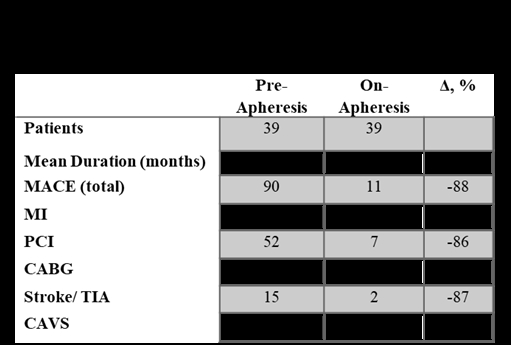
Methods: This case series describes 39 Caucasian patients (mean age 61 years, 70% female, 80% statin intolerant) with FH and/or elevated Lp(a) (Liposorber LA-15, Kaneka) over a mean treatment period of 4.8 years, as compared to an average of 5.3 years pre-treatment. Pre-treatment LDL-C and Lp(a) levels were 144 mg/dL (range, 35-314) and 167 nmol/L (range 2-530). HDL proteomic analysis was performed to identify numerous proteins and lipids segregated into distinct subclasses. Major adverse cardiovascular events were defined as: MI=myocardial event, PCI=percutaneous cornary intervention, CABG=coronary artery bypass surgery, TIA=transient ischemic attack, CAVS=calcific artic stenosis.
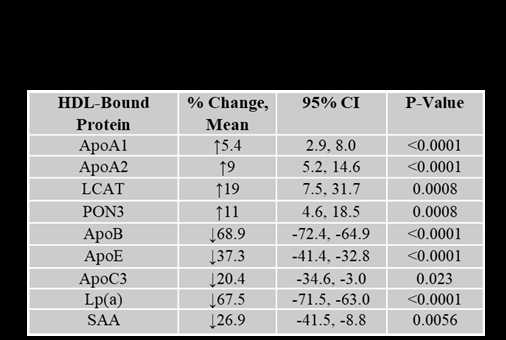
Results: LA therapy reduced mean LDL-C to an average of 40 mg/dL and Lp(a) to 24nmol/L, while total HDL-C was lowered by 14%. Extra small and small-sized HDL-P was reduced by 42% and 20%, respectively (P<0.001). Medium-sized HDL-P increased by 12% (P<0.001). We observed significant modifications in the HDL-bound proteins (Table 1). There was an 88% reduction in major adverse cardiovascular events, with no patient developing CAVS (Table 2).
Conclusions: In patients with FH and/or elevated Lp(a) with established ASCVD, LA effectively lowered the incidence rate of cardiovascular events. LA selectively reduced pro-inflammatory apoC3- and SAA-bound HDL and increased HDL-P, potentially explaining the lack of development and progression of CAVS in patients with elevated Lp(a). This observation merits further investigation with a dedicated controlled clinical study.
Moriarty, Patrick
(
University of Kansas Medical Center
, Kansas City , Missouri , United States )
Safarova, Maya
(
The Medical College of Wisconsin
, Brookfield , Wisconsin , United States )
Author Disclosures:
Patrick Moriarty:DO have relevant financial relationships
;
Research Funding (PI or named investigator):Amgen:Active (exists now)
; Research Funding (PI or named investigator):FH Foundation:Active (exists now)
; Consultant:regeneron:Active (exists now)
; Consultant:Kaneka:Active (exists now)
; Research Funding (PI or named investigator):Kaneka:Active (exists now)
; Research Funding (PI or named investigator):novartis:Active (exists now)
; Research Funding (PI or named investigator):Merck:Active (exists now)
; Research Funding (PI or named investigator):Ionis:Active (exists now)
| Maya Safarova:DO NOT have relevant financial relationships