
Logo

American Heart Association

  110
  0


Final ID: Sa2116

Clinical Impact of Ventricular and Supraventricular Arrhythmia Detection with a Novel Wearable Cardioverter Defibrillator

Abstract Body (Do not enter title and authors here): Background: The wearable cardioverter defibrillator (WCD) can prevent sudden
cardiac death (SCD). It also provides continuous monitoring for detection of
significant cardiac arrhythmias.

Hypothesis: Detection of ventricular and atrial arrhythmia by the WCD can significantly impact clinical decisions and outcomes.

Aims: Report occurrence of ventricular tachycardia/fibrillation (VT/VF) and atrial fibrillation/flutter (AF/AFL) detected by the WCD and clinical consequence of these diagnoses.

Methods: Retrospective analysis of patients prescribed the ASSURE WCD at the Cleveland Clinic. Clinical data were collected via medical chart review. Rhythm classification, of all device-detected and patient-initiated episodes displayed with 4 independent ECG channels, was manually adjudicated by a Board-Certified Electrophysiologist.

Results: Fifty-five patients were fitted with the WCD between January 2023 and April 2024. Overall median daily use was 22 hr/day (IQR 13-24) and median duration of use was 43 days (IQR 8-79). Mean age 60.1 ± 17.6 years; 49% females; 40% ischemic cardiomyopathy; 44% nonischemic cardiomyopathy; 16% other etiology; mean Ejection Fraction (EF) 31.5 ± 6.9% pre-WCD and 38.6 ± 9.3% post-WCD.
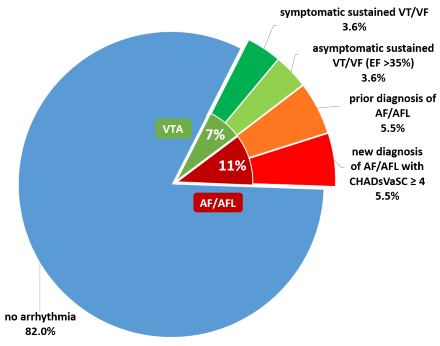
Arrhythmia occurrence in this cohort is shown in Figure 1. Four patients (7%) had sustained VT/VF detected by the WCD, consequently all received a secondary prevention ICD. Notably, 2 patients were asymptomatic and only aware because of the device alerting of an imminent shock. Both patients showed significant recovery of EF >35% during the WCD wear period, and had sustained VT/VF not been detected by the WCD, neither would have met indication for a prophylactic ICD. Additionally, 6 patients (11%) had AF/AFL recorded by the WCD. In 3 patients AF/AFL manifested in a paroxysmal pattern and the diagnosis was new. All were at high risk for stroke with median CHADS-VaSC=4 (IQR 4-6).

Discussion: In addition to its primary utility for preventing SCD, the WCD can detect occult yet clinically significant arrhythmia. Detection of sustained ventricular arrhythmia in asymptomatic at-risk patients resulted in secondary prevention of SCD. Documentation of AF/AFL in high-risk patients could similarly lead to impactful risk reduction.
  • Phukan, Anisha  ( Case Western Reserve University , Cleveland , Ohio , United States )
  • Kanj, Mohamed  ( Cleveland Clinic , Cleveland , Ohio , United States )
  • Chung, Mina  ( Cleveland Clinic , Cleveland , Ohio , United States )
  • Tanaka Esposito, Christine  ( Cleveland Clinic , Cleveland , Ohio , United States )
  • Syed, Zain  ( Case Western Reserve University , Cleveland , Ohio , United States )
  • Gustavson, Laura  ( Kestra Medical Technologies, Inc. , Kirkland , Washington , United States )
  • Li, Brian  ( Cleveland Clinic , Cleveland , Ohio , United States )
  • Hazarika, Surovi  ( Cleveland Clinic , Cleveland , Ohio , United States )
  • Syed, Qarab  ( Cleveland Clinic , Cleveland , Ohio , United States )
  • Chung, Roy  ( Cleveland Clinic , Cleveland , Ohio , United States )
  • Sharma, Navneet  ( Cleveland Clinic , Cleveland , Ohio , United States )
  • Pattisapu, Anish  ( Cleveland Clinic , Cleveland , Ohio , United States )
  • Author Disclosures:
    Anisha Phukan: DO NOT have relevant financial relationships | Mohamed Kanj: DO NOT have relevant financial relationships | Mina Chung: DO NOT have relevant financial relationships | Christine Tanaka Esposito: No Answer | Zain Syed: DO NOT have relevant financial relationships | Laura Gustavson: DO have relevant financial relationships ; Employee:Kestra Medical Technologies, Inc.:Active (exists now) | Brian Li: No Answer | Surovi Hazarika: DO NOT have relevant financial relationships | Qarab Syed: DO NOT have relevant financial relationships | Roy Chung: DO NOT have relevant financial relationships | Navneet Sharma: No Answer | Anish Pattisapu: DO NOT have relevant financial relationships
Meeting Info:

Scientific Sessions 2024

2024

Chicago, Illinois

Session Info:

Unusual Causes and Circumstances - Cardiac Arrhythmia Cases

Saturday, 11/16/2024 , 02:00PM - 03:00PM

Abstract Poster Session

More abstracts on this topic:
Ambulatory Inotropic Support in Patients with Stage D Heart Failure Does Not Increase ICD Therapies

Sunthankar Kathryn, Pfaff Jamie, Farber-eger Eric, Richardson Travis, Wells Quinn, Ooi Henry, Skelton Melanie, Stevenson Lynne, Pedrotty Dawn

A-band titin-truncating variant promotes the development of arrhythmia-induced cardiomyopathy in a novel genetically-engineered porcine model

Lee Kwonjae, Del Rio Carlos, Mcnally Elizabeth, Pfenniger Anna, Bhatnagar Ashita, Glinton Kristofor, Burrell Amy, Ober Rebecca, Mcluckie Alicia, Bishop Brian, Rogers Christopher, Geist Gail

More abstracts from these authors:
Initial Real-World Experience with a Novel Wearable Cardioverter Defibrillator

Syed Zain, Kanj Mohamed, Chung Mina, Tanaka Esposito Christine, Phukan Anisha, Gustavson Laura, Li Brian, Hazarika Surovi, Syed Qarab, Chung Roy, Sharma Navneet, Pattisapu Anish

Left Atrial Appendage Occlusion vs Anticoagulation Following Atrial Fibrillation Ablation: A Propensity-Matched Comparative Outcomes Study

Massad Faysal, Issa Rochell, Calcagno Tess, Chung Mina, Kanj Mohamed, Wazni Oussama, Tang Wai Hong

You have to be authorized to contact abstract author. Please, Login
Not Available