
Logo

American Heart Association

  109
  0


Final ID: MDP1794

Initial Real-World Experience with a Novel Wearable Cardioverter Defibrillator

Abstract Body (Do not enter title and authors here): Background
The wearable cardioverter defibrillator (WCD) can reduce sudden cardiac death; effectiveness depends on adherence. A novel WCD designed for sex specific comfort and noise immunity has reported improved compliance.

Hypothesis
Patient compliance with the WCD maximizes device utility in treating significant arrhythmia.

Aims
Report WCD patient compliance and efficacy in a cohort with balanced gender representation. Evaluate WCD performance in minimizing noise artifact leading to false alarms and unnecessary shocks.

Methods
Retrospective analysis of patients prescribed the ASSURE WCD at the Cleveland Clinic. Clinical data was collected via medical chart review. All device-detected arrhythmia episodes were manually adjudicated by a Board-certified Electrophysiologist. Detected rhythms that persist, result in an audible alarm notifying that a shock is imminent. A conscious patient can manually divert a shock. An alarm was deemed true and shock appropriate if the underlying rhythm was sustained VT/VF.

Results
Fifty-five patients were fitted with a WCD. Median daily use 22 hr/day (IQR 13,24) and median duration of use 43 days (IQR 8,79). Female representation was 49%, significantly greater than prior reports of WCD experience. 4 episodes of sustained VT/VF were detected in 4 patients. A single shock terminated VT/VF in 2, while spontaneous termination of VT/VF occurred in the other 2 patients who diverted shocks. One shock for hemodynamically unstable atrial fibrillation with heart rate >200bpm was delivered and deemed necessary. No deaths occurred while wearing a WCD.

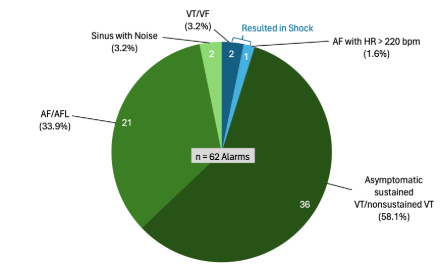
Of 163 recorded episodes, 62 (38%) persisted and triggered an alarm (Figure 1). 10 patients experienced a median of 1 (IQR 1,9.5) alarm during the WCD wear period. The majority (97%) of alarms were associated with a significant tachyarrhythmia, with only 3% due to noise artifact. No inappropriate, unnecessary shocks were delivered.

Discussion
Patient compliance with the ASSURE WCD was high in this real-world observational study with equal representation of both sexes. The WCD effectively terminated sustained hemodynamically significant tachyarrhythmias, emitted few false alarms due to noise and resulted in no unnecessary and inappropriate shocks.
  • Syed, Zain  ( Case Western Reserve University , Cleveland , Ohio , United States )
  • Kanj, Mohamed  ( Cleveland Clinic , Cleveland , Ohio , United States )
  • Chung, Mina  ( Cleveland Clinic , Cleveland , Ohio , United States )
  • Tanaka Esposito, Christine  ( Cleveland Clinic , Cleveland , Ohio , United States )
  • Phukan, Anisha  ( Case Western Reserve University , Cleveland , Ohio , United States )
  • Gustavson, Laura  ( Kestra Medical Technologies, Inc. , Kirkland , Washington , United States )
  • Li, Brian  ( Cleveland Clinic , Cleveland , Ohio , United States )
  • Hazarika, Surovi  ( Cleveland Clinic , Cleveland , Ohio , United States )
  • Syed, Qarab  ( Cleveland Clinic , Cleveland , Ohio , United States )
  • Chung, Roy  ( Cleveland Clinic , Cleveland , Ohio , United States )
  • Sharma, Navneet  ( Cleveland Clinic , Cleveland , Ohio , United States )
  • Pattisapu, Anish  ( Cleveland Clinic , Cleveland , Ohio , United States )
  • Author Disclosures:
    Zain Syed: DO NOT have relevant financial relationships | Mohamed Kanj: DO NOT have relevant financial relationships | Mina Chung: DO NOT have relevant financial relationships | Christine Tanaka Esposito: No Answer | Anisha Phukan: DO NOT have relevant financial relationships | Laura Gustavson: DO have relevant financial relationships ; Employee:Kestra Medical Technologies, Inc.:Active (exists now) | Brian Li: No Answer | Surovi Hazarika: No Answer | Qarab Syed: DO NOT have relevant financial relationships | Roy Chung: DO NOT have relevant financial relationships | Navneet Sharma: No Answer | Anish Pattisapu: DO NOT have relevant financial relationships
Meeting Info:

Scientific Sessions 2024

2024

Chicago, Illinois

Session Info:

New Insights and Novel Techniques in Device Therapies

Monday, 11/18/2024 , 09:30AM - 10:45AM

Moderated Digital Poster Session

More abstracts on this topic:
A nationwide survey of the association between the incidence of fatal ventricular arrhythmias and meteorological conditions in Japan

Mihara Yutaka, Tanabe Yasuhiro, Nozue Tsuyoshi, Akashi Yoshihiro, Kawagoe Yasuhito, Takizawa Shiori, Doi Shunichi, Yoneyama Kihei, Yoshida Toshiya, Koga Masashi, Kaihara Toshiki, Ishibashi Yuki

AI-based prediction of mortality in patients with ventricular tachycardia

Bandyopadhyay Sabyasachi, Narayan Sanjiv, Sadri Shirin, Brennan Kelly, Ganesan Prash, Clopton Paul, Ruiperez-campillo Samuel, Peralta Esteban, Sillett Charlie, Rogers Albert

More abstracts from these authors:
Clinical Impact of Ventricular and Supraventricular Arrhythmia Detection with a Novel Wearable Cardioverter Defibrillator

Phukan Anisha, Kanj Mohamed, Chung Mina, Tanaka Esposito Christine, Syed Zain, Gustavson Laura, Li Brian, Hazarika Surovi, Syed Qarab, Chung Roy, Sharma Navneet, Pattisapu Anish

Left Atrial Appendage Occlusion vs Anticoagulation Following Atrial Fibrillation Ablation: A Propensity-Matched Comparative Outcomes Study

Massad Faysal, Issa Rochell, Calcagno Tess, Chung Mina, Kanj Mohamed, Wazni Oussama, Tang Wai Hong

You have to be authorized to contact abstract author. Please, Login
Not Available