Clinical Hepatic Scores as Predictors of Major Adverse Cardiovascular Events in a SMuRFless Population
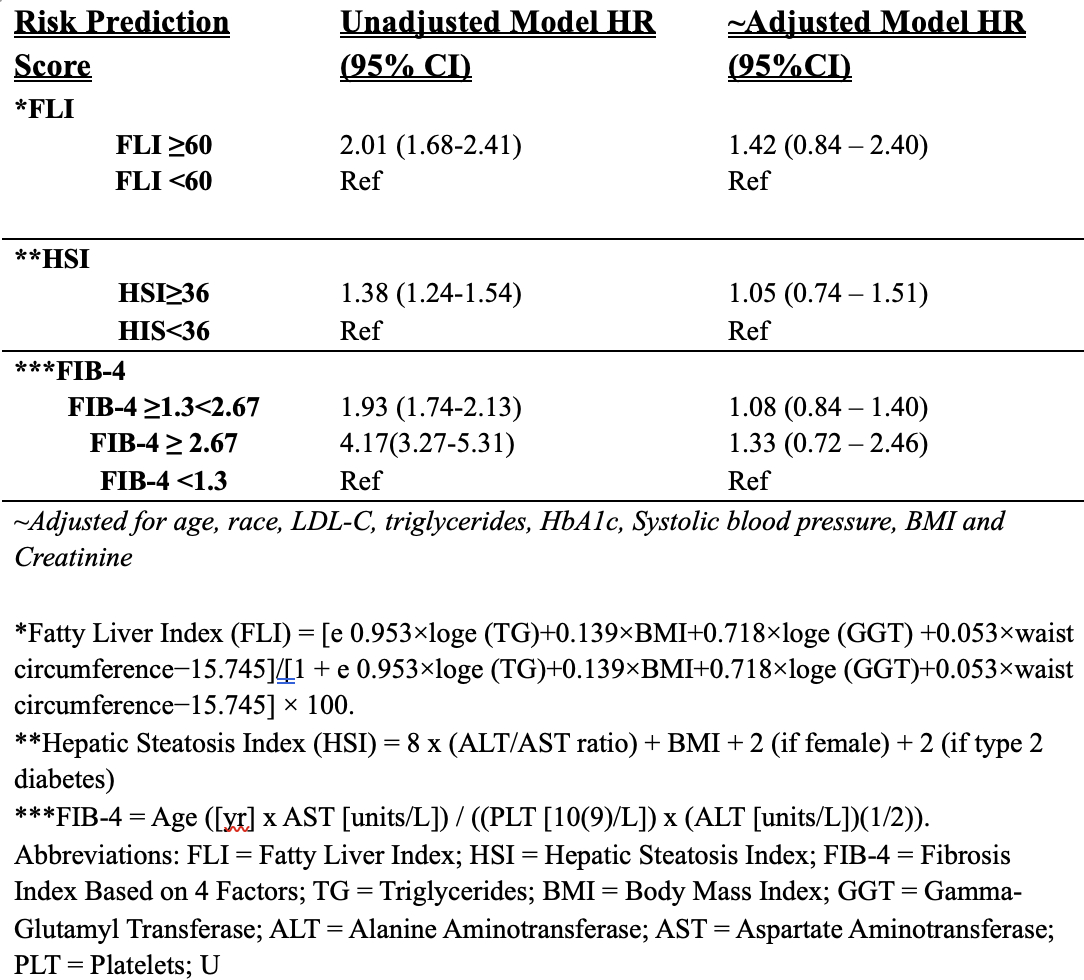
Abstract Body (Do not enter title and authors here): Background Recent evidence suggests that a significant proportion of individuals presenting with myocardial infarction lack standard modifiable cardiovascular disease risk factors (SMuRFs). This SMuRFless population has an elevated risk of mortality, highlighting the need for identifying novel risk markers. Liver steatosis and fibrosis are potential non-traditional markers that have not been evaluated in this population. Therefore, this study investigates clinical hepatic scores as proxies for metabolic liver disease and their association with major adverse cardiovascular events (MACE) in a SMuRFless population within the UK Biobank. Methods We analyzed data from the UK Biobank, a population-based cohort study with a median follow-up of 11 years. The Fatty Liver Index (FLI), Hepatic Steatosis Index (HSI), and Fibrosis Index Based on 4 Factors (FIB-4) were used as non-invasive measures to predict metabolic dysfunction-associated steatotic liver disease, hepatic steatosis, and hepatic fibrosis, respectively. Participants with hypertension, hyperlipidemia, diabetes, or cigarette smoking (SMuRFs) were excluded. Cox proportional hazards models were used to assess the association between FLI, HSI, and FIB-4 scores and MACE, defined as fatal and non-fatal myocardial infarction, stroke, and peripheral artery disease. Results Among 81,339 SMuRFless participants, the mean age was 51.5 years (SD 7.9), and 50,347 (62%) were women. In unadjusted models, higher liver scores (FLI, HSI, and FIB-4) were significantly associated with MACE. Participants with FLI > 60 had a hazard ratio (HR) of 2.01 (95% CI: 1.68-2.41) compared to those with FLI < 60. Those with HSI > 36 had HR of 1.38 (95% CI: 1.14-1.54) compared to HSI < 36, and participants with FIB-4 > 2.67 had an HR of 4.17 (95% CI: 3.27-5.31) compared to FIB-4 < 1.3. However, after adjusting for age, race, hemoglobin A1C, triglycerides, LDL-cholesterol, total cholesterol, body mass index (BMI), and creatinine, these associations were attenuated, and HRs were not statistically significant (Table). Conclusion FLI, HSI, and FIB-4 scores are not significant predictors of MACE in a SMuRFless asymptomatic population after adjusting for confounders.
Alebna, Pamela
(
Virginia Commonwealth University
, Chester , Virginia , United States )
Ambrosio, Mathew
(
Virginia Commonwealth University
, Chester , Virginia , United States )
Sebastian, Blessan
(
Virginia Commonwealth University
, Chester , Virginia , United States )
Bolden, Gabrielle
(
Virginia Commonwealth University
, Chester , Virginia , United States )
Akakpo, Divine
(
Virginia Commonwealth University
, Chester , Virginia , United States )
Chew, Nicholas
(
National University of Singapore, Singapore
, Singapore , Singapore )
Mehta, Anurag
(
Virginia Commonwealth University
, Glen Allen , Virginia , United States )
Author Disclosures:
Pamela Alebna:DO NOT have relevant financial relationships
| Mathew Ambrosio:No Answer
| Blessan Sebastian:DO NOT have relevant financial relationships
| Gabrielle Bolden:DO NOT have relevant financial relationships
| Divine Akakpo:No Answer
| Nicholas Chew:No Answer
| Anurag Mehta:DO have relevant financial relationships
;
Research Funding (PI or named investigator):Novartis:Active (exists now)