
Short-term outcomes and coronary microvascular dysfunction after percutaneous coronary intervention in severely calcified lesions: A comparison between rotational atherectomy and intravascular lithotripsy.
Abstract Body (Do not enter title and authors here): Background: Treatment of calcified coronary artery stenosis remains challenging and is associated with worse clinical outcomes. For successful PCI of calcified lesions, it is imperative to achieve sufficient plaque modification before stent implantation.
Aims: The aims of the current study were to evaluate coronary microvascular dysfunction and short-term outcomes in heavy calcified coronary lesion underwent PCI with intravascular lithotripsy (IVL) versus rotational atherectomy (RA).
Methods: We retrospectively analyzed 91 patients underwent PCI with severely calcified coronary stenosis treated with atherectomy devices. Of these, coronary microvascular function was assessed using temperature-sensor guidewire (PressureWire X, Abott) in 40 patients (IVL: 21, RA: 19) before and after PCI. Procedural success including successful stent delivery with <30% residual angiographic stenosis and successful stent expansion, and post-procedural clinical outcomes (30 days in-hospital) including all cause death, non-fatal myocardial infarction (MI), MI and target vessel revascularization were also evaluated.
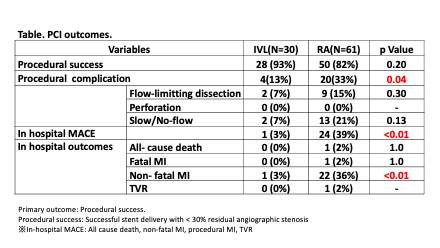
Results: A total of 61 patients underwent calcium modification with RA and 30 with IVL. The mean age was 76.1 years and a high prevalence of diabetes (59%), chronic kidney disease (30%), and dialysis (13%). There were no significant differences in procedural success rate between two groups (93% for IVL vs. 82% for RA, p=0.20) (Table). The rate of procedural complication including flow-limiting dissection, perforation and slow flow phenomenon, was lower in IVL group (13% vs. 33%, p=0.04) and non-fatal MI was high likely observed in RA group compared to IVL group (36% vs. 3%, p<0.01).
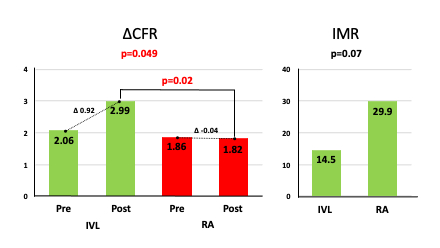
From the physiological analysis, resting full-cycle ratio (RFR) and fractional flow reserve (FFR) were significantly improved after PCI in both groups. Index of microcirculatory resistance (IMR) after PCI was numerically lower in IVL group compared to RA group (14.5 vs. 29.9, p=0.07). Coronary fractional reserve (CFR) after PCI was significantly higher in IVL group (2.99 vs. 1.82, p=0.02) (figure).
Conclusion: IVL and RA are both effective devices to treat severely calcified coronary stenosis with similar procedural success outcomes. However, IVL was associated with lower incidence of coronary microvascular dysfunction compared to RA, indicating that consideration on device selection would be required in high risk patients with severely calcified coronary disease.
Kusumoto, Hirofumi
( Osaka Medical and Pharmaceutical University Hospital
, Takatsuki City, Osaka
, Japan
)
Shishikura, Daisuke
( Osaka Medical and Pharmaceutical Un
, Osaka
, Japan
)
Yamauchi, Yohei
( Osaka medical and phamacutical Univ
, Takatsuki Osaka
, Japan
)
Sakane, Kazushi
( Osaka Medical and Pharmaceutical University Hospital
, Takatsuki City, Osaka
, Japan
)
Morita, Hideaki
( Osaka Medical Pharmaceutical Univ
, Takatsuki
, Japan
)
Hoshiga, Masaaki
( Osaka Medical and Pharmaceutical University Hospital
, Takatsuki City, Osaka
, Japan
)
Author Disclosures:
Hirofumi Kusumoto:DO NOT have relevant financial relationships
| Daisuke Shishikura:DO NOT have relevant financial relationships
| Yohei Yamauchi:DO NOT have relevant financial relationships
| Kazushi Sakane:DO NOT have relevant financial relationships
| Hideaki Morita:DO NOT have relevant financial relationships
| Masaaki Hoshiga:DO NOT have relevant financial relationships