Efficacy and Safety of Extracorporeal CPR in Out-of-Hospital Cardiac Arrest Survival and Neurological Integrity: a Meta-Analysis of Randomized Controlled Trials
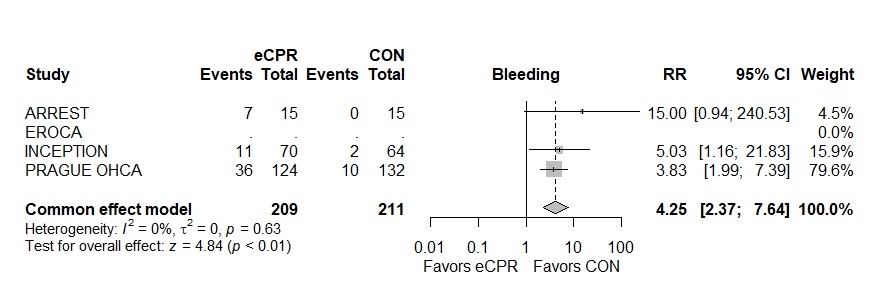
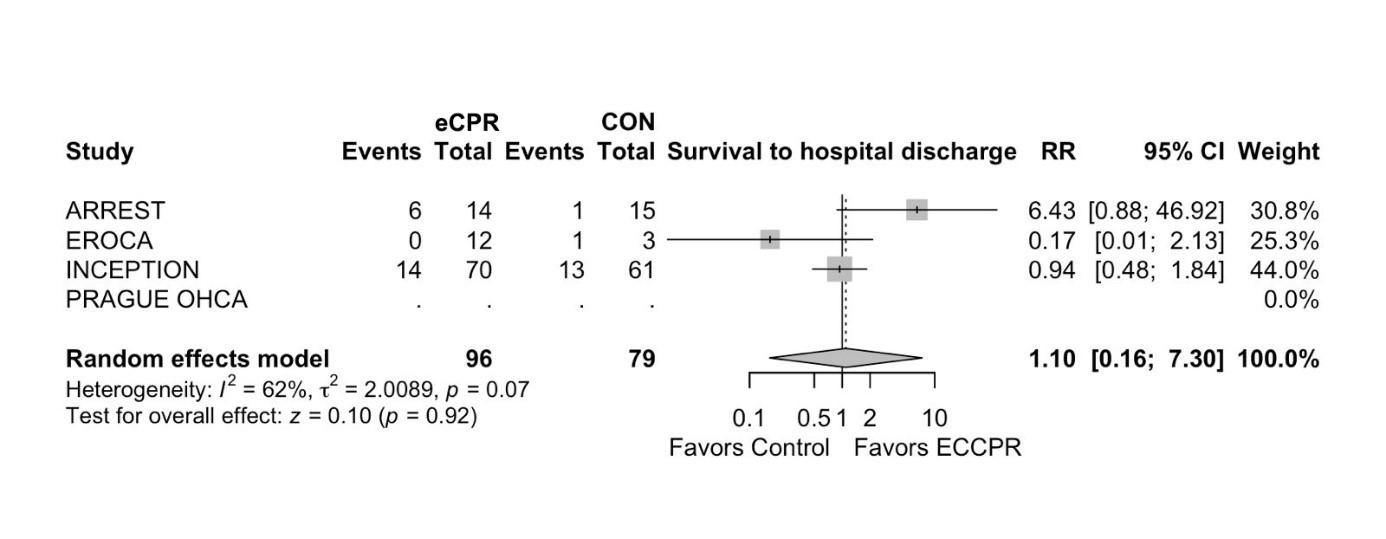
Abstract Body (Do not enter title and authors here): Introduction: Out-of-hospital cardiac arrest (OHCA) remains a significant public health challenge, with conventional cardiopulmonary resuscitation (CPR) often yielding limited success. Extracorporeal CPR (eCPR) has emerged as a potential adjunctive therapy to improve outcomes in OHCA patients. Purpose: To evaluate the efficacy and safety of eCPR compared to conventional CPR in OHCA. Methods: A comprehensive search of Cochrane CENTRAL, PubMed, Ovid Medline, and Web of Science databases was conducted independently until November 10, 2023. Randomized controlled trials (RCTs) comparing eCPR with conventional CPR in OHCA were included. Primary efficacy outcome was defined as survival to hospital discharge, while primary safety outcome was assessed for bleeding events. Summary effect measures of the primary outcomes were obtained by pooling the data with an inverse variance–weighted random-effects model. A sensitivity analysis was performed regarding whether the conclusions reached might differ substantially if a single study was omitted. Statistical analyses were performed with “meta” package in R (version 4.3.2) and Revman 5.4. Results: Four unique RCTs involving 435 patients were included in the analysis. ECCPR was associated with a significantly higher rate of survival at 1 month with good neurological outcome (Risk Ratio [RR] 1.55, 95% Confidence Interval (CI) 1.06 to 2.27, I2: 0%) but comparable at survival to hospital discharge (RR 1.10, 95% CI 0.16 to 7.30, I2: 47%) compared to conventional CPR. Furthermore, no significant differences were observed between eCPR and conventional CPR groups in survival rates at 3 months (RR 1,33, 95% CI 0.92 to 1.94, I2: 64%), survival at 6 months with good neurological outcome (RR 1.39, 95% CI 0.97 to 1.99, I2: 0%), and survival at 6 months (RR 2.79, 95% CI 0.33 to 23.28, I2: 63%). eCPR demonstrated a statistically significant elevation in bleeding events compared to conventional CPR (RR 4.25, 95% CI 2.37 to 7.64, I2: 0%). Sensitivity analysis revealed that none of the studies significantly influenced the pooled risk estimate to any great extent. Conclusion: eCPR shows beneficial results in improving short-term survival and neurological outcomes at 1-month post-OHCA. However, it is associated with an elevated risk of bleeding when compared to conventional CPR. Further investigations are imperative to delineate the specific patient populations that stand to gain the most benefit from ECPR intervention.
Dogan, Muhammed Melih
(
Inonu University Faculty of Medicine
, Malatya , Turkey )
Author Disclosures:
Muhammed Melih Dogan:DO NOT have relevant financial relationships