
Logo

American Heart Association

  14
  0


Final ID: Su3075

No-Touch Saphenous Vein Grafting Reduce Occlusion Risk but Increase Leg Wound Complications in Coronary Artery Bypass Grafts: A Meta-Analysis

Abstract Body (Do not enter title and authors here): Abstract
Introduction
Saphenous vein graft (SVG) failure remains a key limitation in coronary artery bypass grafting (CABG). The no-touch harvesting technique aims to improve graft durability by preserving perivascular tissue and preventing endothelial injury caused by mechanical trauma during conventional harvesting.
Purpose
To assess whether the no-touch SVG harvesting technique offers superior graft patency and acceptable safety outcomes compared to conventional SVG harvesting in patients undergoing CABG.
Methods
A systematic search was conducted in PubMed, Cochrane CENTRAL, Ovid Medline, and Web of Science databases through May 5, 2025. Randomized controlled trials (RCTs) comparing no-touch versus conventional SVG harvesting in CABG were included. The primary outcome was SVG occlusion per graft at the end of follow-up. Secondary outcomes included SVG occlusion per patient, all-cause mortality, total surgery time, and wound complications. Data were pooled using an inverse variance–weighted random-effects model. Analyses were conducted using the “meta” package in R (version 4.4.3).
Results
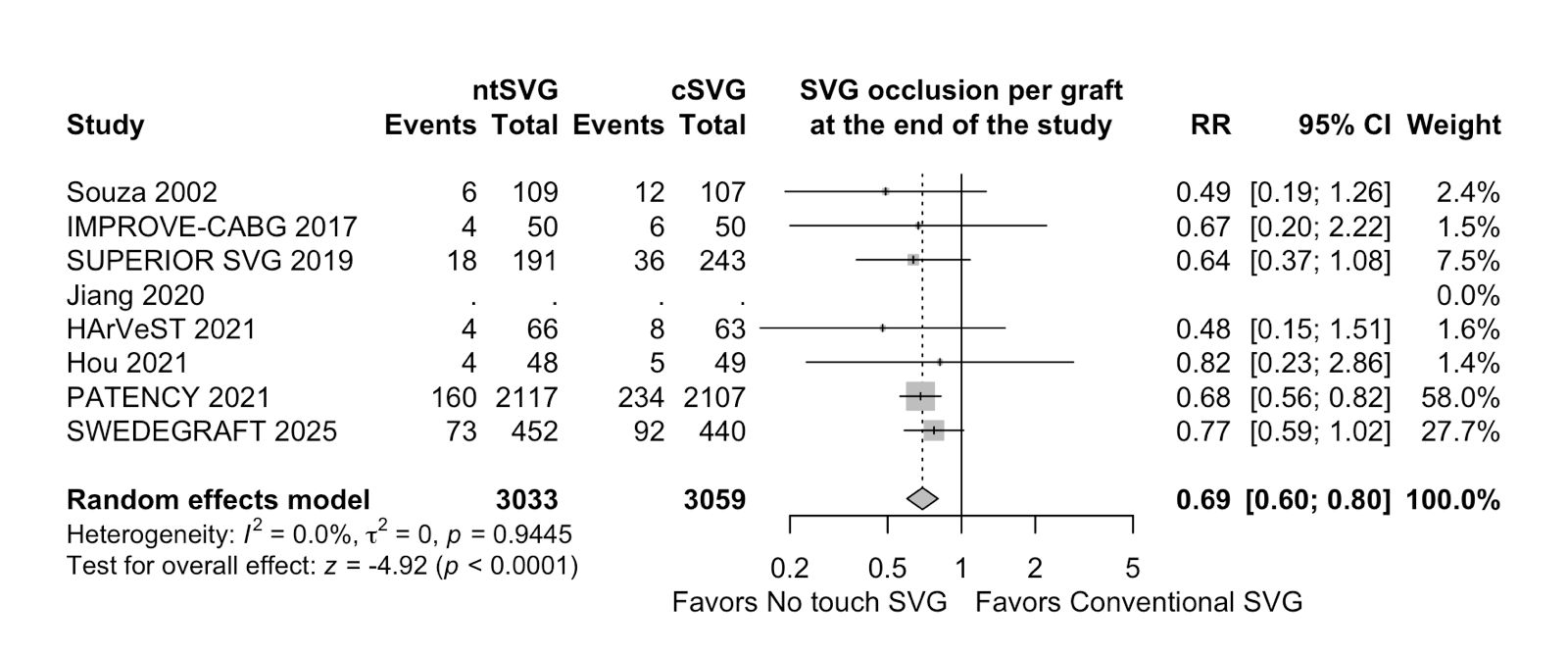
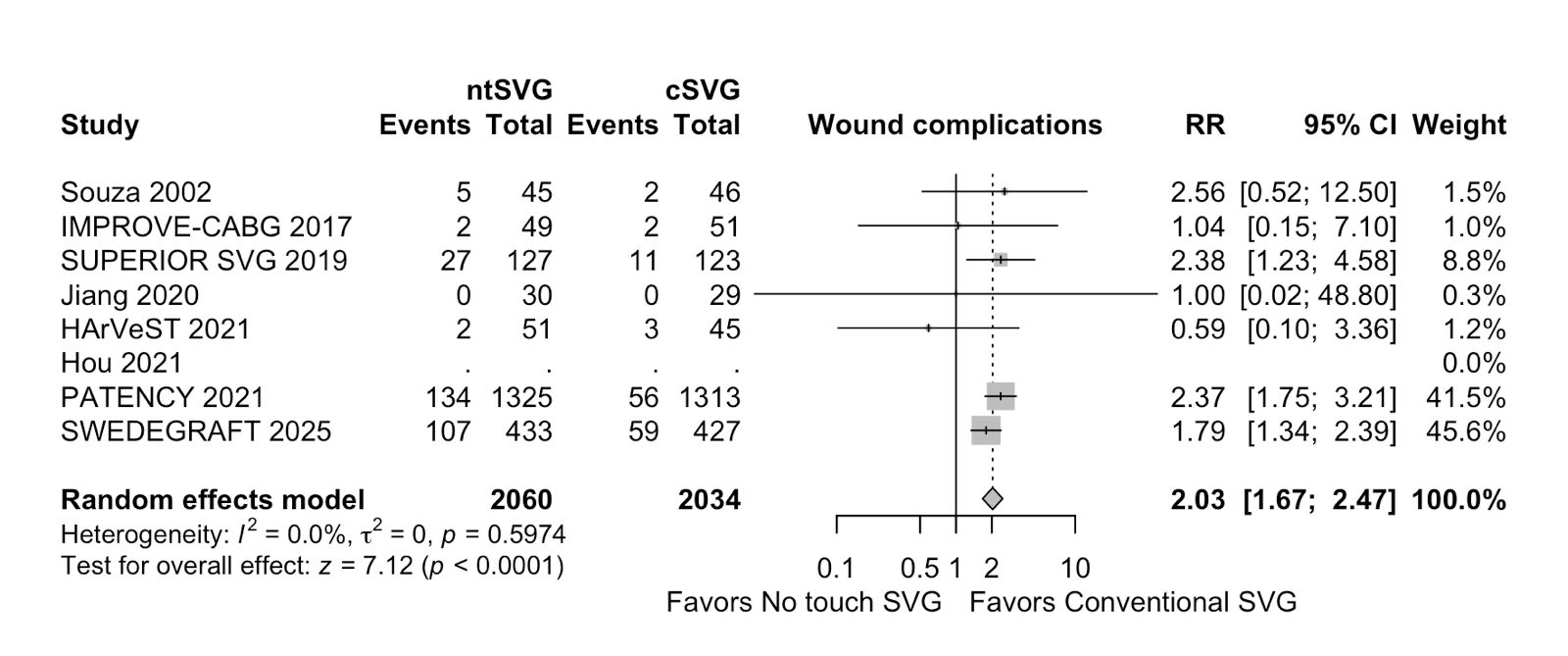
Eight RCTs comprising 4,234 patients (mean age: 62.6 ± 8.5 years) were included. No-touch SVGs were associated with significantly decreased risk of SVG occlusion by 31% compared to conventional SVGs (RR: 0.69; 95% CI: 0.60–0.80; I2 = 0%, p < 0.0001). A similar benefit was observed at the patient level (RR: 0.68; 95% CI: 0.56–0.83; I2 = 0%, p = 0.0002). All-cause mortality was comparable among the techniques (RR: 1.04; 95% CI: 0.63–1.71; I2 = 0%, p = 0.88). The no-touch technique was associated with a statistically significant but clinically negligible increase in operative time (MD: 9.69 minutes; 95% CI: 2.48–16.90; I2 = 62%, p = 0.0084). However, wound complications occurred more frequently in the no-touch group (RR: 2.03; 95% CI: 1.67–2.47; I2 = 0%, p < 0.0001).
Conclusion
The no-touch SVG harvesting technique provides superior graft patency at both the graft and patient levels compared to conventional methods. Although associated with a modest prolongation in operative time and a higher risk of wound complications, these drawbacks may acceptable in patients with low risk for wound morbidity and can potentially be improved upon by increased operator experience with this technique.
  • Dogan, Muhammed Melih  ( Inonu University , Malatya , Turkey )
  • Tanriverdi, Lokman H.  ( Inonu University , Malatya , Turkey )
  • Balkhy, Husam  ( University of Chicago Medicine , Chicago , Illinois , United States )
  • Author Disclosures:
    Muhammed Melih Dogan: DO NOT have relevant financial relationships | Lokman H. Tanriverdi: DO NOT have relevant financial relationships | Husam Balkhy: DO have relevant financial relationships ; Other (please indicate in the box next to the company name):Intuitive Proctor:Active (exists now)
Meeting Info:

Scientific Sessions 2025

2025

New Orleans, Louisiana

Session Info:

Surgical vs Percutaneous Revascularization: Outcomes & Special Populations

Sunday, 11/09/2025 , 11:30AM - 12:30PM

Abstract Poster Board Session

More abstracts on this topic:
Association of Pre-operative Neutrophil to Lymphocyte Ratio (NLR) and Post-operative AKI in Patients Undergoing CABG: A Meta-Analysis

Patel Bhavin, Lapsiwala Boney, Jariwala Prayag, Suresh Aditya, Vanani Samir, Patel Shaurya, Rajani Aayushi, Desai Rupak

A Case of Dilated Cardiomyopathy and Systemic Thromboembolism in a Young Patient on Testosterone Replacement Therapy

Sabri Muhammad, Ijaz Naila, Nadeem Ramsha, Checchio Lucy, Riaz Faiza

More abstracts from these authors:
Efficacy and Safety of Vorapaxar in Patients with Peripheral Arterial Disease: A Meta-Analysis of Randomized Controlled Trials

Dogan Muhammed Melih, Tanriverdi Lokman Hekim

Efficacy of angiotensin receptor blockers in thoracic aortic aneurysm: meta-analysis of randomized controlled trials

Tanriverdi Lokman Hekim, Dogan Muhammed Melih, Barrett Annie, Zafar Mohammad, Ziganshin Bulat, Elefteriades John

You have to be authorized to contact abstract author. Please, Login
Not Available