Logo

American Heart Association

  119
  0


Final ID: Mo3024

Association between Marital Status and Major Adverse Cardiovascular Events: Role of Stress-Related Neural-Immune Mechanisms

Abstract Body (Do not enter title and authors here): Background:
Chronic stress is associated with cardiovascular disease (CVD) in part through neural mechanisms that potentiate inflammation. Disrupted social connections are associated with higher chronic stress. As such, we hypothesized that: 1) previously married (divorced, separated) individuals have higher major adverse cardiovascular event (MACE) risk compared to married individuals and 2) that greater activation of stress-related neural-immune mechanisms contributes to this relationship.

Methods:
Participants (N=75,638) enrolled in the Mass General Brigham Biobank were studied. Marital status and MACE were identified using survey data and ICD-10 codes, respectively. A subset (N=1,121) underwent clinical 18F-FDG-PET imaging, enabling assessment of stress-related neural activity as the ratio of the amygdala to prefrontal cortex activity (AmygAc). Clinical high-sensitivity C-reactive protein (hs-CRP) levels were assessed in another subset of the cohort (N=10,358). Linear and Cox regression and mediation analyses were used.


Results:
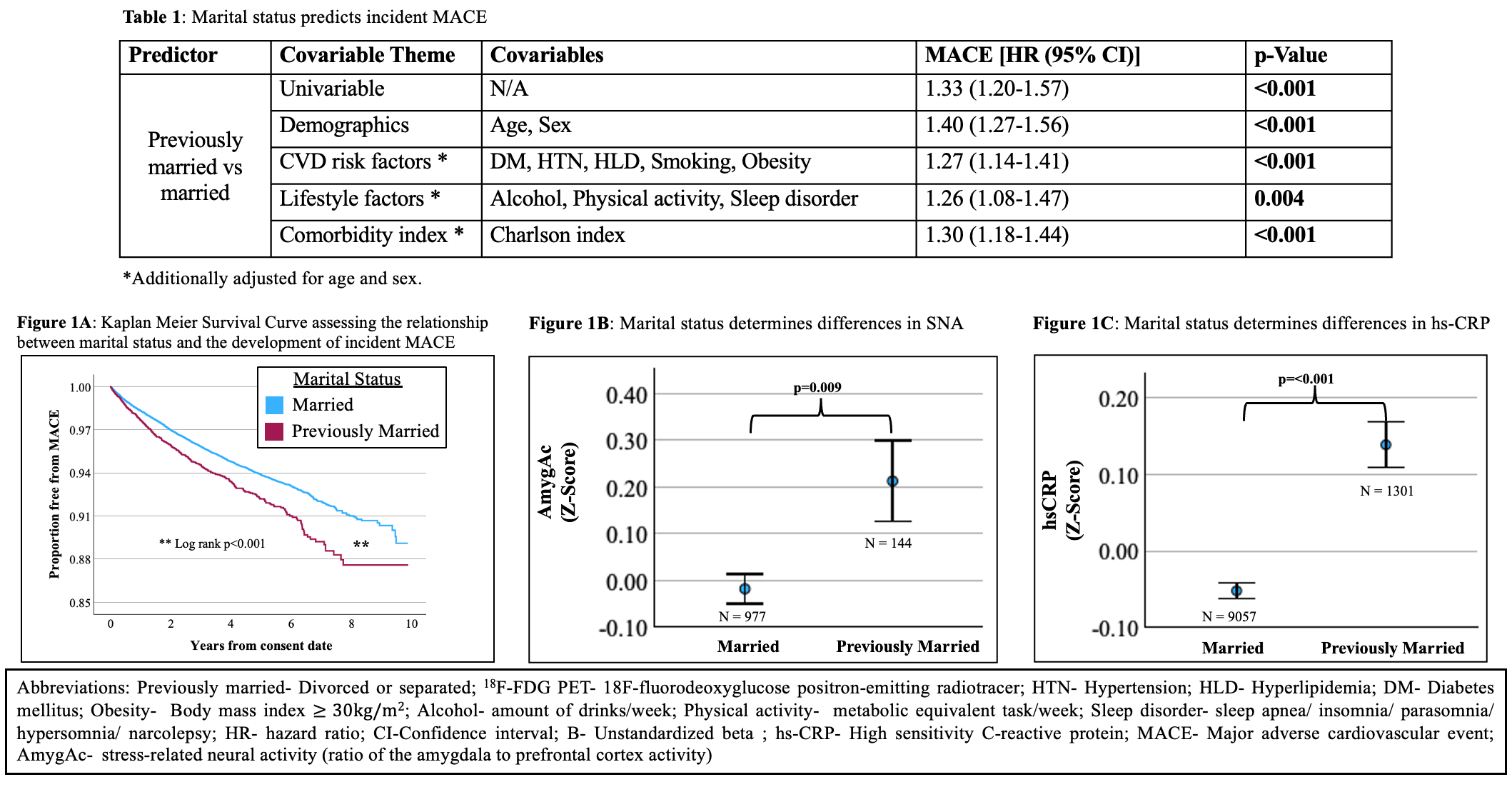
Among participants (median age 62 years; 53% female), 2,978 subjects developed MACE after Biobank enrollment. Previously married (vs. currently married) individuals had greater MACE risk (HR 1.33 [95% CI: 1.20,1.57], p=<0.001, Figure 1A) , higher AmygAc (B=0.23 [95% CI: 0.06-0.40], p=0.009) and higher hs-CRP (B=0.19 [95% CI: 0.13-0.25], p=<0.001). MACE risk remained significant after adjustment for key confounders (Table 1), and both the AmygAc and CRP were higher among divorced or separated individuals (Figure 1B and 1C). Moreover, increased AmygAc and hs-CRP associated with increased MACE risk (HR=1.24 [1.14-1.36], p=<0.001 and 1.13 [1.09-1.16], p=<0.001, respectively), and both AmygAc and hs-CRP mediated the relationship between marital status and MACE (p<0.05).


Conclusions:
Our findings suggest that divorced and separated individuals are at an increased risk for MACE. This relationship appears to be driven in part by stress-related neural-immune mechanisms.
  • Lau, Hui Chong  ( Massachusetts General Hospital , Boston , Massachusetts , United States )
  • Seligowski, Antonia  ( Massachusetts General Hospital , Boston , Massachusetts , United States )
  • Osborne, Michael  ( Massachusetts General Hospital , Boston , Massachusetts , United States )
  • Tawakol, Ahmed  ( Massachusetts General Hospital , Boston , Massachusetts , United States )
  • Abohashem, Shady  ( Massachusetts General Hospital , Boston , Massachusetts , United States )
  • Abikaram, Krystel  ( Massachusetts General Hospital , Boston , Massachusetts , United States )
  • Civieri, Giovanni  ( Massachusetts General Hospital , Boston , Massachusetts , United States )
  • Assefa, Alula  ( Massachusetts General Hospital , Boston , Massachusetts , United States )
  • Hanlon, Erin  ( Massachusetts General Hospital , Boston , Massachusetts , United States )
  • Qamar, Iqra  ( Massachusetts General Hospital , Boston , Massachusetts , United States )
  • Khalil, Maria  ( Massachusetts General Hospital , Boston , Massachusetts , United States )
  • Aldosoky, Wesam  ( Massachusetts General Hospital , Boston , Massachusetts , United States )
  • Author Disclosures:
    HUI CHONG LAU: DO NOT have relevant financial relationships | Antonia Seligowski: DO NOT have relevant financial relationships | Michael Osborne: DO have relevant financial relationships ; Research Funding (PI or named investigator):AHA:Active (exists now) ; Research Funding (PI or named investigator):NIH:Active (exists now) ; Consultant:WCG Clinical:Active (exists now) | Ahmed Tawakol: DO have relevant financial relationships ; Research Funding (PI or named investigator):Lung Biotechnologies:Active (exists now) | Shady Abohashem: No Answer | Krystel AbiKaram: DO NOT have relevant financial relationships | Giovanni Civieri: DO NOT have relevant financial relationships | Alula Assefa: DO NOT have relevant financial relationships | Erin Hanlon: DO NOT have relevant financial relationships | Iqra Qamar: No Answer | Maria Khalil: DO NOT have relevant financial relationships | Wesam Aldosoky: No Answer
Meeting Info:

Scientific Sessions 2024

2024

Chicago, Illinois

Session Info:

Unraveling Cardiovascular Health through Lifestyle and Behavior

Monday, 11/18/2024 , 01:30PM - 02:30PM

Abstract Poster Session

More abstracts on this topic:
A Case of Immune Checkpoint Inhibitor-Induced Myocarditis with Myositis and/or Myasthenia Gravis Overlap Syndrome with New Right Bundle Branch Block and Negative Cardiac MRI

Dasari Srikiran

A Potential Role for NKG2D, an NK cell receptor, in Accelerated CVD risk in African American Women Living in More Adverse Neighborhood Conditions: Data From the Step It Up Physical Activity Digital Health-Enabled, Community-Engaged Intervention

Baez Andrew, Andrews Marcus, Sandler Dana, Aquino Peterson Elizabeth, Sharda Sonal, Tolentino Katherine Joy, Lopez De Leon Shirley, Seo Jein Eleanor, Cintron Manuel, Pita Mario, Tarfa Hannatu, Baumer Yvonne, Reger Robert, Childs Richard, Powell-wiley Tiffany, Dave Ayushi, Saurabh Abhinav, Mendelsohnl Laurel, Chen Long, Igboko Muna, Wells Ayanna, Marah Marie

More abstracts from these authors:
Stress-related genetic factors modify the effect of lower socioeconomic status on cardiovascular disease risk through autonomic and immune mechanisms.

Abikaram Krystel, Choi Karmel, Smoller Jordan, Seligowski Antonia, Tawakol Ahmed, Osborne Michael, Abohashem Shady, Lau Hui Chong, Khalil Maria, Aldosoky Wesam, Qamar Iqra, Civieri Giovanni, Hanlon Erin, Assefa Alula

Depression and anxiety increase risk of chronic kidney disease via gain of CVD risk factors with an accentuated effect among women and non-white individuals

Abikaram Krystel, Assefa Alula, Ahmad Taha, Radfar Azar, Seligowski Antonia, Nigwekar Sagar, Tawakol Ahmed, Osborne Michael, Saeed Fatima, Abohashem Shady, Lau Hui Chong, Khalil Maria, Arora Gagan, Bellinge Jamie, Civieri Giovanni, Aldosoky Wesam

You have to be authorized to contact abstract author. Please, Login
Not Available