Logo

American Heart Association

  116
  0


Final ID: Su2086

Catheter Ablation for Ventricular Arrhythmias in Transthyretin Cardiac Amyloidosis: A Single Center Experience

Abstract Body (Do not enter title and authors here): Background: Transthyretin cardiac amyloidosis (ATTR-CA) carries an elevated risk of developing ventricular arrhythmias (VA) but there remains limited evidence supporting the role of catheter ablation in this population.

Purpose: To assess the safety and efficacy of catheter ablation for VA in ATTR-CA.

Methods: An electronic database was used to identify all patients suspected of having ATTR-CA who underwent catheter ablation for VA at our institution between January 2010 and December 2023. Patients who did not meet the diagnosis of ATTR-CA and had a negative workup who underwent catheter ablation for ventricular tachycardia (VT) or premature ventricular contractions (PVCs) were used to form a control group matched for age, sex and left ventricular ejection fraction at a ratio of 2:1.

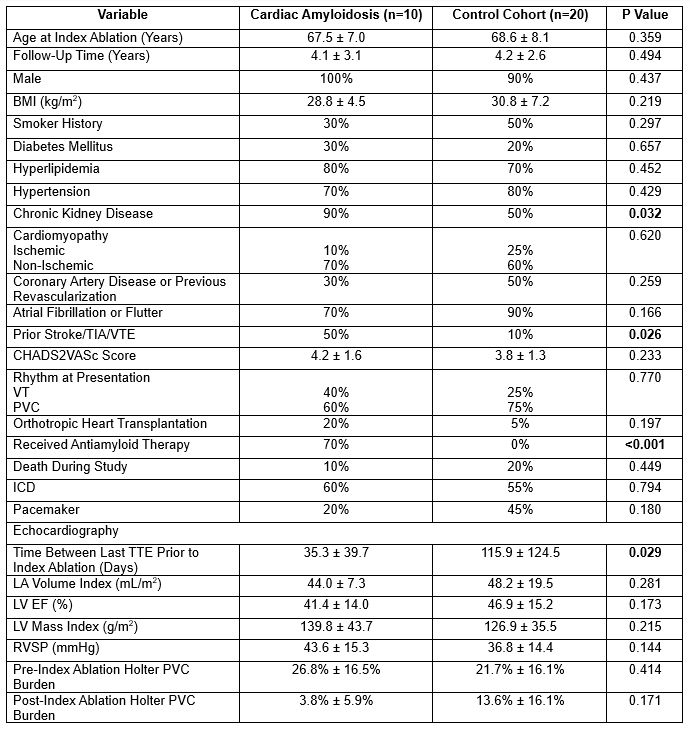
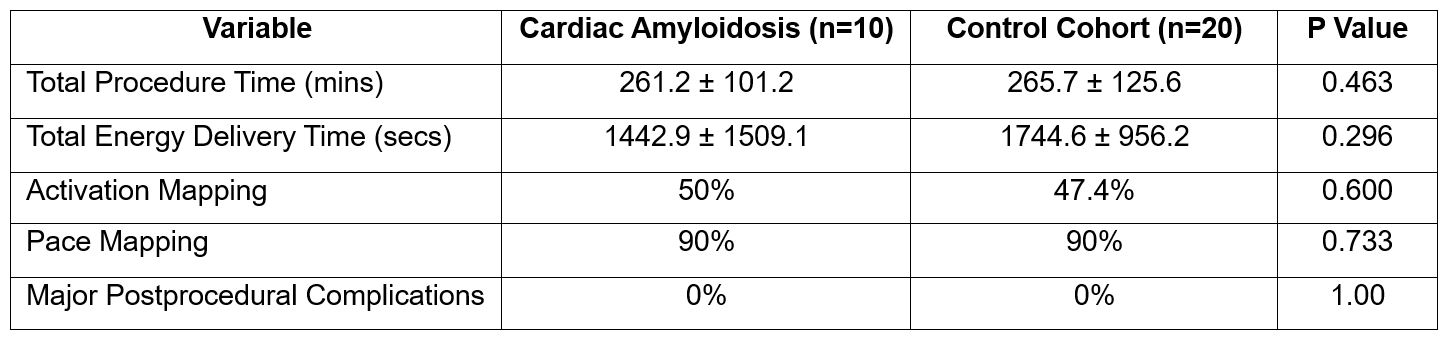
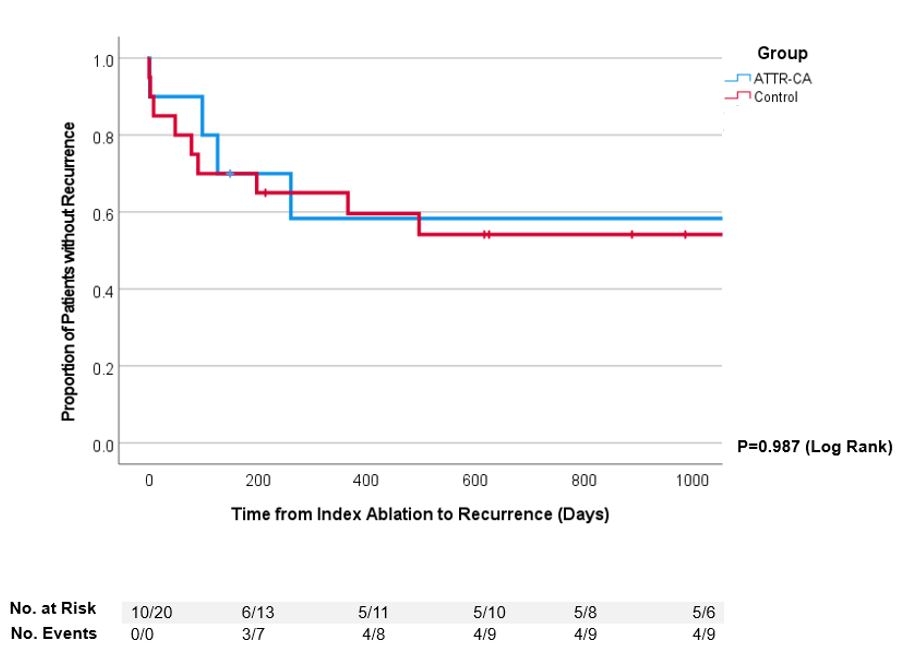
Results: 20 controls and 10 cases of ATTR-CA were identified. Examining the two groups at baseline (Table 1), the mean age at index ablation was 67.7±7.0 and 68.6±8.1 years (p=0.359), mean follow-up time was 4.1±3.1 and 4.2±2.6 years (p=0.494), and the proportion of males was 100% and 90% respectively. The ATTR-CA group had a significantly higher proportion of chronic kidney disease (90% vs. 50%, p=0.032) and prior stroke or thrombotic events compared to the control group (50% vs. 10%, p=0.026) with similar CHA2DS2VASc scores (4.2±1.6 vs. 3.8±1.3, p=0.233). Both groups had comparable left ventricular ejection fraction (41.4%±14% vs. 46.9%±15.2%, p=0.173), VT/PVCs at presentation (40%/60% vs. 25%/75%, p=0.77), use of antiarrhythmics (70% vs. 60%, p=0.592), and high proportion of atrial fibrillation/flutter (70% vs. 90%, p=0.168). Procedural (261.2±101.2 vs. 265.7±125.6 mins, p=0.449) and total energy delivery time (1442.9±1509.1 vs. 1744.6±956.2 secs, p=0.296) was not significantly different in the two groups. Both groups had a significant decrease in PVC burden postablation with a reduction from 26.8% to 3.8% (p=0.024) and from 27.1% to 13.6% (p=0.028) in the ATTR-CA and control group respectively. A downward trend was seen in antitachycardia pacing events for VT postablation in the ATTR-CA (14.7±9.8 vs. 5.3±6.7, p =0.184) and control (193±387.6 vs. 0.67±1.2. p=0.139) groups. No major complications occurred after ablation (Table 2). Mean time to recurrence post-index ablation was similar between both groups (1620.4±483.8 vs. 1498.8±291.4 days, p=0.987, Figure 1).

Conclusions: Catheter ablation appears to be safe and effective for VT and PVCs in patients with ATTR-CA.
  • Al-shakarchi, Nader James  ( Mayo Clinic , Rochester , Minnesota , United States )
  • Haq, Ikram  ( Mayo Clinic , Rochester , Minnesota , United States )
  • Tan, Nicholas  ( Mayo Clinic , Rochester , Minnesota , United States )
  • Grogan, Martha  ( Mayo Clinic , Rochester , Minnesota , United States )
  • Dispenzieri, Angela  ( Mayo Clinic , Rochester , Minnesota , United States )
  • Sugrue, Alan  ( Mayo Clinic Rochester , Rochester , Minnesota , United States )
  • Abou-ezzeddine, Omar  ( Mayo Clinic , Rochester , Minnesota , United States )
  • Killu, Ammar  ( MAYO CLINIC , Rochester , Minnesota , United States )
  • Author Disclosures:
    Nader James Al-Shakarchi: DO NOT have relevant financial relationships | Ikram Haq: No Answer | Nicholas Tan: DO NOT have relevant financial relationships | Martha Grogan: DO have relevant financial relationships ; Research Funding (PI or named investigator):Alnylam:Active (exists now) ; Advisor:NovoNordisk:Active (exists now) ; Advisor:AztraZeneca:Active (exists now) ; Consultant:Janssen:Active (exists now) ; Research Funding (PI or named investigator):Janssen:Past (completed) ; Research Funding (PI or named investigator):NovoNordisk:Active (exists now) ; Research Funding (PI or named investigator):Pfizer:Past (completed) ; Research Funding (PI or named investigator):Eidos:Active (exists now) | Angela Dispenzieri: DO NOT have relevant financial relationships | Alan Sugrue: No Answer | Omar Abou-Ezzeddine: No Answer | Ammar Killu: DO have relevant financial relationships ; Consultant:Boston Scientific:Past (completed) ; Speaker:Abbott:Past (completed) ; Speaker:Atricure:Past (completed) ; Research Funding (PI or named investigator):Boston Scientific:Active (exists now)
Meeting Info:

Scientific Sessions 2024

2024

Chicago, Illinois

Session Info:

Inflamed, Infiltrated, Inherited and Arrhythmic

Sunday, 11/17/2024 , 11:30AM - 12:30PM

Abstract Poster Session

More abstracts on this topic:
Acute Cardiac Function Change After Catheter Ablation of Ventricular Arrhythmias in Patients with Arrhythmogenic Right Ventricular Cardiomyopathy

Davis Nathaniel, Asirvatham Samuel, Friedman Paul, Killu Ammar, Ezzeddine Fatima, Sugrue Alan, Siontis Konstantinos, Kapa Suraj, Kowlgi Gurukripa, Giudicessi John, Bois John, Chang Ian C

Acoramidis Lowers NT-proBNP in a Larger Proportion of ATTRibute-CM Study Participants With Transthyretin Amyloid Cardiomyopathy Compared with Placebo, Independent of Atrial Fibrillation Status

Maurer Mathew, Castano Adam, Tamby Jean-francois, Fox Jonathan, Mitter Sumeet, Hanna Mazen, Sperry Brett, Alexander Kevin, Obici Laura, Poulsen Steen, Januzzi James, Witteles Ronald, Jaber Wael, Brailovsky Yevgeniy, Vogtlaender Kai

More abstracts from these authors:
Transthoracic Echocardiographic and AI-ECG Predictors of Atrial Arrhythmia Recurrence After Surgical Ablation

Goings Dylan, Haq Ikram, Attia Zachi, Brandt Michael, Friedman Paul, Noseworthy Peter, Killu Ammar

Safety of Dofetilide Initiation Following a Shortened Amiodarone Washout Period

Burright Isaac, Del-carpio Munoz Freddy, Deshmukh Abhishek, Asirvatham Samuel, Siontis Konstantinos, Noseworthy Peter, Killu Ammar, Sugrue Alan

You have to be authorized to contact abstract author. Please, Login
Not Available