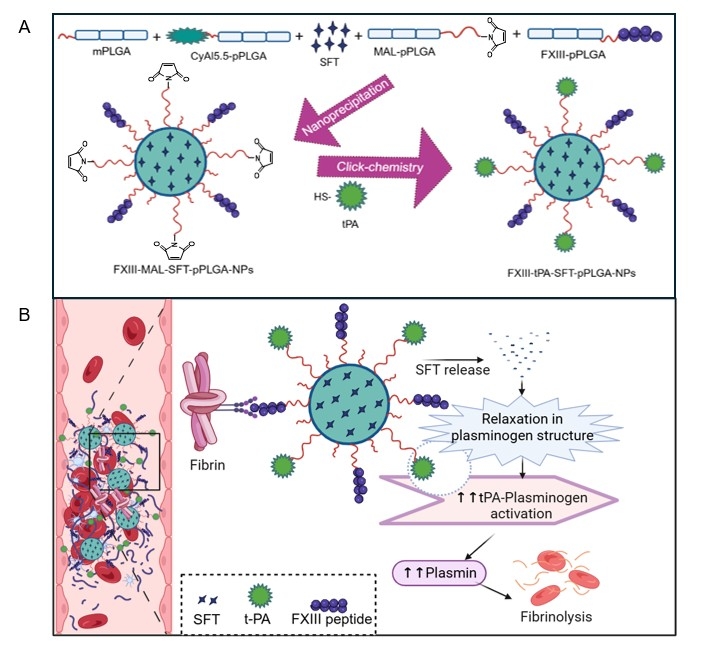
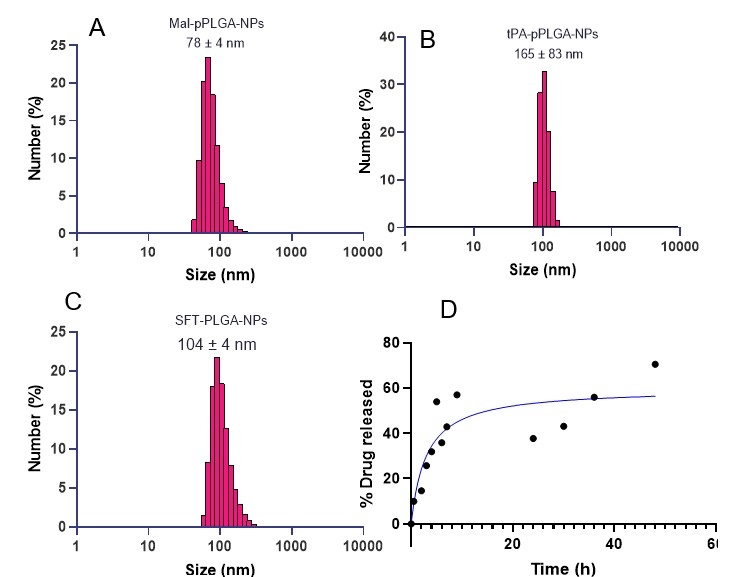
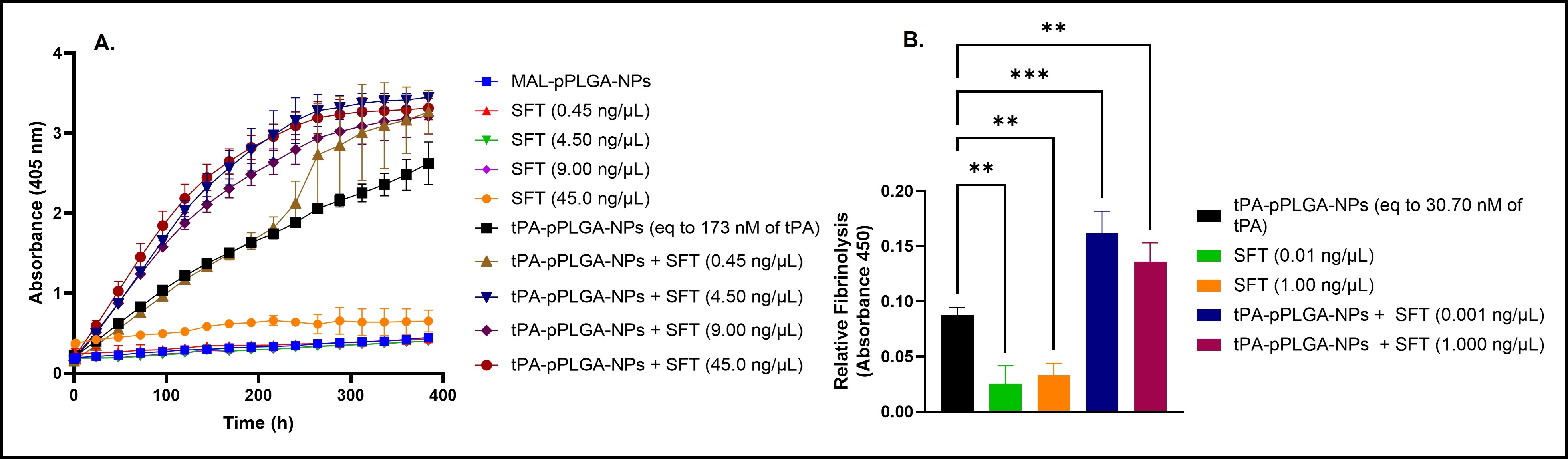
Abstract Body: Introduction: Thrombosis, caused by clot formation in veins or arteries, is a major cardiovascular complication. Recombinant tissue plasminogen activators (tPA) are widely used to treat ischemic stroke, pulmonary embolism (PE), and myocardial infarction; however, their utility is limited by short circulation half-life and systemic bleeding risk. We previously developed fibrin-specific, FXIII peptide-conjugated tPA NPs that improved clot-specific accumulation but did not enhance thrombolytic efficacy over free tPA in a PE model (McCarthy et al., 2012), validating the NP platform for targeted delivery. Hypothesis: We hypothesized that FXIII-targeted PLGA NPs carrying tPA and co-delivering a plasminogen activator modulator (SFT) would synergistically enhance plasminogen activation at the clot, enabling effective fibrinolysis at sub-therapeutic tPA doses while minimizing off-target effects (Fig 1). The NPs are based on PLGA, an FDA-approved polymer widely used in drug delivery, and all components are validated for translational applications. Calculated NP doses of SFT for this design are well below the 500 mg/kg NOAEL, indicating low toxicity risk. Methods: FXIII-targeting peptide was synthesized in-house via solid-phase peptide synthesis for PLGA modification. NP components included SFT and PLGA copolymers functionalized with FXIII, and maleimide (MAL-PEG-PLGA) for tPA conjugation, and methoxy-PEG-PLGA (mPLGA) as the base polymer. To enable systematic incorporation, all NP components were first validated individually. NPs were formulated via nanoprecipitation and characterized to confirm their hierarchical design (Fig. 2). tPA was conjugated to MAL-PLGA NPs via its free cysteine, achieving 80% conjugation efficiency. SFT-loaded PLGA NPs exhibited ~75% entrapment, with ~40% release in 5 h followed by ~60% over 48 h. S-2288 and fibrin D-dimer assays showed enhancement of tPA activity and fibrinolysis across a wide SFT concentration range (Fig 3). Ongoing in vivo studies use a ferric chloride thrombosis model supplemented with human plasminogen to assess SFT synergy. Conclusion: This next-generation FXIII-targeted tPA NP platform co-delivering SFT demonstrates robust in vitro fibrinolytic synergy with ongoing in vivo evaluation. By enabling effective clot lysis at sub-therapeutic tPA doses, this approach offers the potential for safer, more efficacious thrombolytic therapy with translational relevance for acute cardiovascular events such as ischemic stroke and PE.
Vikas, Fnu
(
Masonic Medical Research Institute
, Utica , New York , United States )
Ha, Khanh
(
Masonic Medical Research Institute
, Utica , New York , United States )
Hoehn, Maddelyn
(
Masonic Medical Research Institute
, Utica , New York , United States )
Jablonski, Justin
(
Masonic Medical Research Institute
, Utica , New York , United States )
Mccarthy, Jason
(
Masonic Medical Research Institute
, Utica , New York , United States )
Author Disclosures:
FNU VIKAS:DO NOT have relevant financial relationships
| Khanh Ha:DO NOT have relevant financial relationships
| Maddelyn Hoehn:DO NOT have relevant financial relationships
| Justin Jablonski:DO NOT have relevant financial relationships
| Jason McCarthy:DO have relevant financial relationships
;
Advisor:Encure Biotherapeutics:Active (exists now)