Logo

American Heart Association

  8
  0


Final ID: Wed113

Convergence of Inflammatory and Pro-Fibrotic Pathways Centered Around Fibroblast Activation and Myofibroblast Differentiation in a Canine Model of Prosthetic Arterial Bypass Failure – Insights from Integrated Single-Nuclei and Spatial Transcriptomics

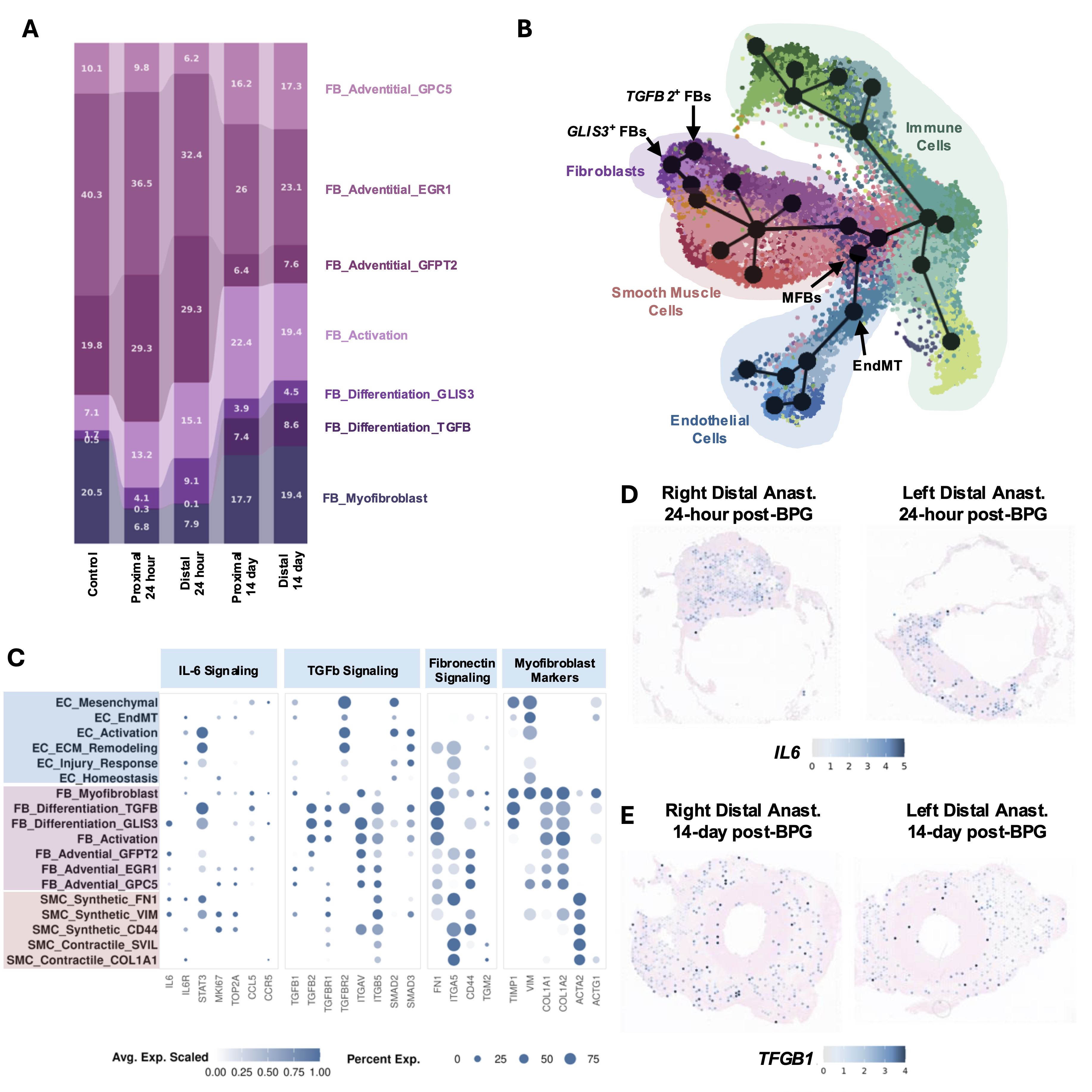
Abstract Body: Up to 40% of arterial prosthetic bypass grafts (PG) will fail within 3 years, largely due to a fibroproliferative process called intimal hyperplasia (IH). Recently, attention has garnered for an “outside in” hypothesis whereby early expansion of adventitial mediators acts via paracrine effects to induce cellular change leading to IH. Activated adventitial fibroblasts (FB) and myofibroblasts (MFB) have been implicated in this process, though their role remains incompletely characterized. Integrated single-nuclei and spatial transcriptomics were used to analyze the prosthetic graft-arterial anastomosis of canine end-to-side carotid artery bypasses at 24h and 14d to elucidate pathways in FB activation and MFB differentiation. Clustering and differential abundance analysis demonstrated a spectrum of FB activation with distinct expression across timepoints and anastomotic location (Figure 1A). Activated FB populations expressing TGFB2 and GLIS3 emerged at 24h, while adventitial MFBs expanded at 14d. GLIS3+ and TGFB2+ FBs expressed differentiation and proliferation markers, suggesting a continuum of FB activation, whereas MFBs lacked such markers, suggesting terminal differentiation. Intercellular communication analysis revealed that MFBs express FN1 and SPP1, whose receptors were present on differentiating FBs and synthetic smooth muscle cells (s-SMCs). Trajectory analyses indicated that MFBs and endothelial-to-mesenchymal transition (EndMT) cells have a common lineage (Figure 1B), evidenced by shared MFB markers TIMP1 and VIM (Figure 1C), suggesting that MFBs may arise from both FB and endothelial cell (EC) precursors. Additionally, GLIS3+ FBs, TGFB2+ FBs, and MFBs all expressed high levels of TIMP1, favoring a secretory and proliferative phenotype and supporting MFB differentiation. Lastly, at 24h, IL-6 expression was prominent, primarily secreted by GLIS3+ FBs and s-SMCs, with IL-6 receptors on s-SMCs and ECs (Figure 1C-D). At 14d, FB-derived TGF-β expression predominated with TGF-β receptors on ECs and integrin aV receptors on FBs and SMCs (Figure 1C, E). In conclusion, a spectrum of early adventitial FB activation moving toward MFB differentiation occurs within a prosthetic graft-arterial anastomosis that is involved in inflammatory and pro-fibrotic signaling. Inhibition of this FB activation spectrum at the time of PG creation may be an attractive strategy to inhibit signaling cascades leading to downstream IH.
  • Ciaramella, Michael  ( Beth Israel Deaconess Medical Center , Boston , Massachusetts , United States )
  • Michaud, Marina  ( Emory University School of Medicine , Atlanta , Georgia , United States )
  • Park, Jemin  ( Beth Israel Deaconess Medical Center , Boston , Massachusetts , United States )
  • Nie, Karen  ( Beth Israel Deaconess Medical Center , Boston , Massachusetts , United States )
  • Mota, Lucas  ( Beth Israel Deaconess Medical Center , Boston , Massachusetts , United States )
  • Jordan, Sean  ( Emory University School of Medicine , Atlanta , Georgia , United States )
  • Bakhtiari, Mojtaba  ( Emory University School of Medicine , Atlanta , Georgia , United States )
  • Contreras, Mauricio  ( Beth Israel Deaconess Medical Center , Boston , Massachusetts , United States )
  • Pradhan, Leena  ( Beth Israel Deaconess Medical Center , Boston , Massachusetts , United States )
  • Ferran, Christiane  ( Beth Israel Deaconess Medical Center , Boston , Massachusetts , United States )
  • Bhasin, Manoj  ( Emory University School of Medicine , Atlanta , Georgia , United States )
  • Liang, Patric  ( Beth Israel Deaconess Medical Center , Boston , Massachusetts , United States )
  • Author Disclosures:
    Michael Ciaramella: DO NOT have relevant financial relationships | Christiane Ferran: No Answer | Manoj Bhasin: No Answer | Patric Liang: No Answer | Marina Michaud: DO NOT have relevant financial relationships | Jemin Park: DO NOT have relevant financial relationships | Karen Nie: DO NOT have relevant financial relationships | Lucas Mota: No Answer | Sean Jordan: DO NOT have relevant financial relationships | Mojtaba Bakhtiari: No Answer | mauricio contreras: DO NOT have relevant financial relationships | Leena Pradhan: DO NOT have relevant financial relationships
Meeting Info:
Session Info:

01. Poster Session 1 & Reception

Wednesday, 05/13/2026 , 06:00PM - 08:00PM

Poster

More abstracts on this topic:
Management of Malignant SVC Syndrome and Acute SVC Thrombosis with Complex Endovascular Intervention

Fischer Karley, Reddy Ananya, Valencia Damian, Rehman Abdur

Impact of Aspirin Use on Amputation Outcomes and Cardiovascular Risk in Peripheral Artery Disease Patients: Insights from a High-Risk Cohort

Linder Eva, Qadura Mohammad, Younes Houssam, Chin Jason, Zamzam Abdelrahman, Abuhalimeh Lina, Alhmouz Musaab, Abuhalimeh Batool

More abstracts from these authors:
Xenium Spatial Profiling Reveals Endothelial Disruption and Smooth Muscle Predominance After Saphenous Vein Distension During Conduit Harvest

Jordan Sean, Park Jemin, Ciaramella Michael, Nie Karen, Michaud Marina, Bakhtiari Mojtaba, Liang Patric, Bhasin Manoj

siRNA Delivery to Perivascular Tissue using an Adhesive Polyacrylic acid (PAA)-Benzaldehyde (BLA) Hydrogel

Park Jemin, Liang Patric, Ciaramella Michael, Nie Karen, Revuelta Cervantes Jesus, Lafuente Gomez Nuria, Lou Junzhe, Contreras Mauricio, Pradhan Leena, Mooney David

You have to be authorized to contact abstract author. Please, Login
Not Available