Lipid Nanoparticle-based Delivery of Sting siRNA for In Vivo Silencing of STING in Aorta to Alleviate Aortic Aneurysm and Dissection
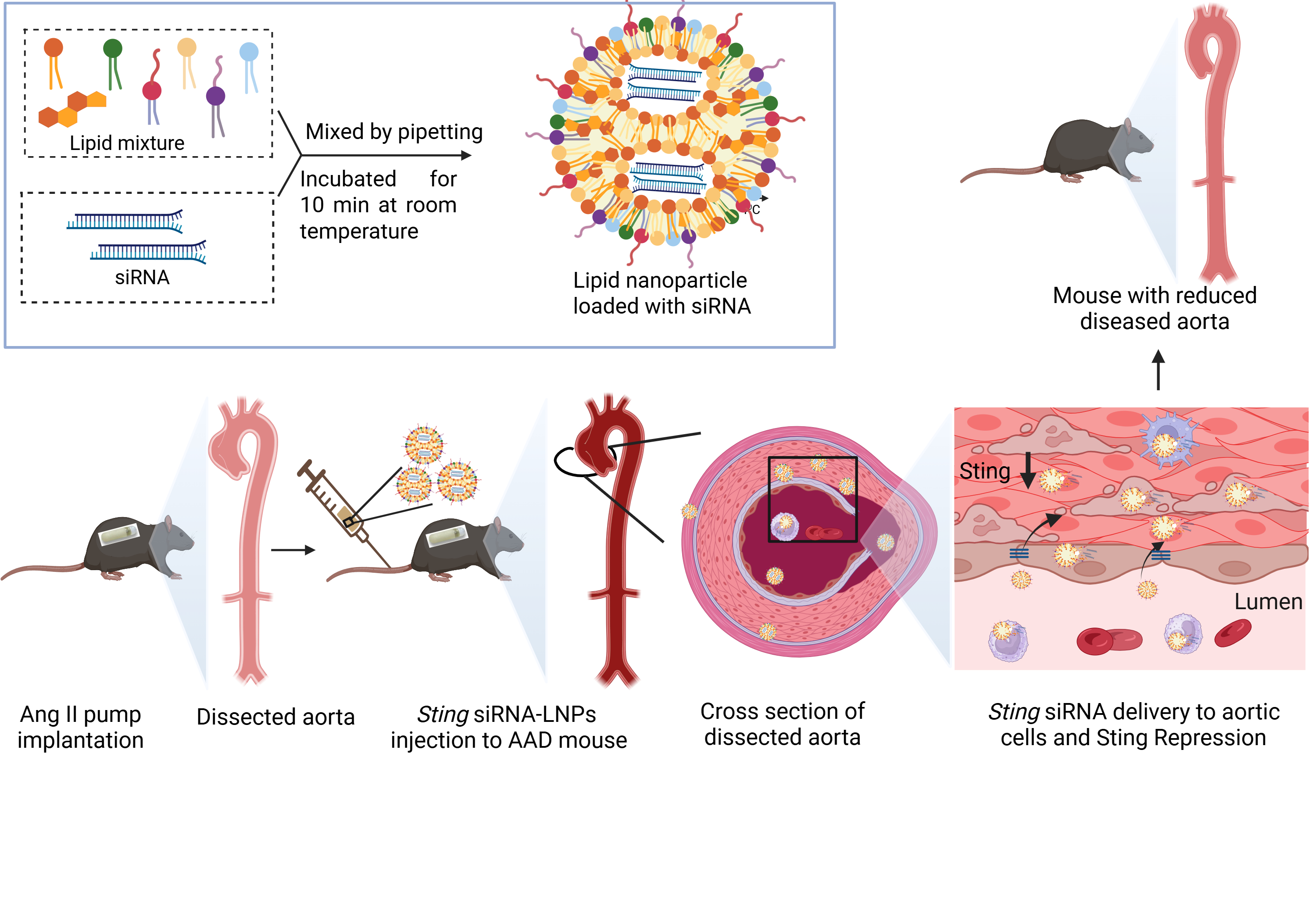
Abstract Body: Introduction Aortic aneurysm and dissection (AAD) is a life-threatening condition characterized by progressive aortic dilation, dissection, and rupture. Despite advances in surgical management for advanced disease, there are no effective pharmacological treatments to halt progression, underscoring a critical unmet need. RNA-based therapeutics delivered via lipid nanoparticles (LNPs) offer a promising strategy for targeted modulation of pathogenic molecules in cardiovascular disease. In this study, we evaluated the therapeutic potential of LNP-mediated delivery of Sting siRNA, targeting a key driver of aortic inflammation and destruction, as a novel treatment approach for AAD. Methods LNPs encapsulated with Cy3-scrambled siRNA and labelled with DiD (DiD-LNP/Cy3-siRNA), loaded with control siRNA (LNP/control siRNA), and Sting siRNA (LNP/Sting siRNA) were formulated using an ionizable lipid, cholesterol, a helper phospholipid, and a PEGylated lipid. The physicochemical and biological properties of LNPs were characterized. LNP/siRNA delivery to aortic wall, STING expression, and AAD incidence were evaluated in wild type mice infused with angiotensin II (Ang II) for 7 days and treated with LNP/control siRNA or LNP/Sting siRNA during Ang II infusion. Results The formulated LNPs exhibited optimal physicochemical properties with hydrodynamic size of 157 ± 4 nm, surface charge of -4 ± 2 mV, and polydispersity index of 0.15 ± 0.05. Encapsulation efficiency for siRNA was approximately 85%, with negligible cytotoxicity and minimal haemolytic activity. Ex vivo imaging detected DiD-LNP and Cy3-siRNA in aortic wall in Ang II-infused mice administered DiD-LNP/Cy3-siRNA, but not in saline-infused mice. Immunofluorescence analysis detected DiD-LNP and Cy3-siRNA in endothelial cells, smooth muscle cells, and macrophages in aorta wall of Ang II-infused mice. Importantly, the incidence of aortic dissection was significantly reduced (p=0.03) in Ang II-infused mice that were treated with LNPs/Sting siRNA compared to those that received LNP/control siRNA. The reduction of AAD development was associated with decreased STING protein level in aortic wall. Conclusions The study demonstrates the successful formulation and delivery of Sting siRNA via LNPs and establishes its efficacy in suppressing STING and preventing AAD in vivo. This study provides proof-of-concept for LNP-based RNA therapeutics in AAD; further rigorous studies are warranted to optimize the therapeutic regimen.
Sarkar, Sanjib
(
Baylor College of Medicine
, Houston , Texas , United States )
Zhang, Chen
(
Baylor College of Medicine
, Houston , Texas , United States )
Li, Yanming
(
Baylor College of Medicine
, Houston , Texas , United States )
Li, Bowen
(
Baylor College of Medicine
, Houston , Texas , United States )
Vasquez, Hernan
(
Baylor College of Medicine
, Houston , Texas , United States )
Bhatt, Tanya
(
Baylor College of Medicine
, Houston , Texas , United States )
Zhang, Lin
(
Baylor College of Medicine
, Houston , Texas , United States )
Acharya, Ghanashyam
(
Baylor College of Medicine
, Houston , Texas , United States )
Ghaghada, Ketan
(
Baylor College of Medicine
, Houston , Texas , United States )
Lemaire, Scott
(
Geisinger
, Danville , Pennsylvania , United States )
Shen, Ying
(
Baylor College of Medicine
, Houston , Texas , United States )
Author Disclosures:
Sanjib Sarkar:DO NOT have relevant financial relationships
| Scott LeMaire:DO have relevant financial relationships
;
Consultant:Cerus:Active (exists now)
| Ying Shen:No Answer
| Chen Zhang:No Answer
| Yanming Li:DO NOT have relevant financial relationships
| Bowen Li:DO NOT have relevant financial relationships
| Hernan Vasquez:No Answer
| Tanya Bhatt:No Answer
| Lin Zhang:No Answer
| Ghanashyam Acharya:DO NOT have relevant financial relationships
| Ketan Ghaghada:DO NOT have relevant financial relationships