
Logo

American Heart Association

  5
  0


Final ID: Wed013

Distinct Type 2 Diabetes Mechanisms Show Contrasting Effects on Abdominal Aortic Aneurysm

Abstract Body: Introduction: The association between type 2 diabetes (T2D) and abdominal aortic aneurysm (AAA) remains unclear in observational studies. As T2D is pathophysiologically heterogeneous—encompassing insulin resistance and β-cell dysfunction—these mechanisms may have opposing effects on vascular remodeling. We therefore investigated whether AAA risk differs across distinct mechanistic pathways of T2D.
Methods: We performed two-sample Mendelian randomization with genetic instruments selected from the T2DGGI (242,283 individuals with T2D; 1,569,730 without) and summary-level outcome data from the AAAgen (37,214 cases and 997,456 controls) consortia in Europeans. Predefined clusters of T2D-associated genetic variants that represent independent mechanistic pathways were tested in relation to genetic liability to AAA. To independently assess mechanism-specific effects we tested the effects of genetically proxied glycemic (fasting glucose, 2-hour glucose, hemoglobin A1c) and insulin resistance (fasting insulin, insulin sensitivity, triglyceride-to-HDL ratio, body mass index, waist-to-hip ratio) traits on genetic liability to AAA. The inverse variance weighted (IVW) method was used as the primary analysis and supplemented by other methods, including MR-Egger regression, as sensitivity analyses.
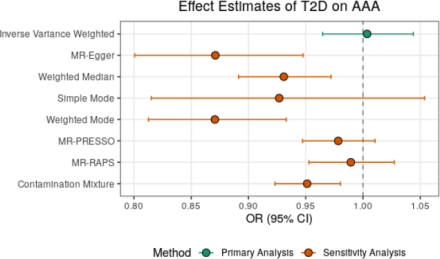
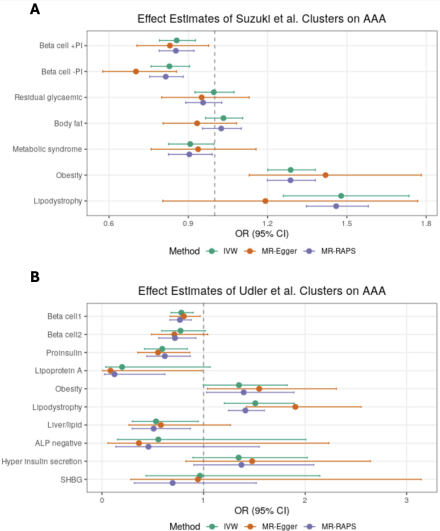
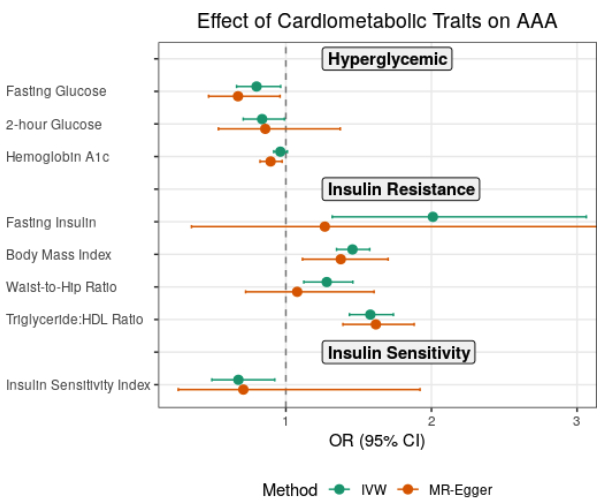
Results: Estimates of the association between genetic liability to T2D and genetic liability to AAA did not exclude the null (OR 1.00, 95%CI 0.96–1.05) in the primary analysis; however, this null association was not consistently observed in the sensitivity analyses (Figure 1), suggesting the possibility of pleiotropy. Cluster-specific analyses revealed that variants within beta cell dysfunction clusters were inversely associated with AAA, whereas those within the obesity and lipodystrophy clusters were associated with higher risk of AAA (Figure 2). Independently, genetically proxied glycemic traits were associated with lower genetic liability to AAA, whereas genetically proxied insulin resistance related traits demonstrated consistently increased AAA risk (Figure 3).
Conclusions: Type 2 diabetes shows mechanism-specific heterogeneity in abdominal aortic aneurysm (AAA) risk. Genetic liability driven by hyperglycemia and β-cell dysfunction appears protective, whereas liability reflecting insulin resistance and adiposity is associated with higher AAA risk.
  • Devaro, David  ( University of Pennsylvania , Philadelphia , Pennsylvania , United States )
  • Raghavan, Sridharan  ( Rocky Mountain VA MEDICAL CENTER , Aurora , Colorado , United States )
  • Walker, Venexia  ( Bristol Medical School , Bristol , United Kingdom )
  • Gaunt, Tom  ( Bristol Medical School , Bristol , United Kingdom )
  • Larsson, Susanna  ( Karolinska Institutet , Stockholm , Sweden )
  • Levin, Michael  ( University of Pennsylvania , Philadelphia , Pennsylvania , United States )
  • Tsao, Philip  ( Stanford University-VAPAHCS , Los Altos , California , United States )
  • Yuan, Shuai  ( University of Pennsylvania , Philadelphia , Pennsylvania , United States )
  • Damrauer, Scott  ( University of Pennsylvania , Philadelphia , Pennsylvania , United States )
  • Author Disclosures:
    David DeVaro: DO NOT have relevant financial relationships | Sridharan Raghavan: No Answer | Venexia Walker: No Answer | Tom Gaunt: No Answer | Susanna Larsson: No Answer | Michael Levin: DO have relevant financial relationships ; Research Funding (PI or named investigator):MyOme:Active (exists now) ; Consultant:BridgeBio Pharma:Active (exists now) | Philip Tsao: DO NOT have relevant financial relationships | Shuai Yuan: No Answer | Scott Damrauer: DO have relevant financial relationships ; Consultant:Tourmaline Bio:Past (completed) ; Research Funding (PI or named investigator):Amgen:Active (exists now) ; Research Funding (PI or named investigator):Novo Nordisk:Active (exists now)
Meeting Info:
Session Info:

01. Poster Session 1 & Reception

Wednesday, 05/13/2026 , 06:00PM - 08:00PM

Poster

More abstracts on this topic:
More abstracts from these authors:
Triglyceride-rich lipoproteins, low-density lipoproteins, and risk of abdominal aortic aneurysm

Yuan Shuai, Damrauer Scott, Bjornson Elias, Shakt Gabrielle, Dinatale Tia, Lynch Julie, Chang Kyong-mi, Tsao Philip, Levin Michael, Leeper Nick

A Sparse Proteomic Risk Score Incorporating Plasma MMP12 Level Improves Prediction of Abdominal Aortic Aneurysm

Clark Michael, Yuan Shuai, Larsson Susanna, Levin Michael, Woerner Jakob, Kim Dokyoon, Damrauer Scott

You have to be authorized to contact abstract author. Please, Login
Not Available