Pcpe2 Drives Obesity and Adipose Dysfunction Through TGFβ Signaling
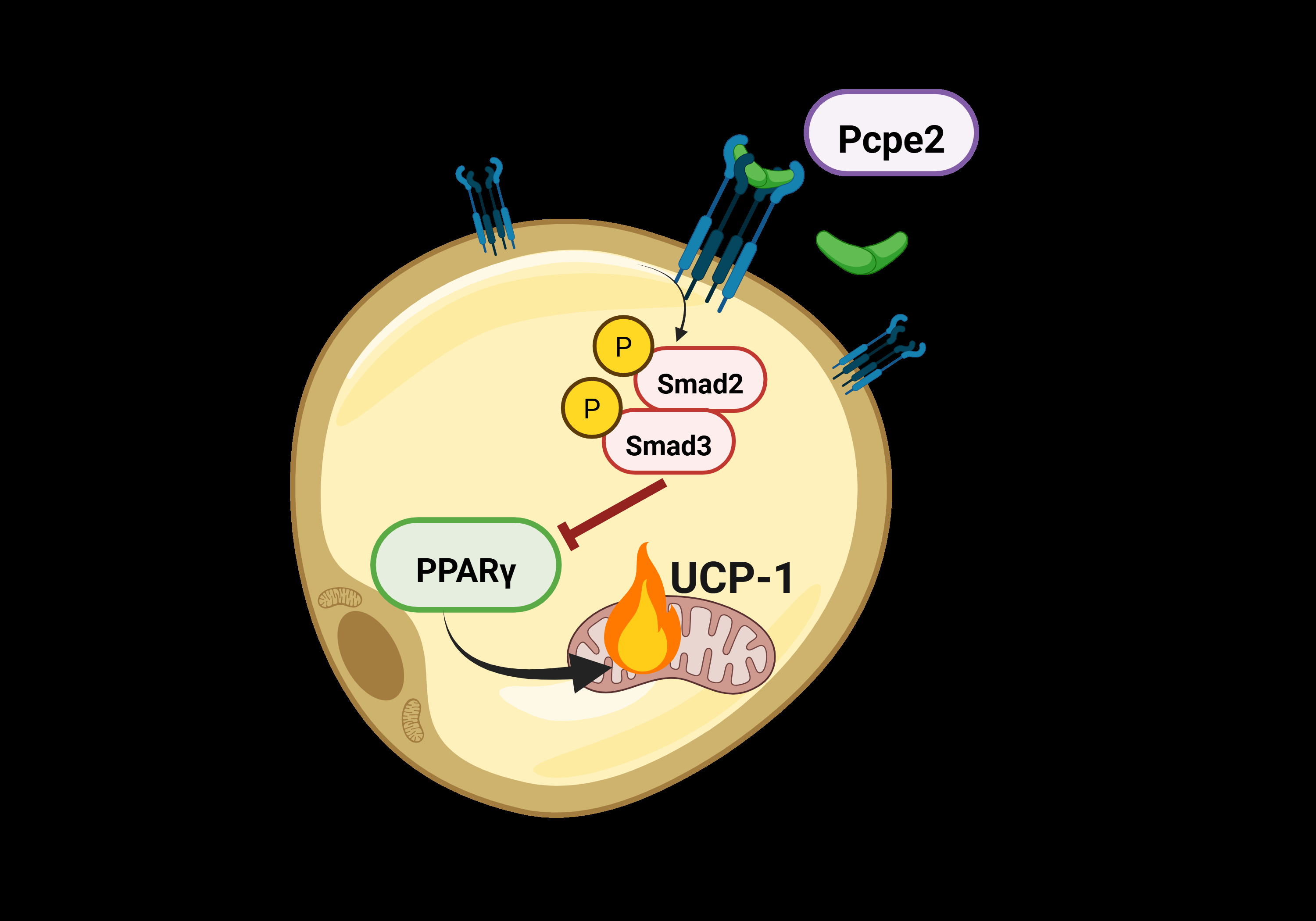
Abstract Body: Obesity is a chronic health condition primarily affecting white adipose tissue (WAT) and is exacerbated by the consumption of a Western Diet (WD). Currently, it is estimated that >40% of the U.S. population is obese, and rising, dramatically increasing mortality by raising the prevalence of cardiovascular disease and cancer. It is well established that transforming growth factor beta (TGFβ) signaling is elevated in WAT and contributes to pathological adipose expansion and remodeling. Functionally, TGFβ signaling in WAT inhibits the master regulator of adipogenesis, peroxisome proliferator-activated receptor gamma (PPARγ). When PPARγ is attenuated, differentiation of new preadipocytes is impaired, leading to hypertrophy of existing adipocytes. WAT hypertrophy results in local inflammation and the downregulation of uncoupling protein 1 (UCP-1), a mitochondrial transporter associated with beiging of WAT. In WAT, mechanisms regulating TGFβ signaling are not fully understood, providing an opportunity to control healthy adipose expansion. We hypothesize thatProcollagen C-endopeptidase Enhancer 2 (Pcpe2), an extracellular matrix glycoprotein expressed highly in WAT, promotes TGFβ signaling, which in turn inhibits PPARγ and UCP1 expression, as shown in Figure1. Using an adipose-specific Pcpe2 knockout mouse model (Adipo+Pcpe2KO) we have shown the deletion of Pcpe2 protects against diet induced obesity (25% body weight reduction, p<0.01, n=12), reduces plasma glucose (23% reduction, p<0.01, n=12), and increases whole body energy expenditure (p<0.03, n=8), as measured by metabolic cage analyses, compared to control mice. Additionally, adipocytes lacking Pcpe2 show reduced TGFβ signaling, evidenced by a decrease in the phosphorylated-SMAD2/3 to total SMAD ratio. To further our investigations into Pcpe2’s mechanism, we next examined PPARγ and UCP1 mRNA in adipocytes and found elevated PPARγ mRNA (8-fold, p<0.01) and UCP1 (6-fold, p<0.0001), in cells lacking Pcpe2 compared to controls. Overall, these data suggest that Pcpe2 acts as an extracellular enhancer of TGFβ signaling, which has the downstream effects of inhibiting PPARγ, and UCP1 and consequently attenuating healthy adipose expansion and remodeling.
Rocksvold, Alexander
(
Medical College of Wisconsin
, Milwaukee , Wisconsin , United States )
Beg, Mirza
(
Medical College of Wisconsin
, Milwaukee , Wisconsin , United States )
Ahmad, Bilal
(
Medical College of Wisconsin
, Milwaukee , Wisconsin , United States )
Xu, Hao
(
Medical College of Wisconsin
, Milwaukee , Wisconsin , United States )
Gupta, Rana
(
Duke Molecular Physiology Institute
, Durham , North Carolina , United States )
Grobe, Justin
(
Medical College of Wisconsin
, Milwaukee , Wisconsin , United States )
Reho, John
(
Medical College of Wisconsin
, Milwaukee , Wisconsin , United States )
Sorci Thomas, Mary
(
Medical College of Wisconsin
, Milwaukee , Wisconsin , United States )
Author Disclosures:
Alexander Rocksvold:DO NOT have relevant financial relationships
| Mirza Beg:DO NOT have relevant financial relationships
| Bilal Ahmad:DO NOT have relevant financial relationships
| Hao Xu:DO NOT have relevant financial relationships
| Rana Gupta:No Answer
| Justin Grobe:DO NOT have relevant financial relationships
| John Reho:DO NOT have relevant financial relationships
| Mary Sorci Thomas:DO NOT have relevant financial relationships