FDA-approved drug library screen identifies antidepressants, antimicrobials, and anti-CVD agents as potent in vitro and in vivo blockers of NLRP3 inflammasome.
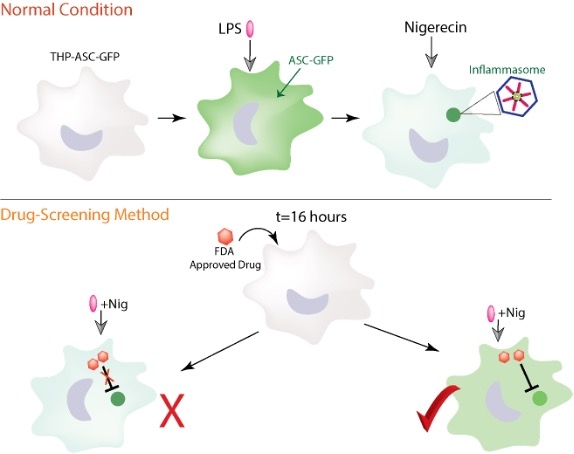
Abstract Body: Introduction: Dysregulated activation of NLRP3 inflammasome promotes metabolic disorders such as diabetes, obesity, atherosclerosis, Alzheimer’s/Parkinson’s, and asthma/COPD. Objective: To identify FDA-approved drugs that can specifically block priming or assembly of NLRP3 inflammasome. Methods: Tocriscreen FDA-approved drug library of 190 compounds, human THP-1-ASC-GFP monocytes, mouse model of NLRP3 assembly, LPS-induced sepsis, and biochemical assays (IL-1β release, autophagy, etc.) were employed. Results: We identified FDA-approved drugs that: (1) block LPS-induced priming of inflammasome or (2) inhibit ASC speck (puncta) formation. Various classes of drugs, such as antidepressants (Fluoxetine, Duloxetine), antimalarials (Mefloquine), antifungals (Azoles, Ciclopirox), anti-diabetic (Rosiglitazone), anti-COPD, and antivirals (Saquinavir, Remdesivir), were identified as potent blockers of either priming or assembly of NLRP3 inflammasome. Several mechanistic studies were undertaken, with some drugs inducing autophagy, with significant increase in LC3-II by Rosiglitazone (1.6-fold, *p<0.02), Irbesartan (3.3-fold, **p<0.001), Dasatinib (3.4-fold, **p<0.02), Felodipine (2.1-fold, *p<0.03), and Fluoxetine (2.1-fold, *p<0.05) (N=3, mean±SE, **p<0.05 by t-test). Some drugs, such as Mefloquine, Fluoxetine and Ciclopirox inhibited LPS-induced NF-kB nuclear localization in mouse and human macrophages (N>50 cells, mean±SE, ***p<0.001 by one-way ANOVA). Mefloquine, Fluoxetine, and Ciclopirox decreased mitochondrial membrane potential by ~71%, ~13.4% and ~90% respectively (N=5, mean±SE, **p<0.05 by one-way ANOVA). Mefloquine reduced ~16% dipole potential vs control (N=3, ***p< 0.001). WT C57BL6/J mice treated with ASC-speck blockers (Miconazole, Saquinavir, Salmeterol) showed markedly reduced IL-1b in peritoneal lavage (N=5, mean±SD, **p<0.01 by t-test), while drugs blocking LPS-induced priming (Mefloquine, Fluoxetine, and Ciclopirox) showed a markedly higher survival in sepsis mouse model. The median survival for males on Mefloquine (N=17) was undefined, ****p<0.0001 by Logrank test; Ciclopirox (N=6) was undefined, ***p<0.0002 by Logrank test and Fluoxetine (N=16) was 22.2 hours compared to male control 14.25 hours (N=11), ****p<0.0001 by Logrank test. Similar results were found in females. Conclusion: Diverse mechanistic classes uncovered in this screen illustrate the potential for strategic repurposing of FDA-approved drugs for unmet needs in inflammatory diseases.
Timinski, Kara
(
Cleveland State University
, Cleveland , Ohio , United States )
Neupane, Kalash
(
Cleveland State University
, Cleveland , Ohio , United States )
Prince, Ashutosh
(
Cleveland State University
, Cleveland , Ohio , United States )
Khan, Mariam
(
Cleveland State University
, Cleveland , Ohio , United States )
Bhandari, Nilam
(
Cleveland State University
, Cleveland , Ohio , United States )
Sharma, Swati
(
Centre of Gene Regulation in Health and Disease, Cleveland State University, Cleveland, OH, USA
, Cleveland , Ohio , United States )
Traughber, Calicia
(
Cleveland State University
, Cleveland , Ohio , United States )
Gulshan, Kailash
(
Cleveland State University
, Cleveland , Ohio , United States )
Author Disclosures:
Kara Timinski:DO NOT have relevant financial relationships
| Kalash Neupane:No Answer
| Ashutosh Prince:DO NOT have relevant financial relationships
| Mariam Khan:No Answer
| Nilam Bhandari:No Answer
| Swati Sharma:DO NOT have relevant financial relationships
| CAlicia Traughber:No Answer
| Kailash Gulshan:DO NOT have relevant financial relationships