
Logo

American Heart Association

  13
  0


Final ID: Fri018

Role of PIP2 in cholesterol homeostasis and membrane modulation

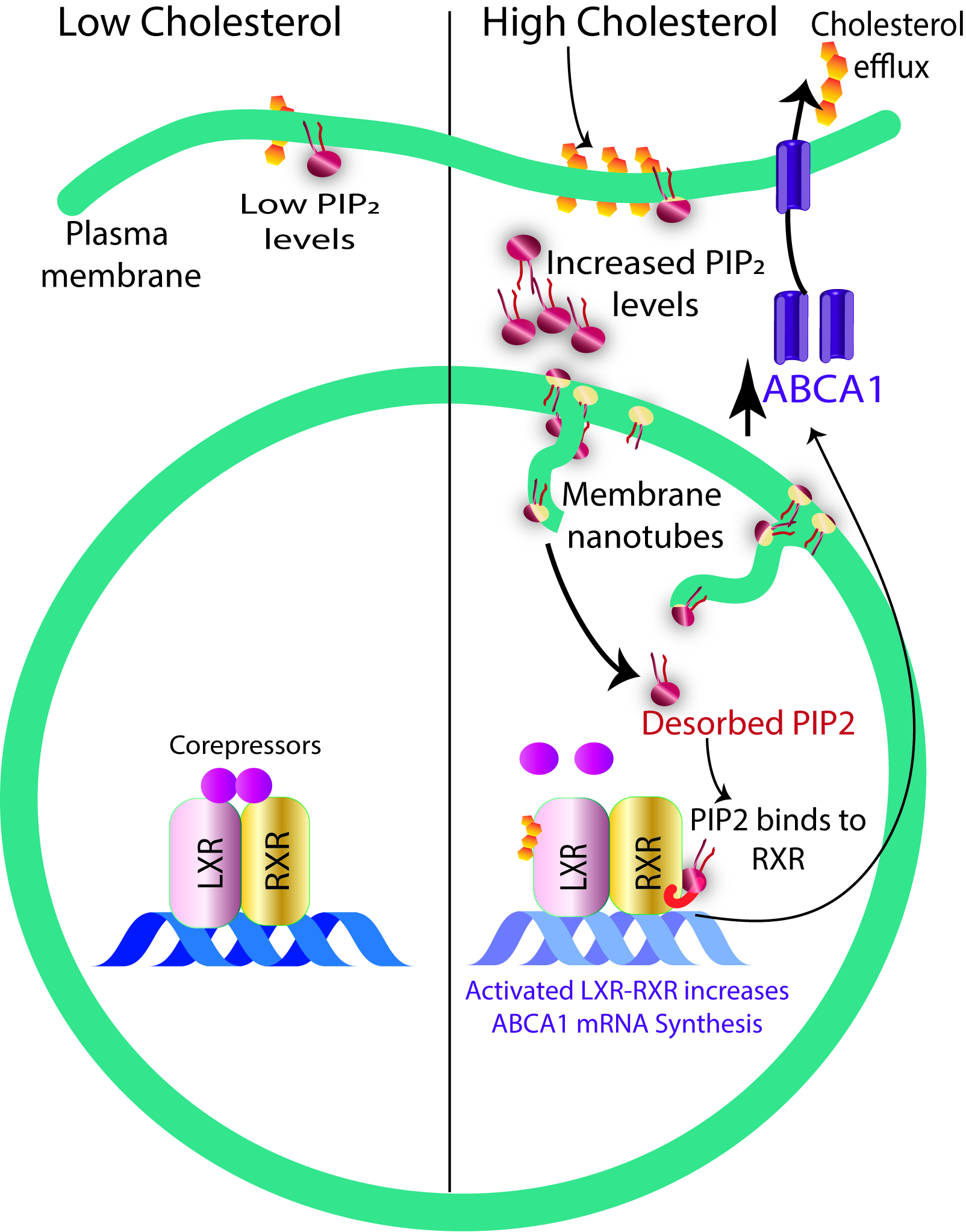
Abstract Body: Background: Cholesterol homeostasis is tightly regulated by LXR-RXR heterodimer complex. However, it’s not fully clear if any specific lipid can modulate the activity of LXR-RXR complex. We found that cholesterol loading increases nuclear PIP2. One intriguing question is how increased PIP2 relays cholesterol status to LXR/RXR complex.

Hypothesis: PIP2 has a specifically high critical micelle concentration (~10 µM) and inverted conical shape, allowing PIP2 to translocate/desorb from membrane bilayer and interact with RXR.

Goal: To determine the interaction between PIP2 and RXR and mechanism for PIP2 desorption/translocation from lipid bilayer.
Methods and Results: We identified a conserved putative PIP2 binding motif in human RXRA (aa:185-196). Using Rosetta-fold and PONDER prediction, RXR-PIP2 binding domain (RXR-PBD) comprising aa 111-228 was found to be highly disordered, forming a putative binding surface for anionic molecules. Microscale thermophoresis showed binding of DOPC:PIP2 with Alexa488-RXR-PBD (Kd-19.6±1.5µM, N=3, mean±S.E) vs no binding with DOPC. Surface Plasmon Resonance (SPR) using immobilized biotinylated-PIP2 and RXR-PBD showed binding with Kd of 1.65±0.3 µM (N=3 mean±S.E). Fluorescence resonance energy transfer (FRET) using Alexa 488-RXR-PBD and RhodPE-PIP2 pair showed robust binding, while RXR with mutations in PIP2 binding region showed markedly reduced binding (N=3, mean±S.E). STEDyCON microscopy, using giant unilamellar vesicles (GUV) doped with PIP2 showed strong binding of RXR-PBD-WT, while RXR-PBD-mutant showed no binding (N=30), confirms interaction between RXR and PIP2. Increased PIP2 levels and exogenous PIP2 addition in DOPC-GUVs drive nanotube formation. Fluorescence recovery after photobleaching (FRAP) revealed modulation of lipid mobility—DOPC:5% PIP2 showed increased diffusion (30.5 ± 0.24 µm2/s) vs DOPC (18.7±0.35 µm2/s), whereas exogenous PIP2 reduces diffusion (17.9 ± 4.5 µm2/s) compared with control DOPC (29.5 ± 4.2 µm2/s). Atomic force microscopy of giant plasma membrane vesicles (GPMVs) from HepG2 cells treated with PIP2 showed significantly increased Young’s modulus and membrane tension while reduced tether radius (n>30) vs GPMVs treated with PC.
Conclusion: Nuclear PIP2 binds RXR via a novel and conserved PIP2-binding domain. Mechanistically, PIP2 lowers tether radius, increases membrane tension and stiffness promotes high-curvature nanotube formation, and PIP2 desorption. The desorbed PIP2 interacts with RXR.
  • Prince, Ashutosh  ( Cleveland State University , Cleveland , Ohio , United States )
  • Khan, Mariam  ( Cleveland State University , Cleveland , Ohio , United States )
  • Surti, Pranav  ( Cleveland State University , Cleveland , Ohio , United States )
  • Sharma, Swati  ( Cleveland State University , Cleveland , Ohio , United States )
  • Ertugral, Elif  ( Cleveland State University , Cleveland , Ohio , United States )
  • Kothapalli, Chandrasekhar  ( Cleveland State University , Cleveland , Ohio , United States )
  • Gulshan, Kailash  ( Cleveland State University , Cleveland , Ohio , United States )
  • Author Disclosures:
    Ashutosh Prince: DO NOT have relevant financial relationships | Mariam Khan: No Answer | Pranav Surti: No Answer | Swati Sharma: DO NOT have relevant financial relationships | Elif Ertugral: DO NOT have relevant financial relationships | Chandrasekhar Kothapalli: DO NOT have relevant financial relationships | Kailash Gulshan: DO NOT have relevant financial relationships
Meeting Info:
Session Info:

15. Poster Session 3 & Reception

Friday, 05/15/2026 , 05:00PM - 07:00PM

Poster

More abstracts on this topic:
A 3-Year, Pre-Trial, Real-world Data Analysis of Patients Enrolled in VICTORION-INITIATE: Insights Using Tokenization

Rodriguez Fatima, Cosmatos Irene, Desai Nihar, Wright R, Ross Elsie, Ali Yousuf, Kumar Biswajit, Han Guangyang, Cai Beilei, Abbas Cheryl, Ryan Amy

A Health Coach-Based Multi-Level Personalized Strategy Lowers LDL-Cholesterol and Enhances Lipid Control in Veterans with Atherosclerotic Cardiovascular Disease – The VA Lipid Optimization Reimagined Quality Improvement Project at VA New York Harbor Healthcare System

Chen Tina, Ingerman Diana, Haley Leah, Salovaara Priscilla, Nicholson Andrew, Illenberger Nicholas, Natarajan Sundar

More abstracts from these authors:
PIP2 Modulates ABCA1 Expression and Reverse Cholesterol Transport

Sharma Swati, Prince Ashutosh, Khan Mariam, Timinski Kara, Neupane Kalash, Gulshan Kailash

FDA-approved drug library screen identifies antidepressants, antimicrobials, and anti-CVD agents as potent in vitro and in vivo blockers of NLRP3 inflammasome.

Timinski Kara, Neupane Kalash, Prince Ashutosh, Khan Mariam, Bhandari Nilam, Sharma Swati, Traughber Calicia, Gulshan Kailash

You have to be authorized to contact abstract author. Please, Login
Not Available