Logo

American Heart Association

  15
  0


Final ID: Or137

Systematic Mapping of Smooth Muscle Cell Gene Programs That Drive Genetic Risk for Coronary Artery Disease

Abstract Body: Introduction: Coronary artery disease (CAD) is a leading cause of death worldwide. It is now generally accepted that residual risk for CAD resides in genetic variation that regulates cellular processes of smooth muscle cells (SMCs) in the vessel wall.

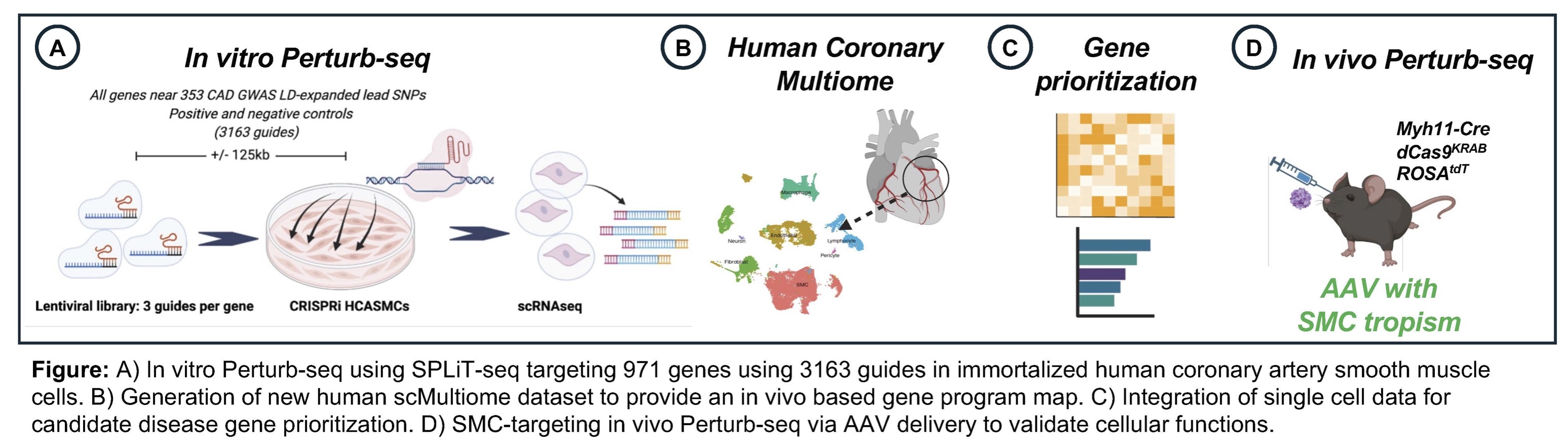
Methods: We applied CRISPRi Perturb-seq using split-pool barcoding (SPLiT-seq) in immortalized human coronary artery SMCs, targeting 971 genome wide association study (GWAS) nominated genes with 3,163 guides across 954,000 cells. In vitro Perturb-seq transcriptomic effects were measured using single-cell RNA-seq. Explanted coronary arteries from cardiac transplant recipients was collected to generate a high quality scMultiome human coronary artery cell atlas (n=9). Together, this provided orthogonal references to map gene programs using consensus non-negative matrix factorization (cNMF) with robust cross-validation of gene programs. In vivo Perturb-seq via SMC-targeted AAV delivery is performed for mechanistic validation and characterization of in vivo effects.

Results: cNMF decomposition performed on the Perturb-seq and human scMultiome atlas revealed 50 in vitro, and 40 in vivo gene programs, respectively. In total, 84% of our candidate genes demonstrated statistically robust knockdown. This allowed systematic integration of GWAS variants to gene linking followed by analysis of perturbation-associated differential gene signatures with SMC-specificity and CAD risk gene enrichment that converged across both cNMF references. Together, this enabled quantitative ranking of functional disease genes by their impact on transcriptional circuits. To extend upon this framework, SMC-targeted in vivo Perturb-seq demonstrated robust knockdown across 19 target genes using 123 guides, enabling rapid simultaneous characterization of cellular functions. Integration of these analyses highlighted convergence of CAD-associated perturbations on risk associated vascular regulatory programs such as TGFB signaling and nominated ZEB1 as a high-confidence mediator of CAD genetic risk. Transcriptomic analysis of in vivo effects revealed a shift in SMC cellular state marked by ectopic activation of epithelial markers and upregulation of immune signaling.

Conclusion: We combine SPLiT-seq CRISPRi screening with multi-modal gene program references for robust hypothesis generation and in vivo Perturb-seq for rapid functional validation of CAD risk associated loci, identifying ZEB1 as a novel regulator of SMC identity and disease risk.
  • Li, Daniel  ( Stanford University , Stanford , California , United States )
  • Zhao, Quanyi  ( Stanford University , Stanford , California , United States )
  • Monteiro, Joao  ( Stanford University , Stanford , California , United States )
  • Kang, Helen  ( Stanford University , Stanford , California , United States )
  • Zhu, Sophia  ( Stanford University , Stanford , California , United States )
  • Yu, Amelia  ( Stanford University , Stanford , California , United States )
  • Davalle, Claire  ( Stanford University , Stanford , California , United States )
  • Nguyen, Trieu  ( Stanford University , Stanford , California , United States )
  • Park, Chong  ( Stanford University , Stanford , California , United States )
  • Engreitz, Jesse  ( Stanford University , Stanford , California , United States )
  • Quertermous, Thomas  ( Stanford University , Stanford , California , United States )
  • Author Disclosures:
    Daniel Li: DO NOT have relevant financial relationships | Jesse Engreitz: DO have relevant financial relationships ; Speaker:Amgen:Past (completed) ; Speaker:Roche:Past (completed) ; Speaker:GSK:Past (completed) | Thomas Quertermous: No Answer | Quanyi Zhao: DO NOT have relevant financial relationships | Joao Monteiro: DO NOT have relevant financial relationships | Helen Kang: No Answer | Sophia Zhu: No Answer | Amelia Yu: DO NOT have relevant financial relationships | Claire DaValle: DO NOT have relevant financial relationships | Trieu Nguyen: No Answer | Chong Park: No Answer
Meeting Info:
More abstracts on this topic:
Elucidating Isoform Drivers of Vascular Smooth Muscle Cell Fibromyocyte Transdifferentiation in Atherosclerosis

Iyer Shraddha, Auguste Gaelle, Murach Maria, Shillito Katherine, Sittipongpittaya Natchanon, Sheynkman Gloria, Miller Clint

A Hypertrophic Cardiomyopathy Polygenic Score Modifies Penetrance of Pathogenic Hypertrophic and Dilated Cardiomyopathy Variants in Opposite Directions

Abramowitz Sarah, Hoffman-andrews Lily, Depaolo John, Judy Renae, Owens Anjali, Damrauer Scott, Levin Michael

More abstracts from these authors:
Variant-enhancer-gene mapping at the 9p21 locus in smooth muscle cells reveals new enhancer-gene pairs and mechanistic insights for coronary artery disease

Ramste Markus, Qin Guyu, Nguyen Trieu, Kim Juyong, Engreitz Jesse, Assimes Themistocles, Park Chong, Quertermous Thomas, Weldy Chad, Zhao Quanyi, Ramste Amanda, Li Daniel, Sharma Disha, Monteiro Joao, Worssam Matthew, Amgalan Dulguun

ZEB1 Regulates Coronary Disease Risk Through Epigenetic Control of Smooth Muscle Cell Identity

Li Daniel, Jackson William, Gu Wenduo, Yu Amelia, Zhu Sophia, Zhao Quanyi, Nguyen Trieu, Cheng Paul, Quertermous Thomas

You have to be authorized to contact abstract author. Please, Login
Not Available