Logo

American Heart Association

  20
  0


Final ID: MP2736

ZEB1 Regulates Coronary Disease Risk Through Epigenetic Control of Smooth Muscle Cell Identity

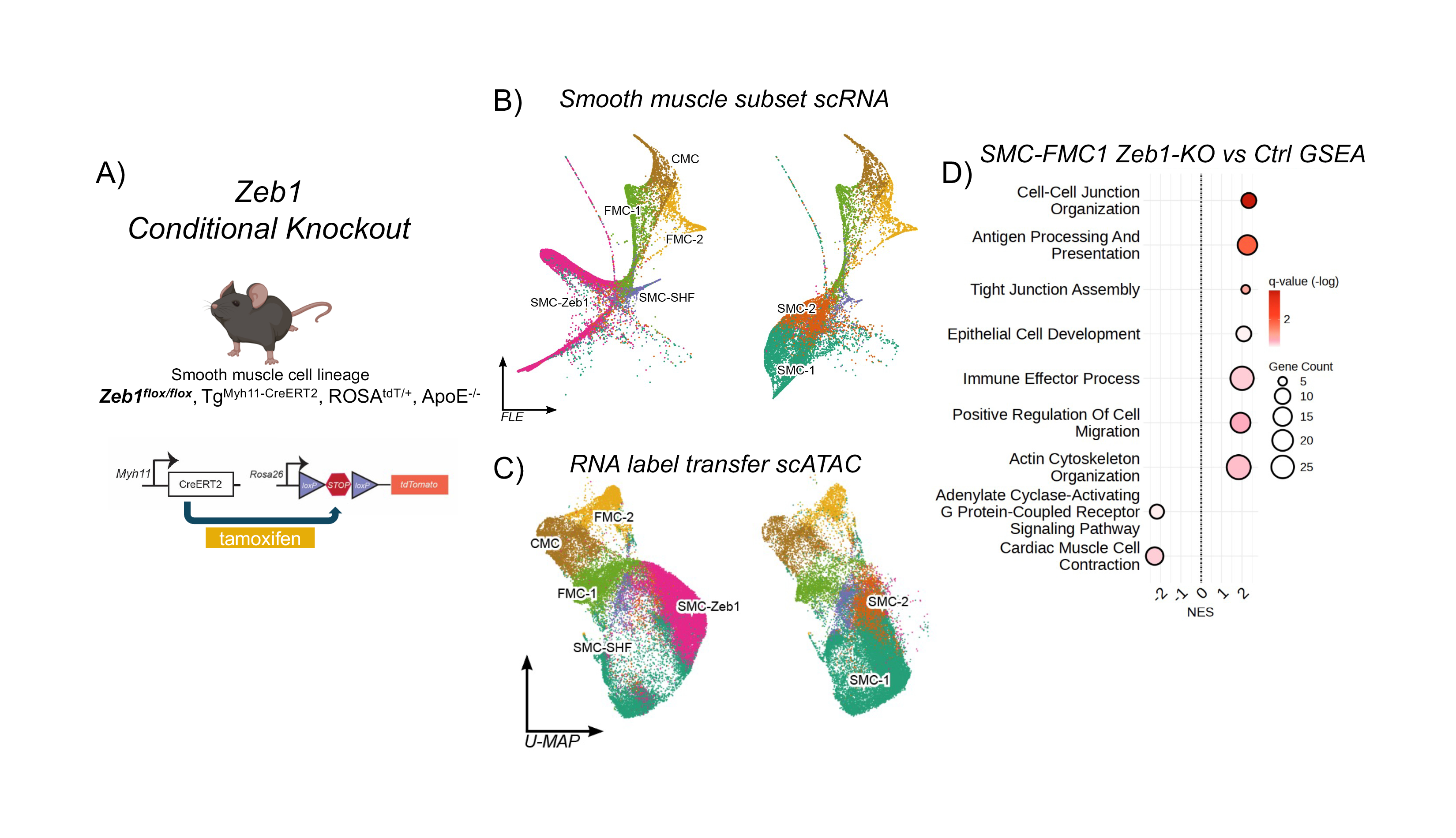
Abstract Body (Do not enter title and authors here): Background: Vascular smooth muscle cells (SMCs) contribute significantly to heritable coronary artery disease (CAD) risk and undergo phenotypic transitions in the intimal plaque during atherosclerosis. ZEB1 is a master regulator of epithelial-to-mesenchymal transition, that has been associated with CAD through human genetic studies. ZEB1 orchestrates cell state changes through modulation of TGFβ signaling and numerous epigenetic regulators. However, the mechanisms underlying the genetic association between ZEB1 and CAD remain unexplored.
Methods: Single-cell RNA and ATAC sequencing on lineage-traced SMCs from the atherosclerotic aortic roots of SMC-specific Zeb1 knockout mice (Zeb1-KO; Myh11CreERT2, ROSAtdT/+, ApoE-/-) were collected after 16 weeks on high-fat diet to characterize the changes in transcriptomic and epigenetic landscape. siRNA knockdown of ZEB1 in combination with TGFβ and IFNγ stimulations were performed in vitro on human coronary artery SMCs (HCASMCs) to validate in vivo findings.
Results: Zeb1-KO single cell RNA and ATAC sequencing showed the emergence of a novel epithelial-like SMC state characterized by robust ectopic activation of tricellular tight junction and cell polarity genes. Despite this increase in epithelial features, Zeb1-KO also led to an increase in phenotypically transitioning SMCs contributing to the intimal plaque, accompanied by multi-fold enrichment in interferon-gamma (IFNγ) signaling targets. Motif analysis revealed near complete opening of chromatin accessibility at previously closed ZEB1 binding motifs, implicating ZEB1 mediated epigenetic repression. In vitro co-stimulation with TGFβ and IFNγ showed that siZEB1 abolished the inhibitory effect of TGFβ on IFNγ signaling and demonstrated enriched for migratory and growth factor response functions by bulk RNAseq. Cell-cell signaling analysis by MultiNicheNet identified ectopic expression of migratory marker Lamc2 and concurrent increases in its interacting integrin partners in Zeb1-KO SMCs. Furthermore, siZEB1 HCASMCs also showed elevated expression of LAMC2, its integrin interacting partners, as well as increased wound healing capacity by scratch assay.
Conclusion: We identify ZEB1 as a critical epigenetic repressor required for the maintenance of the SMC cell state, suppressing epithelial marker expression and modifying cellular response to interferon signaling to ultimately augment SMC phenotypic transitions, linking genetic association between ZEB1 and CAD risk.
  • Li, Daniel  ( Stanford University , Stanford , California , United States )
  • Jackson, William  ( Stanford University , Stanford , California , United States )
  • Gu, Wenduo  ( Stanford University , Stanford , California , United States )
  • Yu, Amelia  ( Stanford University , Stanford , California , United States )
  • Zhu, Sophia  ( Stanford University , Stanford , California , United States )
  • Zhao, Quanyi  ( Stanford University , Stanford , California , United States )
  • Nguyen, Trieu  ( Stanford University , Stanford , California , United States )
  • Cheng, Paul  ( Stanford University , Stanford , California , United States )
  • Quertermous, Thomas  ( Stanford University , Stanford , California , United States )
  • Author Disclosures:
    Daniel Li: DO NOT have relevant financial relationships | William Jackson: No Answer | Wenduo Gu: No Answer | Amelia Yu: No Answer | Sophia Zhu: No Answer | Quanyi Zhao: No Answer | Trieu Nguyen: DO NOT have relevant financial relationships | Paul Cheng: No Answer | Thomas Quertermous: DO NOT have relevant financial relationships
Meeting Info:

Scientific Sessions 2025

2025

New Orleans, Louisiana

Session Info:

Atherosclerosis and Vascular Diseases: New Molecular and Cellular Mechanisms

Monday, 11/10/2025 , 01:45PM - 02:40PM

Moderated Digital Poster Session

More abstracts on this topic:
A major uremic toxin indoxyl sulfate impairs macrophage efferocytosis and accelerates atherogenesis: a potential mechanism for cardiovascular risk in chronic kidney disease

Jha Prabhash, Kasai Taku, Vromman Amelie, Holden Rachel, Libby Peter, Tabas Ira, Singh Sasha, Aikawa Elena, Aikawa Masanori, Lupieri Adrien, Sonawane Abhijeet, Le Thanh-dat, Becker-greene Dakota, Chelvanambi Sarvesh, Turner Mandy, Nakamura Yuto, Passos Livia

A 3-Year, Pre-Trial, Real-world Data Analysis of Patients Enrolled in VICTORION-INITIATE: Insights Using Tokenization

Rodriguez Fatima, Cosmatos Irene, Desai Nihar, Wright R, Ross Elsie, Ali Yousuf, Kumar Biswajit, Han Guangyang, Cai Beilei, Abbas Cheryl, Ryan Amy

More abstracts from these authors:
Uncovering Sex-Specific Mechanisms in Vascular Disease through a Multi-Omics Approach

Iyer Meghana, Cheng Paul, Li Daniel, Gu Wenduo, Jackson William, Zhao Quanyi, Damiani Isabella, Nguyen Trieu, Berezowitz Alexa, Kim Juyong

Vascular smooth muscle cell atherosclerosis trajectories characterized at single cell resolution identify causal transcriptomic and epigenomic mechanisms of disease risk

Li Daniel, Palmisano Brian, Weldy Chad, Kundu Ramendra, Kundaje Anshul, Wirka Robert, Quertermous Thomas, Kundu Soumya, Cheng Paul, Gu Wenduo, Jackson William, Zhao Quanyi, Nguyen Trieu, Worssam Matthew, Monteiro Joao

You have to be authorized to contact abstract author. Please, Login
Not Available