Increasing Rates of Lipoprotein(a) Testing of Peripheral Arterial Disease Patients from 2015-2024: An Analysis of 3.4 Million Individuals
Abstract Body: Background: Lipoprotein(a) [Lp(a)] is a genetically determined biomarker associated with increased risk of cardiovascular diseases. As Lp(a) increases, rates and severity of diseases like peripheral arterial disease (PAD) increase. Despite this risk, Lp(a) testing remains underperformed in PAD patients, and limited data on national testing trends are available.
Methods: This study includes data from Epic Cosmos, a nationwide, de-identified electronic health record dataset comprising over 300 million patients, between January 1, 2015, to December 31, 2024. We evaluated the number of PAD patients who had undergone Lp(a) testing, the testing rate per annual PAD patients, geographical variation, and percentages of patients tested stratified by age, sex, ethnicity, race, social vulnerability index (SVI), and diagnosis of coronary artery disease (CAD).
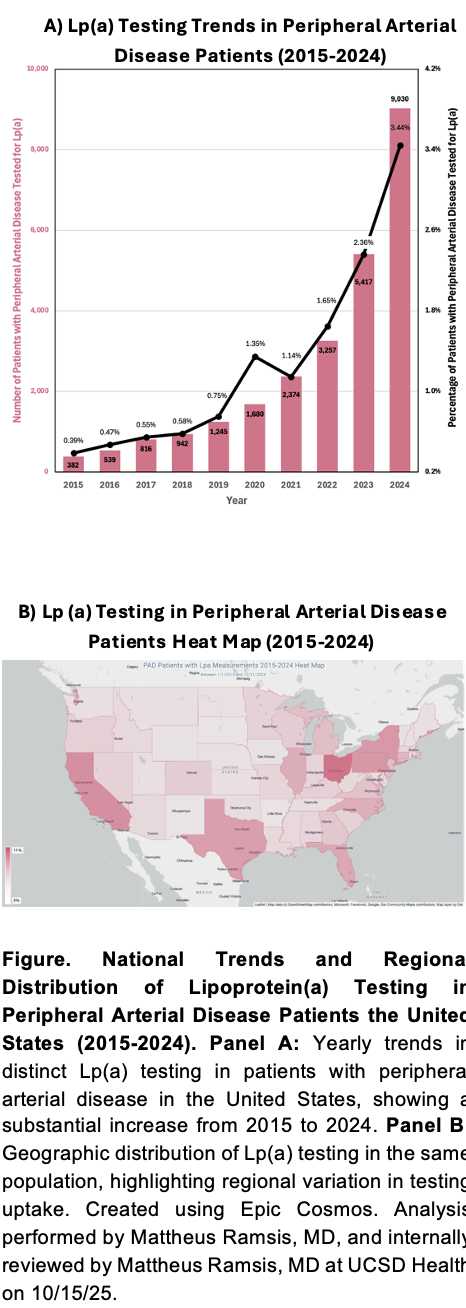
Results: From 2015 to 2024, out of a total of 3,409,189 distinct PAD patients, 36,406 (1.07%) underwent Lp(a) testing. Additionally, the annual number of tested patients increased significantly from 382 in 2015 to 9,030 in 2024 (χ2 test, p<0.001), and the annual percentage of patients undergoing Lp(a) testing increased from 0.39% in 2015 to 3.44% in 2024. Most tests were performed in Ohio (10.2%), California (7.5%), and Pennsylvania (7.0%). Age-stratified analyses revealed that the largest group of patients tested were adults between the ages of 65-75 years (12,217; 33.4%). Between sexes, men (1.09%) had significantly higher testing rates than women (1.05%). Rates were similar among patients who identified as Hispanic or Latino (1.08%) and those who did not (1.07%). Stratifying patients by race, the highest rates of testing occurred in patients who identified primarily as Asian (1.70%), followed by those who identified as Other Race (1.27%), White (1.08%), Black or African American (0.98%) and “None of the above” (0.78%). Patients with an SVI <25% had the highest testing rates (1.24%) and those with an SVI ≥75% had the lowest (0.92%). Of the PAD patients who had a concurrent diagnosis of CAD, 26,558 (1.40%) underwent testing.
Conclusion: Lp(a) testing of PAD patients has increased significantly over the past decade. However, low rates of testing and the variation by region, age, race, SVI and history of CAD suggest that further efforts are needed to promote standardized Lp(a) testing guidelines for this population. Further research is needed to optimize the use of Lp(a) testing for PAD risk stratification.
Naguib, Mustafa
(
UCSD School of Medicine
, San Diego , California , United States )
Fascetti, Ava
(
University of California, San Diego
, La Jolla , California , United States )
Ross, Elsie
(
UC San Diego Health
, La Jolla , California , United States )
Wang, Edward
(
University of California, San Diego
, La Jolla , California , United States )
Wilkinson, Michael
(
UC San Diego Health
, La Jolla , California , United States )
Mahmud, Ehtisham
(
UC San Diego Health
, La Jolla , California , United States )
Taub, Pam
(
UC San Diego Health
, La Jolla , California , United States )
Bhatia, Harpreet
(
UC San Diego Health
, La Jolla , California , United States )
Ramsis, Mattheus
(
UC San Diego Health
, La Jolla , California , United States )
Author Disclosures:
Mustafa Naguib:DO NOT have relevant financial relationships
| Ava Fascetti:DO NOT have relevant financial relationships
| Elsie Ross:DO have relevant financial relationships
;
Consultant:Cook Medical:Past (completed)
; Consultant:Novartis:Past (completed)
| Edward Wang:No Answer
| Michael Wilkinson:No Answer
| Ehtisham Mahmud:No Answer
| Pam Taub:No Answer
| Harpreet Bhatia:No Answer
| Mattheus Ramsis:DO NOT have relevant financial relationships