
Logo

American Heart Association

  1
  0


Final ID: Wed020

Novel Retrievable Drug Infusion Stentgraft Highlights the Benefits of Liquid Drug Delivery for the Treatment of Vascular Restenosis

Abstract Body: Introduction
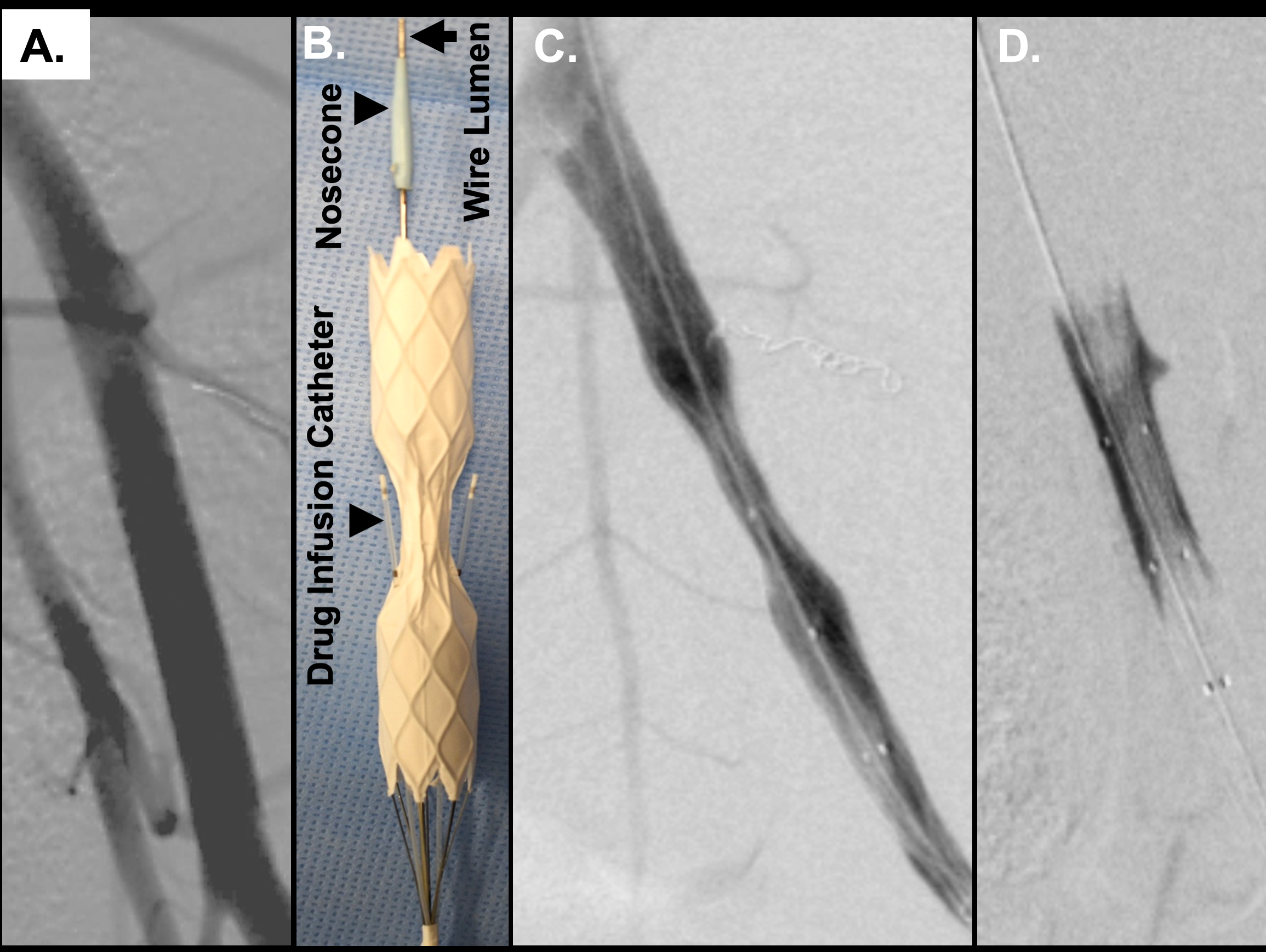
Current Drug-Coated Balloons (DCB) primarily deliver drugs in crystalline form, which can lead to distal embolization and inefficient vessel wall uptake due to luminal wash-off. DCB are also occlusive of perfusion. We evaluated a novel retrievable drug infusion stentgraft (RDIS), designed for continuous distal perfusion while delivering liquid Paclitaxel to an isolated segment of the iliac artery (Figure 1). We hypothesized that liquid phase delivery would result in superior transmural drug penetration.

Methods
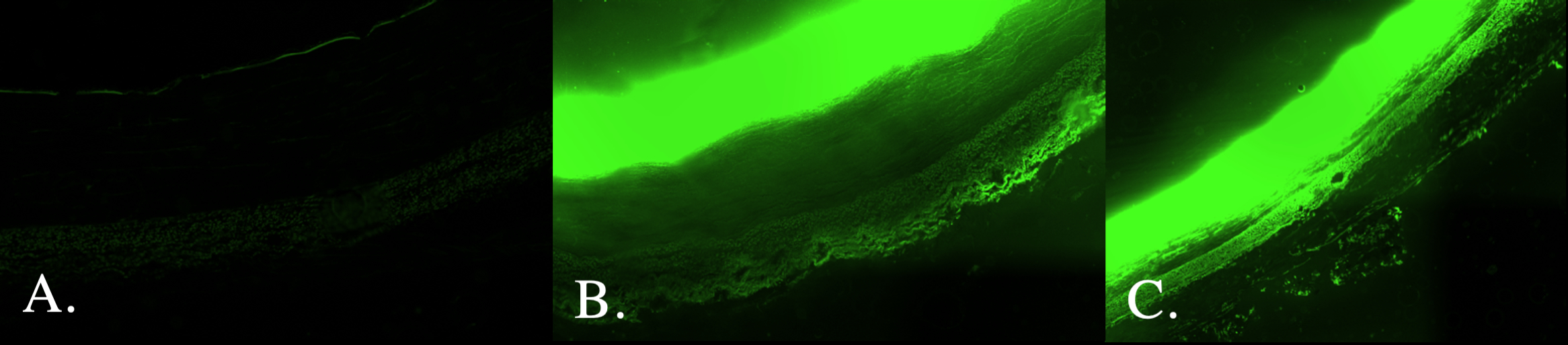
Two Yorkshire pigs underwent fluorescent paclitaxel drug delivery to one iliac artery using RDIS followed by vessel explant at either 3 or 10 minutes (Figure 2). To quantify drug delivery by vessel layer, additional animals underwent Paclitaxel administration by DCB or our RDIS followed by vessel explant at 1 hour (n=2) and 24 hours (n=2). Laser capture dissection of histologic specimens was used to isolate 1) intima and adjacent cell layers 2) media, and 3) adventitia, using mass spectrometry (MS) to quantify the amount of Paclitaxel in ng/mm3 of tissue for these different delivery modalities. Separate animals underwent balloon injury with drug delivery by the RDIS (n=6) or DCB (n=5) followed by vessel extraction at one month. Lastly, animals underwent RDIS delivery of fluorescent sirolimus followed by vessel explant at 3 (n=3) and 8 minutes (n=3).

Results
Fluorescent microscopy showed liquid delivery of paclitaxel through the vessel by 10 minutes and sirolimus at 8 minutes. MS of tissue at 1 hour compared to 24 hours revealed an average concentration drop after DCB of 85% (3,323 vs 491 ng/mm3, respectively) within the intima. MS of the media showed an average 2.2-fold increase in paclitaxel concentration after RDIS as compared to DCB at 24 hours (2.6 vs 1.2 ng/mm3, respectively). Luminex analysis of tissue 1-month following treatment showed a decreased expression of pro-inflammatory IL-18 in vessels treated with the RDIS vs DCB (3,695 vs 10,506 ng/mL, respectively; p=0.003).

Conclusion
The RDIS platform overcomes the "wash-off" effect seen with crystalline DCB coatings by providing stable, liquid-phase delivery to the deeper vessel layers. By achieving superior medial drug concentration and significantly reducing long-term inflammatory markers (IL-18), the RDIS represents a promising advancement in the treatment of vascular restenosis while preserving perfusion during drug transfer and offers promise for new agents (sirolimus).
  • Gage, Daniel  ( The Ohio State University , Columbus , Ohio , United States )
  • Stafford, Jordan  ( The Ohio State University , Columbus , Ohio , United States )
  • Kenawy, Dahlia  ( The Ohio State University , Columbus , Ohio , United States )
  • Amari, Foued  ( The Ohio State University , Columbus , Ohio , United States )
  • Tillman, Bryan  ( The Ohio State University , Columbus , Ohio , United States )
  • Author Disclosures:
    Daniel Gage: DO NOT have relevant financial relationships | Jordan Stafford: No Answer | Dahlia Kenawy: DO NOT have relevant financial relationships | Foued Amari: DO NOT have relevant financial relationships | Bryan Tillman: No Answer
Meeting Info:
Session Info:

01. Poster Session 1 & Reception

Wednesday, 05/13/2026 , 06:00PM - 08:00PM

Poster

More abstracts on this topic:
Nitric Oxide Releasing Bionanomatrix Gel For Dialysis Arteriovenous Fistula Maturation

Jun Ho-wook, Hwang Patrick, Somarathna Maheshika, Chen Jun, Sherwood Jennifer, Brott Brigitta, Lee Timmy

Chemotherapy Induced Cardiotoxicity Analysis of Oxaliplatin on Human Heart Organoids Using Optical Coherence Tomography

Jose Joven, Paul Ratul, Wang Fei, Du Junwei, Berezin Mikhail, Zhou Chao

More abstracts from these authors:
Proinflammatory Changes in a Porcine Elastin Injury Model of Aneurysm

Gage Daniel, Stafford Jordan, Kenawy Dahlia, Amari Foued, Tillman Bryan

The Role of Pro-Inflammatory Monocyctes in Early Aortic Aneurysm Formation after Elastase Injury

Gage Daniel, Stafford Jordan, Kenawy Dahlia, Marshall Jordin, Amari Foued, Tillman Bryan

You have to be authorized to contact abstract author. Please, Login
Not Available