
Logo

American Heart Association

  9
  0


Final ID: Fri155

A Novel Adenosine A2A Receptor Agonist Potently Inhibits Platelet Signaling and Prevents Arterial Thrombosis

Abstract Body: Introduction
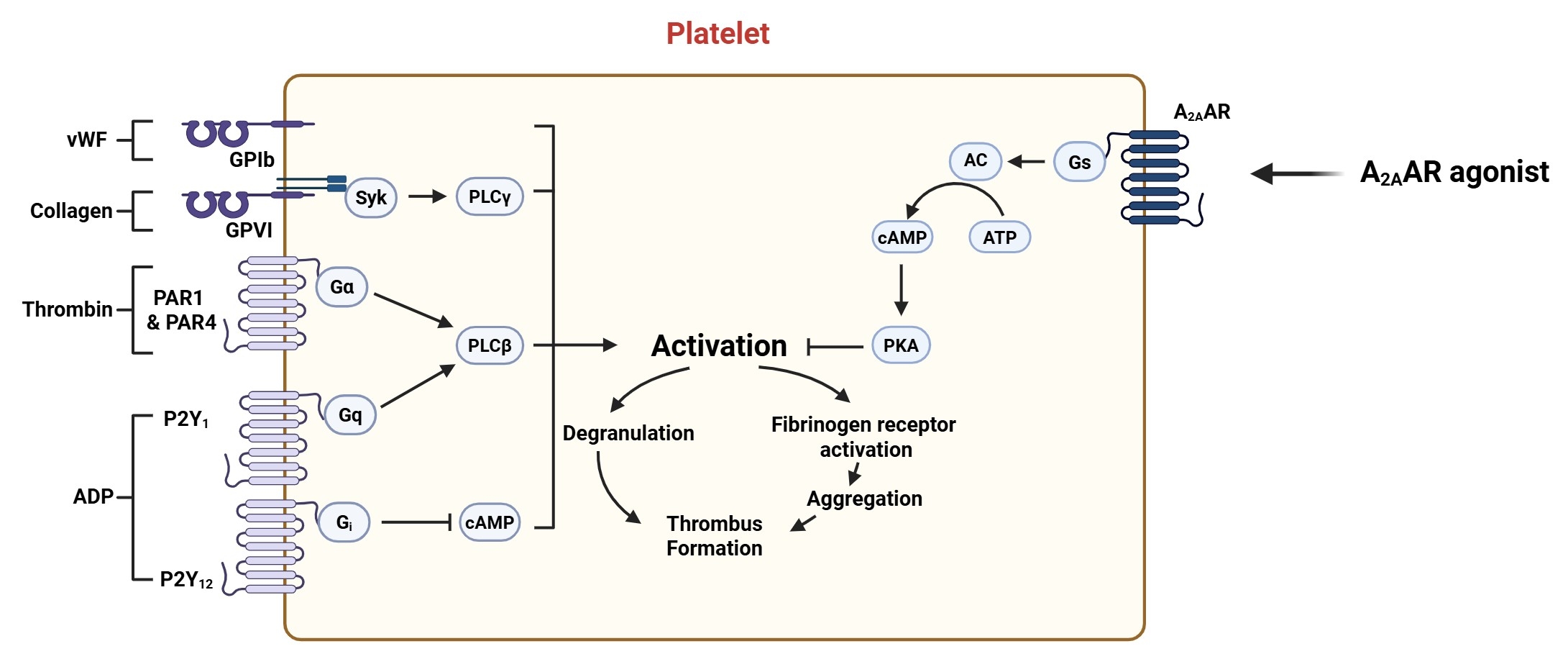
Arterial thrombosis driven by platelet activation is the central pathological mechanism underlying myocardial infarction and ischemic stroke. Elevation of intraplatelet cyclic adenosine monophosphate (cAMP) is a critical endogenous mechanism that restrains platelet activation. Although the adenosine A2A receptor is a dominant regulator of this pathway in platelets, the clinical application of existing agonists is hindered by limited potency and poor pharmacokinetics.

Hypothesis
We assessed the hypothesis that a novel high affinity adenosine A2A receptor agonist inhibits platelet activation via the cAMP–protein kinase A (PKA) pathway and prevents arterial thrombosis in vivo without impairing physiological hemostasis.

Methods
Human platelet-rich plasma and washed platelets were used to evaluate aggregation, cAMP levels, and calcium mobilization. Binding affinity was determined by radioligand assays (n = 3 to 4). In vivo antithrombotic efficacy was assessed using a ferric-chloride induced carotid artery thrombosis model, and hemostasis was evaluated by tail bleeding assays in mice (n = 6 per group).

Results
The lead agonist bound the human A2A receptor with high affinity (Ki = 7.4 ± 0.8 nM) and inhibited adenosine diphosphate-induced human platelet aggregation with a half maximal inhibitory concentration (IC50) of 11.8 ± 4.3 nM. This potency was superior to that of the P2Y12 receptor inhibitor ticagrelor (IC50 = 21.5 ± 9.8 nM). Treatment with 10 nM of the agonist increased intraplatelet cAMP levels by 204%, corresponding to an increase from 2.5 ± 0.1 to 5.1 ± 0.3 pmol/108 platelets (n = 3). This signaling induced PKA-dependent phosphorylation of vasodilator stimulated phosphoprotein and inositol trisphosphate receptor and significantly attenuated calcium mobilization. Consequently, integrin αIIbβ3 activation and fibrinogen binding were suppressed. Oral administration of 10 mg/kg of the agonist significantly delayed carotid artery occlusion compared with vehicle (16.6 ± 3.3 vs. 7.6 ± 0.5 min, n = 6, p = 0.0005) without prolonging bleeding time. The oral bioavailability was 5.3% (n = 4).

Conclusions
In conclusion, this novel adenosine A2A receptor agonist suppresses platelet activation through cAMP–PKA signaling and prevents arterial thrombosis without compromising hemostasis, supporting its potential as a next-generation antithrombotic agent with an improved safety profile.
  • Oh, Eun Bee  ( Seoul National University , Seoul , Korea (the Republic of) )
  • Kim, Seung Woo  ( Seoul National University , Seoul , Korea (the Republic of) )
  • Park, Ji Won  ( Seoul National University , Gwanak-Gu , Korea (the Republic of) )
  • Chang, Tong-shin  ( Seoul National University , Seoul , Korea (the Republic of) )
  • Jeong, Lak Shin  ( Seoul National University , Seoul , Korea (the Republic of) )
  • Author Disclosures:
    Eun Bee Oh: DO NOT have relevant financial relationships | Seung Woo Kim: No Answer | Ji Won Park: DO NOT have relevant financial relationships | Tong-Shin Chang: No Answer | Lak Shin Jeong: No Answer
Meeting Info:
Session Info:

15. Poster Session 3 & Reception

Friday, 05/15/2026 , 05:00PM - 07:00PM

Poster

More abstracts on this topic:
A Selective Agonist of the Beta 2 Retinoic Acid Receptor Reduces Necrosis, Lipid Peroxidation, and Oxidative Stress in Doxorubicin-induced Cardiotoxicity

Varzideh Fahimeh, Jankauskas Stanislovas, Kansakar Urna, Tang Xiao-han, Gudas Lorraine, Levi Roberto, Gambardella Jessica, Santulli Gaetano

Anticoagulation versus Antiplatelets in Coronary Artery Ectasia and Acute Coronary Syndrome: A Systematic Review and Meta-analysis

Hernandez-pastrana Sarai, Latapi Ruiz Esparza Ximena, Martignoni Felipe, Araiza Diego, Doma Mohamed, Fatima Syeda Rubab, Hemdanieh Maya, Kritya Mangesh, Huang Wilbert, Naji Zahra, Lingamsetty Shanmukh Sai Pavan, Gewehr Douglas

More abstracts from these authors:
You have to be authorized to contact abstract author. Please, Login
Not Available