Targeting Oxidative Stress Via NAD+ Modulation to Mitigate Microvascular Disease
Abstract Body: Microvascular disease (MVD) contributes substantially to morbidity and mortality in diabetes, hypertension, and heart failure. Despite its broad impact, current treatments fail to target common molecular mechanisms driving endothelial dysfunction in MVD, which is characterized by impaired blood flow, endothelial barrier dysfunction, microthrombosis, and capillary rarefaction. Emerging evidence implicates excess mitochondrial reactive oxygen species (mtROS) as a central driver of progressive endothelial dysfunction and microvascular injury. This research investigates whether nicotinamide riboside (NR), vitamin B3 analogue and NAD+ precursor that activates SIRT3, can reduce oxidative stress to restore endothelial homeostasis and prevent MVD progression. SIRT3 activation limits mtROS through activation of superoxide dismutase 2 (SOD2). We hypothesize that NR-mediated enhancement of NAD+/SIRT3 signaling attenuates oxidative stress and microvascular remodeling.
We will (1) develop a patient-derived, three-dimensional biomimetic microfluidic model of diabetic capillary disease to assess the effects of NR on endothelial integrity, inflammatory signaling, and oxidative stress using cellular assays, histology, immunohistochemistry, dextran perfusion, and transcriptomic profiling; and (2) determine the effect of NR on oxidative stress, inflammation, endothelial barrier function, and microvascular remodeling in db/db diabetic mice. This integrative approach will define NR-responsive pathways across in vivo, in vitro, and patient-relevant systems.
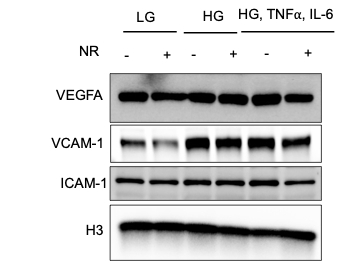
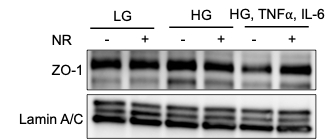
Preliminary data show that a diabetic microenvironment (30 mM glucose, 1 ng/mL TNF, and 1 ng/ml IL-6) reduces levels of endothelial junctional protein ZO-1 while increasing inflammatory mediators ICAM-1 and VCAM-1 and angiogenic mediator VEGFA in human aortic endothelial cells; these changes are prevented with NR treatment (Figs. 1-2). Additionally, in vivo cardiac microvessel (CD31+, 5-50 µm diameter) density trends lower in db/db mice (p=0.13) and is preserved with dietary NR (p=0.23) (n=3-6 mice/genotype/treatment group).
Together, these studies highlight the therapeutic potential of NAD+ modulation to mitigate MVD by preventing endothelial barrier dysfunction, inflammation, and capillary rarefaction. The findings are expected to advance understanding of mitochondrial dysfunction in MVD and provide critical preclinical evidence supporting NAD+/SIRT3 targeting for prevention and treatment of microvascular complications.
Kaw, Anita
(
Emory University School of Medicine
, Decatur , Georgia , United States )
Yu, Tao
(
emory university
, Marietta , Georgia , United States )
Hansen, Laura
(
EMORY UNIVERSITY
, Atlanta , Georgia , United States )
Author Disclosures:
Anita Kaw:DO NOT have relevant financial relationships
| Tao Yu:DO NOT have relevant financial relationships
| Laura Hansen:DO NOT have relevant financial relationships
Tahir Muhammad Waseem, Saleem Junaid, Tahir Zubia, Hamayal Muhammad, Ahmad Amna, Malik Junaid Mehmood, Nauman Haider Dr Muhammad, Ashraf Arslan, Kashif Mohammad