
Logo

American Heart Association

  3
  0


Final ID: Fri154

Physiologically Shear-conditioned Endothelialization Improves patency in Vascular Reconstruction

Abstract Body: Introduction: Tissue-engineered vascular grafts (TEVGs) represent a promising alternative for vascular reconstruction; however, thrombosis, stenosis, and maladaptive remodeling continue to limit clinical translation, largely due to the absence of a functional endothelial lining.
Hypothesis: To address this challenge, we developed a ready-to-use endothelialization strategy in which TEVGs are preconditioned under physiologically relevant shear stress tailored to specific circulatory environment.
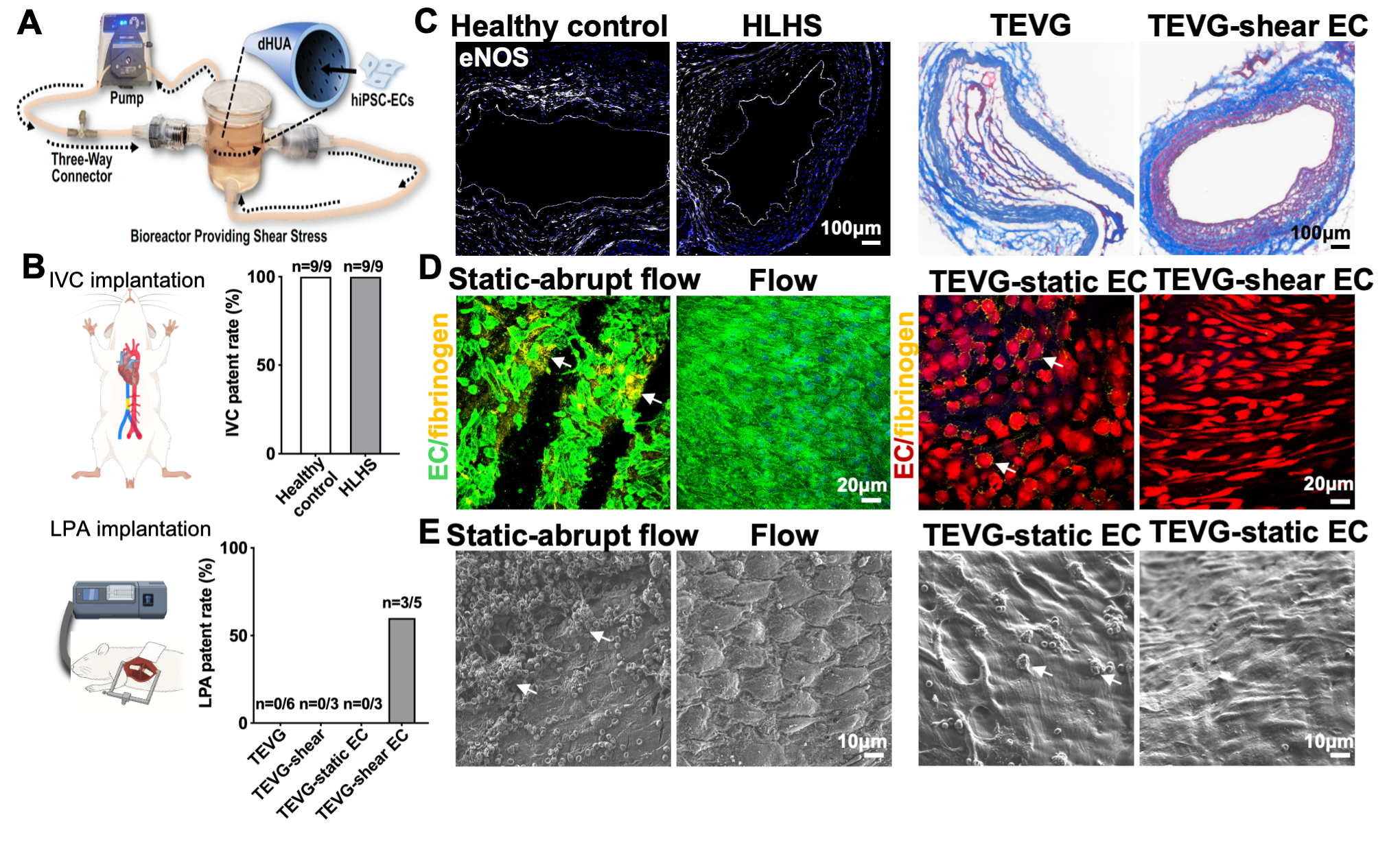
Methods: Endothelial cells (ECs) were derived from autologous human induced pluripotent stem cells (hiPSCs) and subjected to a ramp-up shear conditioning protocol exceeding physiological levels to promote functional maturation and resistance to perioperative flow disturbance (Fig. A). Endothelialized TEVGs were evaluated in rat inferior vena cava (IVC) and left pulmonary artery (LPA) implantation models.
Results: At one month post-implantation, shear-conditioned endothelialized TEVGs demonstrated significantly improved patency and favorable graft remodeling in both models compared with controls (Fig. B-D). In vitro analyses showed that shear-conditioned endothelium exhibited enhanced resistance to hemodynamic stress, along with improved anti-inflammatory and antithrombotic properties (Fig. E-F). In the IVC model, hiPSC-derived ECs from patients with hypoplastic left heart syndrome (HLHS) showed partial restoration of mechanosensitive NOTCH1 signaling, previously reported to be downregulated in HLHS, and achieved in vivo performance comparable to healthy controls following shear conditioning. In the LPA model, shear-conditioned endothelialized TEVGs maintained patency with robust recellularization, whereas control grafts developed severe stenosis.
Conclusions: Physiologically shear-conditioned endothelialization enhances TEVG performance across distinct vascular environments, supporting its translational potential to improve outcomes in diverse vascular reconstruction settings.
  • Zhang, Wei  ( Yale Cardiovascular Research Center , New Haven , Connecticut , United States )
  • Floodia, Saba  ( Yale Cardiovascular Research Center , New Haven , Connecticut , United States )
  • Qyang, Yibing  ( Yale University , New Haven , Connecticut , United States )
  • Author Disclosures:
    Wei Zhang: DO NOT have relevant financial relationships | Saba Floodia: No Answer | Yibing Qyang: No Answer
Meeting Info:
Session Info:

15. Poster Session 3 & Reception

Friday, 05/15/2026 , 05:00PM - 07:00PM

Poster

More abstracts on this topic:
Chemically Modified LncRNA LEENE Promotes Angiogenesis And Ischemic Recovery in Mouse Models

Malhi Naseeb, Luo Yingjun, Tang Xiaofang, Li Hongye, Sun Jiawei, Liu Xuejing, Wang Mark Kuei-chun, Cooke John, Chen Zhen

Comparison of Short-Term Outcomes after Lower Extremity Bypass versus Peripheral Vascular Intervention in Patients with Chronic Limb-Threatening Ischemia and Diabetes Mellitus

Aggarwal Abhinav, Romain Gaelle, Callegari Santiago, Cleman Jacob, Smolderen Kim, Mena-hurtado Carlos

You have to be authorized to contact abstract author. Please, Login
Not Available