
Logo

American Heart Association

  3
  0


Final ID: Wed156

D-Flate: A Soft Robotic and Sensor-Guided Programmable Compression Sleeve for Vascular and Lymphatic Therapy

Abstract Body: Introduction
Compression therapy is central to the management of lymphedema and phlebolymphedema. Current pneumatic compression devices are bulky, tethered, and difficult to don. Non-pneumatic alternatives offer mobility but actuate slowly. Manual straps lead to inconsistent pressure distribution and lack adaptability to changes in limb girth over time during therapy. Furthermore, all devices operate with a single actuation mode and three fixed pressure levels. The impact of actuation pattern type on venous outflow has not been well investigated.
Hypothesis
We hypothesize that: 1) the sequence of segment actuation plays a more significant role in enhancing venous flow than changes in pressure level alone, and 2) varying actuation patterns without altering pressure can yield distinct and potentially improved venous flow outcomes.
Methods
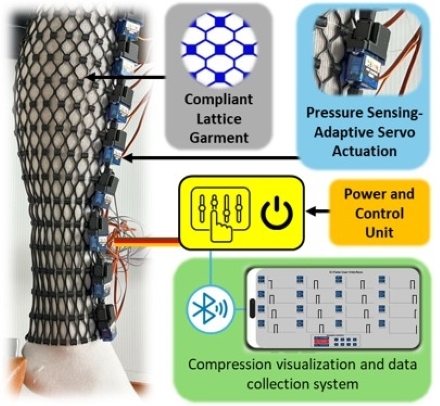
D-Flate (Figure 1), is a lightweight, mobile compression device featuring a compliant metamaterial sleeve with cable-driven actuation segments. Each segment is tensioned by a servo motor and its pressure is regulated by a sensor. Sensor feedback enables consistent and adaptive compression control during donning and therapy. A microcontroller generates peristaltic compression sequences using four programmable parameters: number of compressed segments, number of traveling waves, number of segments advanced per step, and compression magnitude.
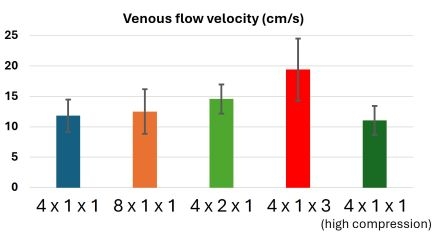
An IRB-approved clinical study was conducted to evaluate the effect of parameters on venous outflow. Healthy participants (n=10) had D-Flate applied to the lower leg. Effects of five different compression waveforms on popliteal venous flow speed were recorded via duplex ultrasound imaging (GE Logiq E9) and compared to respirophasic baseline.
Results
All compression waveforms produced a statistically significant increase (p < 0.05) in popliteal venous flow compared to baseline respirophasic flow (Figure 2). Among the tested sequences, the compression mode using a higher number of segments advanced per step resulted in the greatest increase in venous flow velocity.
Conclusions
D-Flate introduces a novel compression strategy using programmable waveforms beyond those offered by current devices. Our findings demonstrate that tailored and optimized actuation patterns enhance venous flow in healthy subjects. D-Flate is a novel promising technology to improve venous return and potentially lymphatic drainage. Further evaluation among patients and comparing to current devices is warranted.
  • Dikici, Yusuf  ( Case Western Reserve University , Cleveland , Ohio , United States )
  • Lambert, Gianna  ( Case Western Reserve University , Cleveland , Ohio , United States )
  • Gilliam, Cameron  ( Case Western Reserve University , Cleveland , Ohio , United States )
  • Pacheco, Hernan  ( University Hospitals , Cleveland , Ohio , United States )
  • Blackburn, Gary  ( Case Western Reserve University , Cleveland , Ohio , United States )
  • Akkus, Ozan  ( Case Western Reserve University , Cleveland , Ohio , United States )
  • Harth, Karem  ( University Hospitals , Cleveland , Ohio , United States )
  • Author Disclosures:
    Yusuf Dikici: DO NOT have relevant financial relationships | Gianna Lambert: No Answer | Cameron Gilliam: No Answer | Hernan Pacheco: DO NOT have relevant financial relationships | Gary Blackburn: No Answer | Ozan Akkus: DO have relevant financial relationships ; Research Funding (PI or named investigator):Case Coulter Foundation:Active (exists now) | Karem Harth: DO have relevant financial relationships ; Consultant:Medtronic:Active (exists now) ; Advisor:MedVasc:Active (exists now) ; Consultant:Cook:Active (exists now) ; Consultant:Inquis:Active (exists now) ; Consultant:Boston Scientific:Active (exists now) ; Speaker:GE:Active (exists now) ; Advisor:VVT :Active (exists now) ; Consultant:Stryker/Inari:Active (exists now)
Meeting Info:
Session Info:

01. Poster Session 1 & Reception

Wednesday, 05/13/2026 , 06:00PM - 08:00PM

Poster

More abstracts on this topic:
You have to be authorized to contact abstract author. Please, Login
Not Available