PIP2 metabolism as a novel therapeutic target for reverse cholesterol transport and atherosclerosis.
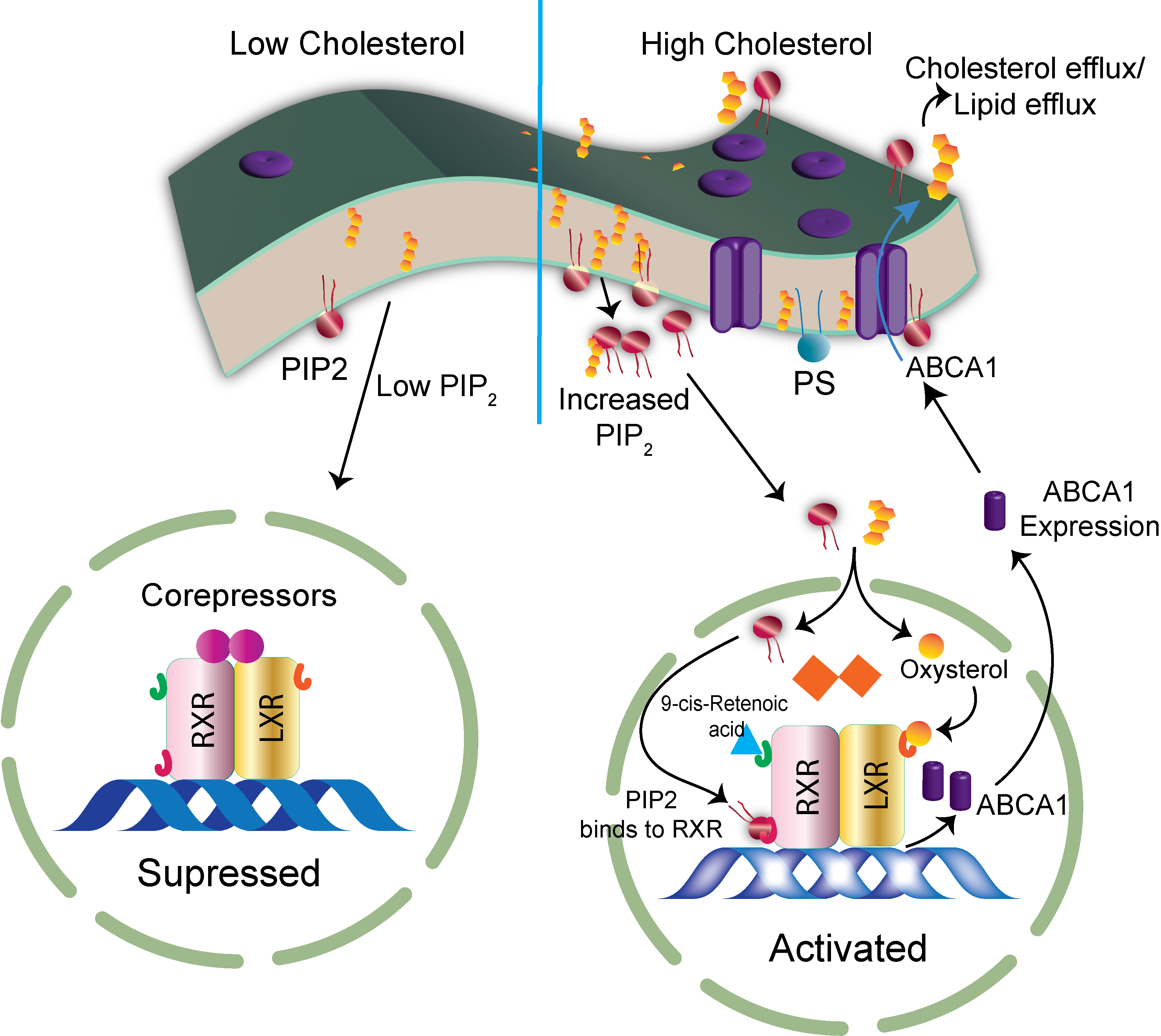
Abstract Body: Introduction: Reverse cholesterol transport (RCT) is impaired by inflammation and is defective in advanced human atherosclerotic plaques. Objective: To determine the mechanism by which Phosphatidylinositol-4,5-bisphosphate (PIP2) regulates in vivo cholesterol homeostasis and promotes RCT. Methods: Human macrophages/hepatocytes/iPSC-derived liver organoids, and WT C57BL/6J mice were used to determine how PIP2 regulates in vivo cholesterol homeostasis and RCT. Cholesterol was depleted by Simvastatin/cyclodextrin or supplemented via AcLDL/cyclodextrin-cholesterol. PIP2 was depleted by Crispr-Cas9 KO of PIP2 biosynthetic enzyme PIP5k1a or supplemented via PIP2 liposomes or adeno-associated-virus expressing PIP5k1a. High-resolution STED, FRAP, SPR, FRET, nanotube formation assay, and purified WT or mutant RXR proteins were used to demonstrate direct PIP2-RXR interaction. Results: Cholesterol loading increased PIP2 (p<0.01 by t-test), while depletion reduced PIP2 in human/mouse macrophages (p<0.005 by t-test). Cholesterol loading increased nuclear PIP2 (N=5, mean±SD, p<0.005). PIP2 supplementation increased, while PIP2 depletion decreased, ABCA1 mRNA and protein in human macrophages/hepatocytes (~46-59% change, N=5, mean±SD, p<0.05, p<0.005 by t-test). A novel PIP2 binding site allows PIP2 to bind RXR (Kd=1.65 ± 0.3 mM by SPR), and PIP2 promotes membrane nanotube formation, allowing interaction with RXR. Point mutations in PIP2-binding domain abolished RXR-PIP2 binding. Cholesterol loading increased nuclear PIP2 and ABCA1 expression in hiPSC-derived liver organoids. Importantly, CRISPR-Cas9 deletion of PIP5K1a in human macrophages/hepatocytes blocked cholesterol-induced ABCA1 expression (~ 80% reduction vs. WT cells, n=3). PIP5K1a transgenic mice showed a marked increase in hepatic/intestinal ABCA1 protein (>2-3.5-fold increase, N=4-9, mean±SD, with **p<0.01 by unpaired t-test), and ABCA1 mRNA (*p<0.05 by t-test). PIP5K1a-transgenic mice showed markedly higher RCT to plasma (increase of 1.4-fold at 24 h, 2.1-fold at 48 h, and 3-fold at 72 h) and liver (2.8-fold increase) vs. control. ABCA1 expression was higher in transgenic PIP5K1a rAAV-PCSK9 hyperlipidemic mouse, with atherosclerosis studies underway. Conclusion: Cholesterol loading increases nuclear PIP2, allowing PIP2-RXR interaction. PIP2 is essential for cholesterol-induced ABCA1 expression. PIP2 induces liver and intestinal ABCA1. PIP2 is a novel therapeutic target for enhancing cholesterol efflux from body.
Gulshan, Kailash
(
Cleveland State University
, Cleveland , Ohio , United States )
Khan, Mariam
(
Cleveland State University
, Cleveland , Ohio , United States )
Author Disclosures:
Kailash Gulshan:DO NOT have relevant financial relationships
| Mariam Khan:No Answer