
Logo

American Heart Association

  15
  0


Final ID: Fri064

Toll-like receptor 4 signaling coordinates fibrinolysis and vein wall remodeling during venous thrombus resolution

Abstract Body: Background
Toll-like receptor 4 (TLR4) signaling via innate immune cells has been implicated in thromboinflammation, but the in vivo role of TLR4 in venous thrombus resolution is not fully investigated.
Objectives
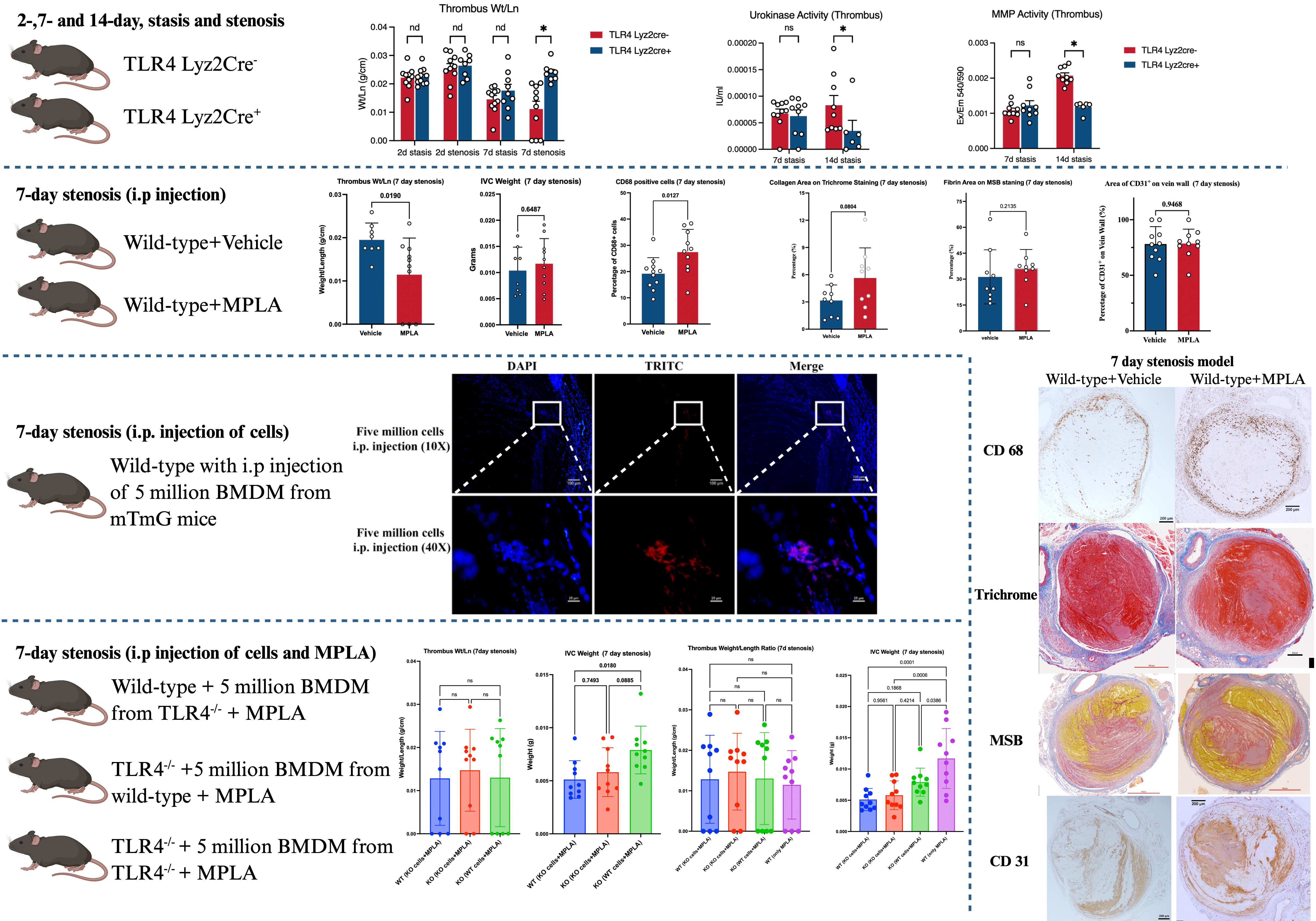
Based on prior observations that monophosphoryl lipid A (MPLA) enhances expression of fibrinolytic and inflammatory mediators in macrophages in vitro and that urokinase activity is reduced in TLR4fl/flLyz2-Cre+ mice in vivo, we hypothesized that monocyte/macrophage (MO/Mφ) TLR4 signaling regulates thrombus resolution and vein wall remodeling.
Methods
Venous thrombosis was induced using inferior vena cava (IVC) stenosis and stasis models in wild-type, global TLR4 knockout (TLR4-/-), and TLR4fl/flLyz2-Cre+/- mice. Thrombus burden, fibrinolytic activity, inflammatory signaling, and vein wall remodeling were assessed by histologic, immunohistochemical, and molecular analyses. Systemic TLR4 activation was achieved by intraperitoneal administration of MPLA (20 µg/day, total 40 µg). For adoptive transfer experiments, bone marrow–derived monocytes/macrophages (BMDMs) from wild-type or TLR4-/- donors were administered intraperitoneally before and after thrombosis induction to assess their functional contribution within distinct host backgrounds.
Results
Impaired MO/Mφ TLR4 signaling was associated with significantly reduced intrathrombus urokinase and matrix metalloproteinase activity and delayed thrombus resolution, reflected by an increased thrombus weight-to-length ratio in the 7-day IVC stenosis model (p <0.05). Systemic TLR4 activation with MPLA enhanced thrombus resolution (p=0.019) but was accompanied by increased macrophage accumulation (p=0.013) and collagen content (p=0.080) in wild-type mice. Adoptive transfer experiments demonstrated that wild-type hosts receiving TLR4-/- MO/Mφs exhibited significantly lower IVC weight than TLR4-/- hosts receiving wild-type MO/Mφs (p=0.018).
Conclusions
TLR4 signaling exerts dual distinct roles during venous thrombus resolution, promoting fibrinolytic thrombus clearance while concurrently shaping inflammatory and fibrotic remodeling of the vein wall. These findings establish intraperitoneally administered MO/Mφs can migrate to venous thrombi and functionally influence post-thrombotic remodeling. Although pharmacologic TLR4 activation enhances thrombus resolution, it also augments vascular inflammation and fibrosis, highlighting the need for cell-specific or thrombus-targeted immunomodulatory strategies.
  • Zhao, Yanqing  ( University of Michigan Health , Ann Arbor , Michigan , United States )
  • Kumar, Kiran  ( University of Michigan , Ann Arbor , Michigan , United States )
  • Moreno, Oscar  ( University of Michigan Health , Ann Arbor , Michigan , United States )
  • Eggleston, Trevin  ( University of Michigan , Ann Arbor , Michigan , United States )
  • Luke, Catherine  ( University of Michigan , Ann Arbor , Michigan , United States )
  • Henke, Peter  ( University of Michigan Health , Ann Arbor , Michigan , United States )
  • Moore, Bethany  ( University of Michigan Health , Ann Arbor , Michigan , United States )
  • Gallagher, Katherine  ( University of Michigan Health , Ann Arbor , Michigan , United States )
  • Obi, Andrea  ( University of Michigan Health , Ann Arbor , Michigan , United States )
  • Author Disclosures:
    Yanqing Zhao: DO NOT have relevant financial relationships | Kiran Kumar: No Answer | Oscar Moreno: DO NOT have relevant financial relationships | Trevin Eggleston: No Answer | Catherine Luke: DO NOT have relevant financial relationships | Peter Henke: DO NOT have relevant financial relationships | Bethany Moore: DO NOT have relevant financial relationships | Katherine Gallagher: DO NOT have relevant financial relationships | Andrea Obi: DO have relevant financial relationships ; Research Funding (PI or named investigator):Surmodics:Active (exists now) ; Research Funding (PI or named investigator):Medtronic:Active (exists now)
Meeting Info:
Session Info:

15. Poster Session 3 & Reception

Friday, 05/15/2026 , 05:00PM - 07:00PM

Poster

More abstracts on this topic:
A mechanism whereby SGLT2 inhibitor dapagliflozin reverses cardiac diastolic dysfunction in a model of HFpEF

Liu Man, Liu Hong, Kang Gyeoung-jin, Kim Eunji, Neumann Mitchell, Johnson Madeline, Murikinati Ruthvika, Dudley Samuel

An innate immune component in hypertension-induced cardiac dysfunction
Christoph Mora, Katherine Deck, Yunmeng Liu, Lance Benson, Tonya Rafferty, & Shengyu Mu

Mora Christoph, Deck Katherine, Liu Yunmeng, Mu Shengyu, Benson Lance, Guo Yunping

More abstracts from these authors:
JAK/STAT Inhibition Modulates Endothelial Mixed Lineage Leukemia 1 (Kmt2a/MLL1) Induction and Immunothrombosis During SARS-CoV-2 Infection

Parchment Nathaniel, Moreno Oscar, Kumar Kiran, Sharma Sriganesh, Rocco Sabrina, Luke Catherine, Gallagher Katherine, Henke Peter, Obi Andrea

The Evaluation of Anti-Fibrotic and Anti-Thrombotic Effects of an Oral Galectin-3 Inhibitor in a Mouse Model of Venous Thrombosis

Pandey Arnav, Moreno Oscar, Pellerito Mattea, Luke Catherine, Obi Andrea, Henke Peter, Myers Daniel

You have to be authorized to contact abstract author. Please, Login
Not Available