
Logo

American Heart Association

  10
  0


Final ID: Fri144

Implementation of a High-Potency P2Y12 Inhibitor Protocol Did Not Increase Discharge Use After PCI for ACS at a High-Volume Tertiary Center

Abstract Body: Introduction: Guidelines recommend higher-potency P2Y12 receptor inhibitors over clopidogrel in ACS patients undergoing PCI. Real-world adoption varies. A protocol favoring higher-potency P2Y12 inhibitors was implemented at a high-volume tertiary PCI center serving a catchment population of approximately 2.2 million people.

Hypothesis: We assessed the hypothesis that protocol implementation would increase discharge prescription of higher-potency P2Y12 inhibitors among ACS patients treated with PCI.

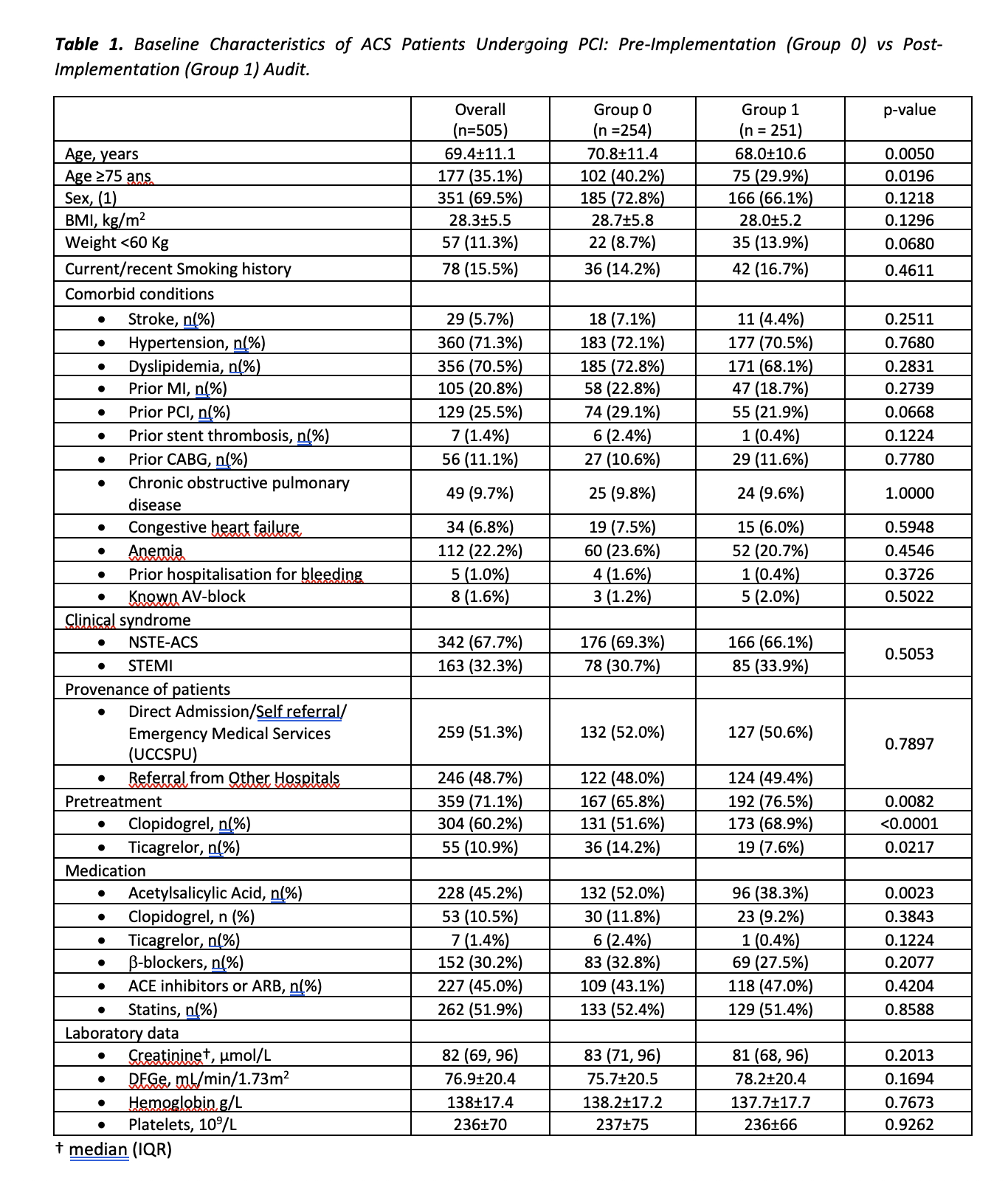
Methods: We conducted a retrospective single-center audit of consecutive adults with ACS undergoing PCI before and after protocol implementation. Patients were assigned to pre-implementation (February 2020 to May 15, 2021; 254 patients) or post-implementation (May 16 to November 2021; 251 patients) cohorts. Patients with stable coronary disease or requiring anticoagulation were excluded. Ticagrelor was the only higher-potency P2Y12 inhibitor available in Canada at the time. The primary outcome was discharge prescription of higher-potency P2Y12 inhibitors.

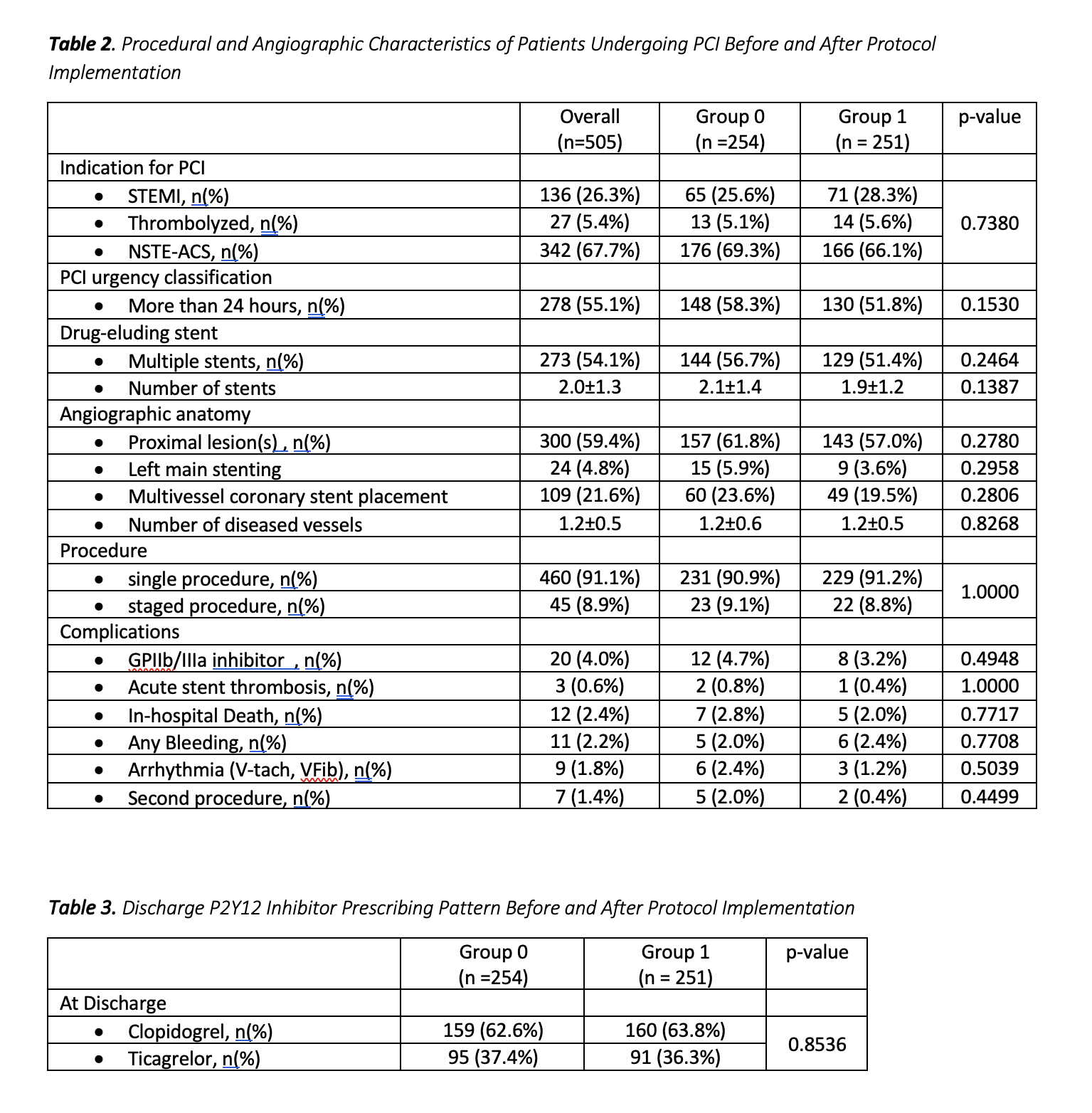
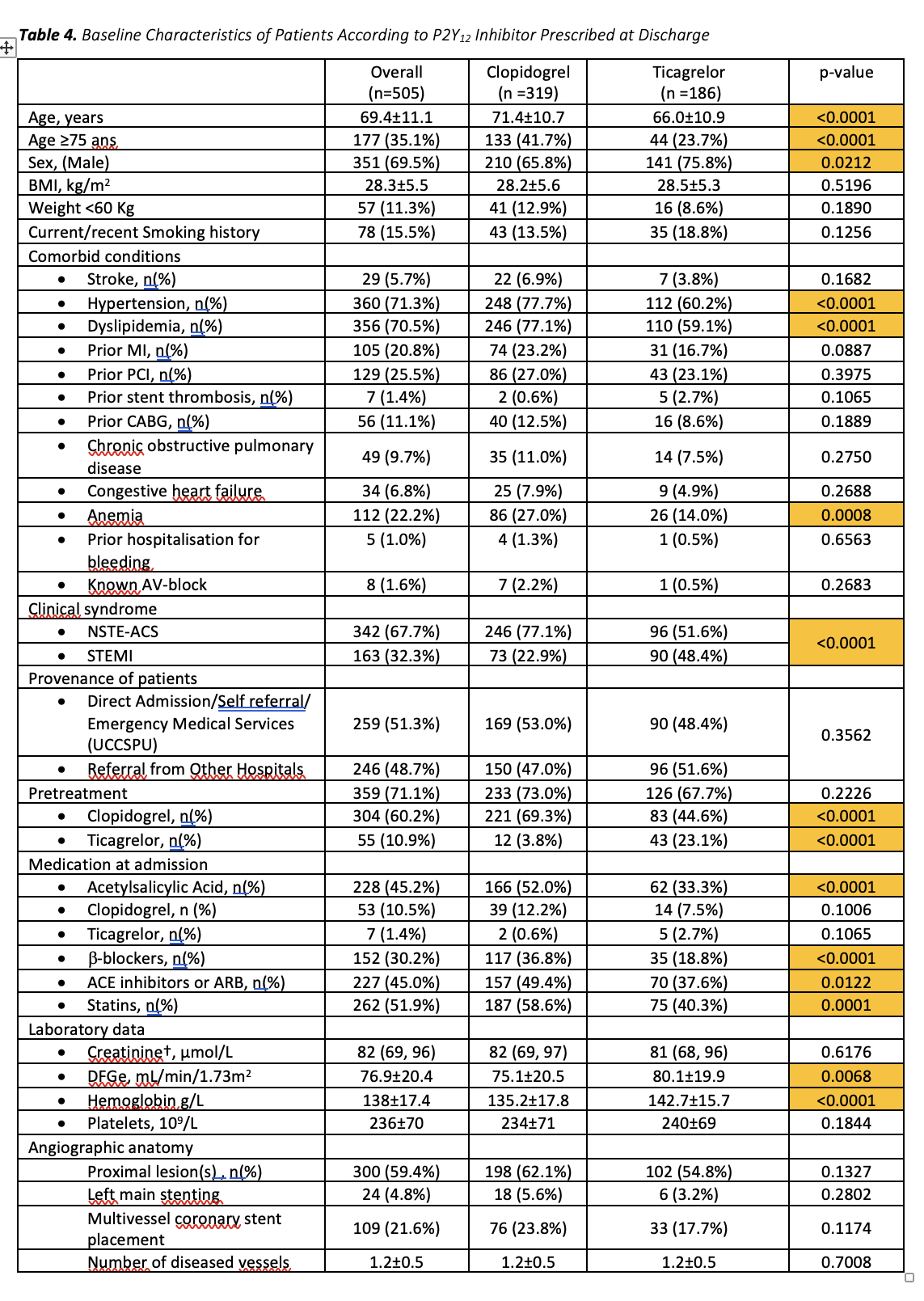
Results: Among 505 patients (mean age 69.4 ± 11.1 years; 351 [69.5%] men), discharge prescription of higher-potency P2Y12 inhibitors was 37.4% (95/254) pre- and 36.3% (91/251) post-implementation. Patients receiving higher-potency therapy were younger (66.0 vs 71.4 years; p<0.0001), more often men (75.8% vs 65.8%; p=0.021), and more likely to present with STEMI (48.4% vs 22.9%; p<0.0001). Traditional cardiovascular risk factors such as hypertension (60.2% vs 77.7%; p<0.0001), dyslipidemia (59.1% vs 77.1%; p<0.0001), and anemia (14.0% vs 27.0%; p=0.0008) were less common among higher-potency recipients. Baseline laboratory values showed higher eGFR (80.1 ± 19.9 vs 75.1 ± 20.5 mL/min/1.73 m2; p=0.0068) and hemoglobin (142.7 ± 15.7 vs 135.2 ± 17.8 g/L; p<0.0001) in the higher-potency P2Y12 inhibitor group. Other comorbidities—including prior MI, PCI, CABG, stroke, COPD, heart failure, prior stent thrombosis, prior bleeding, and AV block—were comparable between groups.

Conclusions: Protocol implementation did not increase use of higher-potency P2Y12 inhibitors at discharge after PCI for ACS. These findings suggest that the perceived risk of adverse outcomes is a key determinant of clinical decision-making and warrants further investigation. In this assessment of contemporary practice in a tertiary care center, opportunities remain to further optimize evidence-based antiplatelet therapy.
  • Pavlovic, Ana  ( Montreal University , Montreal , Quebec , Canada )
  • Jean, Guillaume  ( Quebec's Heart and Lung Institute , Quebec , Quebec , Canada )
  • Cieza, Tomas  ( Quebec Heart and Lung Institute , Québec , Quebec , Canada )
  • Dery, Jean-pierre  ( Quebec Heart and Lung Institute , Quebec , Quebec , Canada )
  • Author Disclosures:
    Ana Pavlovic: DO NOT have relevant financial relationships | Guillaume Jean: No Answer | Tomas Cieza: DO NOT have relevant financial relationships | Jean-Pierre Dery: No Answer
Meeting Info:
Session Info:

15. Poster Session 3 & Reception

Friday, 05/15/2026 , 05:00PM - 07:00PM

Poster

More abstracts on this topic:
Comparative Efficacy and Safety of P2Y12 Inhibitors versus Aspirin Monotherapy Following Dual Antiplatelet Therapy in Patients undergoing Percutaneous Coronary Intervention: A Systematic Review and Meta-Analysis

Younas Bilal, Arshad Muhammad Muneeb, Nasser Ibrahim, Mesmar Ahmad, Khawaja Muhammad Nadeem, Al-zoubi Amer, Chatha Salman, Tariq Dr. Osama, Zulfiqar Eeshal, Ahmed Mushood, Ahmed Phd Raheel, Kazmi Muhammad, Kassim Dohadwala Taha, Haleem Syed, Thirupathy Umabalan, Sajnani Piyush, Camila Pena, Ayyad Mennatalla, Ch'ng Brandon Xian

Comparative Bleeding Risks Following Acute Myocardial Infarction: Clopidogrel and Ticagrelor, with Consideration for Clopidogrel Resistance

Gupta Nikita, Anuforo Anderson, Vaishnav Pratyaksh, Ochani Rohan Kumar, Harisingani Avi, Devakumar Sahana, Chaudhuri Debanik

You have to be authorized to contact abstract author. Please, Login
Not Available