VAMP8 Deficiency Attenuates Atherosclerosis Through Impaired Platelet Secretion and Hepatic Lipid Remodeling
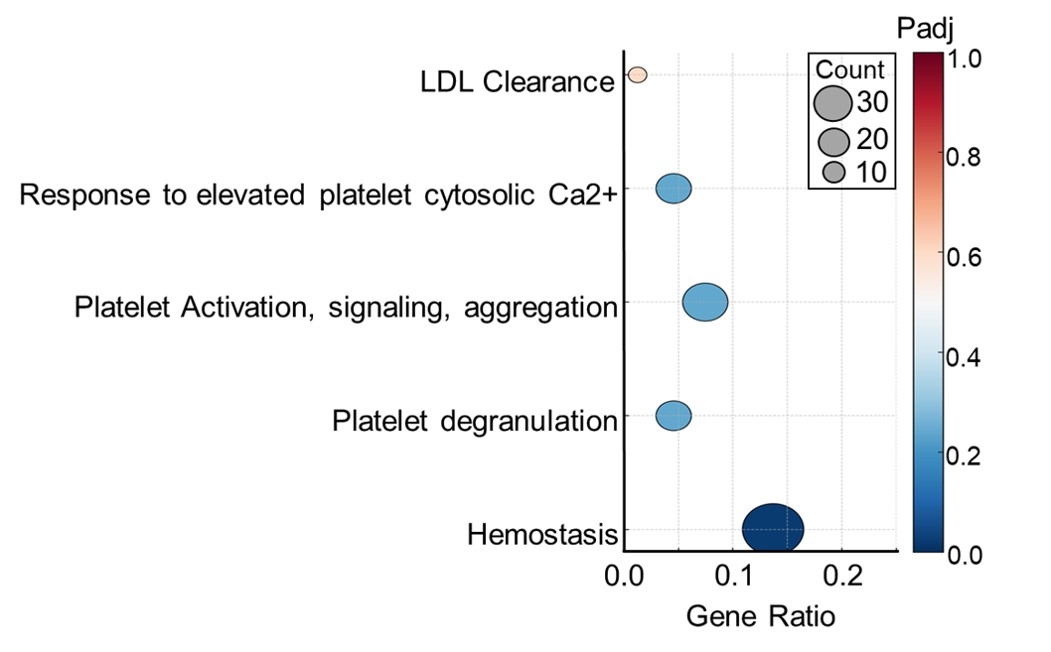
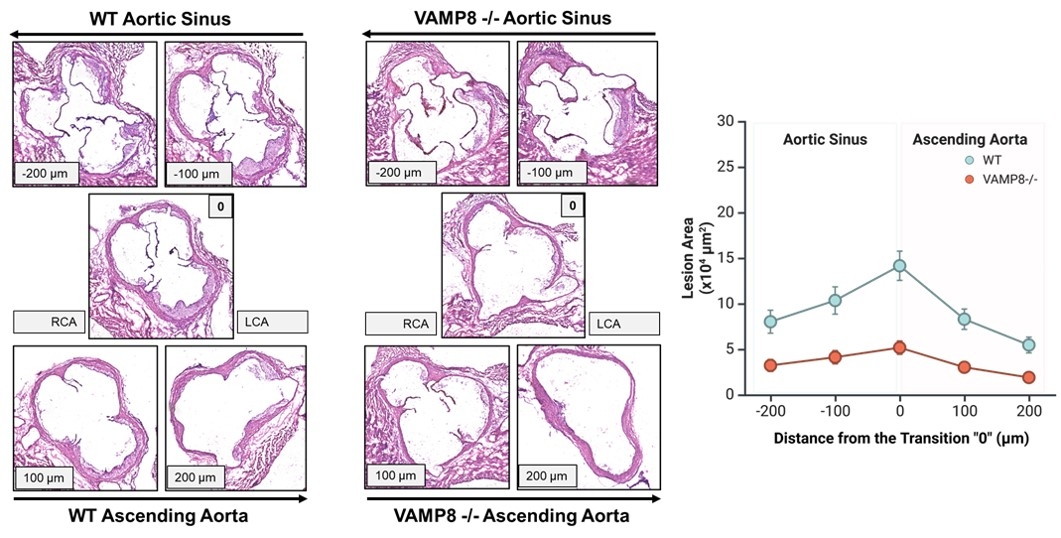
Abstract Body: Background and Objective: Platelet granule secretion is a key driver of vascular homeostasis, yet its role in lipid-driven aortic disease remains unclear. We previously identified VAMP8, the dominant v-SNARE required for platelet granule fusion, as a determinant of abdominal aortic aneurysm, where early platelet transcriptional reprogramming preceded disease. Here, we investigated how hyperlipidemia reshapes platelet programming and the contribution of VAMP8 to atherosclerosis. Methods and Results: To assess whether platelet secretory pathways are engaged during atherogenesis, we analyzed publicly available single-cell RNA-seq datasets from human (GSE260657) and murine (GSE260656) atherosclerotic lesions. Pathway enrichment revealed conserved platelet-related genes involved in granule degranulation across vascular cell populations, implicating that platelet-derived cargo could contribute to plaque development. To define the molecular consequences of hyperlipidemia on circulating platelets, we performed bulk RNA-seq on isolated platelets. Hyperlipidemia upregulated pathways related to platelet activation, signaling, aggregation, and degranulation, accompanied by accelerated occlusive thrombosis. To test whether granule secretion contributes directly to atherogenesis, we used Vamp8-/-mice in a PCSK9-AAV–induced hypercholesterolemia model. After 12 weeks of a Western diet, aortic root and en face analyses indicated that VAMP8 deficiency markedly reduced atherosclerotic percent lesion area (n=9, 3.89×104 μm2 ± 0.60) compared to controls (WT: n=11, 12.9×104 μm2 ± 1.12). Surface P-selectin levels were unchanged, whereas platelet–neutrophil aggregate formation was significantly reduced in Vamp8-/- blood. Surprisingly, parallel liver bulk RNA-seq revealed suppression of cholesterol and fatty-acid biosynthesis pathways and reduced hepatic thrombopoietin (Tpo) expression, consistent with ~35% lower platelet counts. Plasma lipid profiling confirmed lower total, LDL, and HDL cholesterol in Vamp8-/- mice, despite remaining in the hypercholesterolemic range. Conclusion: Our data identify a dual protective mechanism of VAMP8 deficiency in hyperlipidemic atherogenesis: a hepatic axis characterized by improved lipoprotein metabolism, and a platelet-intrinsic axis driven by impaired VAMP8-dependent granule release. VAMP8-mediated secretion thus emerges as a previously unrecognized regulator linking systemic lipid metabolism to thrombo-inflammatory vascular remodeling.
Mohammadmoradi, Shayan
(
University of Kentucky
, Lexington , Kentucky , United States )
Driehaus, Elizabeth
(
NYU Grossman School of Medicine
, New York , New York , United States )
Dunn, Emily
(
University of Kentucky
, Lexington , Kentucky , United States )
Alfar, Hammodah
(
University of Pittsburgh
, Pittsburgh , Pennsylvania , United States )
Voy, Clairity
(
University of Kentucky
, Lexington , Kentucky , United States )
Dong, Brittany
(
University of Kentucky
, Lexington , Kentucky , United States )
Joshi, Smita
(
Eastern Kentucky University
, Richmond , Kentucky , United States )
Gordon, Scott
(
University of Kentucky
, Lexington , Kentucky , United States )
Whiteheart, Sidney
(
University of Kentucky
, Lexington , Kentucky , United States )
Author Disclosures:
Shayan Mohammadmoradi:DO NOT have relevant financial relationships
| Elizabeth Driehaus:DO NOT have relevant financial relationships
| Emily Dunn:No Answer
| Hammodah Alfar:DO NOT have relevant financial relationships
| Clairity Voy:DO NOT have relevant financial relationships
| Brittany Dong:DO NOT have relevant financial relationships
| Smita Joshi:DO NOT have relevant financial relationships
| Scott Gordon:DO NOT have relevant financial relationships
| Sidney Whiteheart:DO NOT have relevant financial relationships