
Logo

American Heart Association

  74
  0


Final ID: Th0016

Photo-induced universal modifying vessels or cardiovascular devices with a hemocompatible peptide to improve blood compatibility

Abstract Body: Introduction
We have developed a novel photoreactive peptide that can be universally modified onto the lumen surfaces of native vessels and cardiovascular devices through brief UV exposure. This peptide enhances endothelial cell recruitment while preventing platelet adhesion. We hypothesize that this photoreactive peptide can improve the blood-contact surfaces of cardiovascular devices, including autologous grafts, synthetical conduits, patches, and tissue-engineered vascular grafts, to promote endothelialization and reduce the risk of restenosis.
Material and Methods
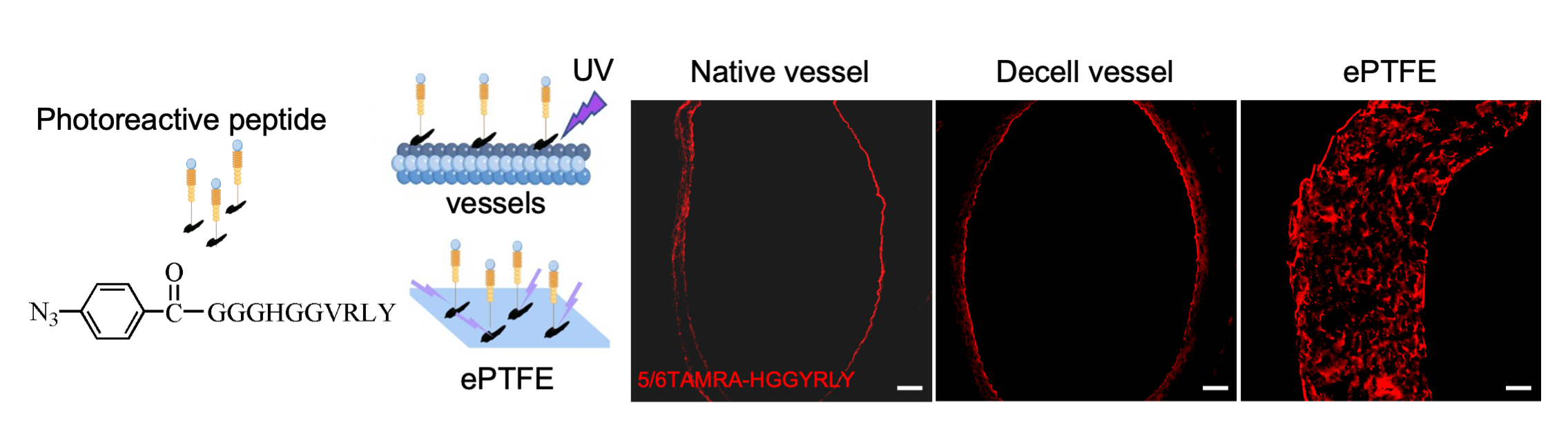
The hemocompatible peptide (His–Gly–Gly–Val–Arg–Leu–Tyr; HGGVRLY) was conjugated with a phenylazide group, enabling its modification onto various materials within 2 minutes of UV exposure. Tests were conducted on native and decellularized rat abdominal aorta (AA) as well as expanded polytetrafluoroethylene (ePTFE). The binding of endothelial cells and platelets to the modified surfaces was assessed. Additionally, in vivo performance of the modified decellularized vascular grafts was evaluated through implantation.
Results
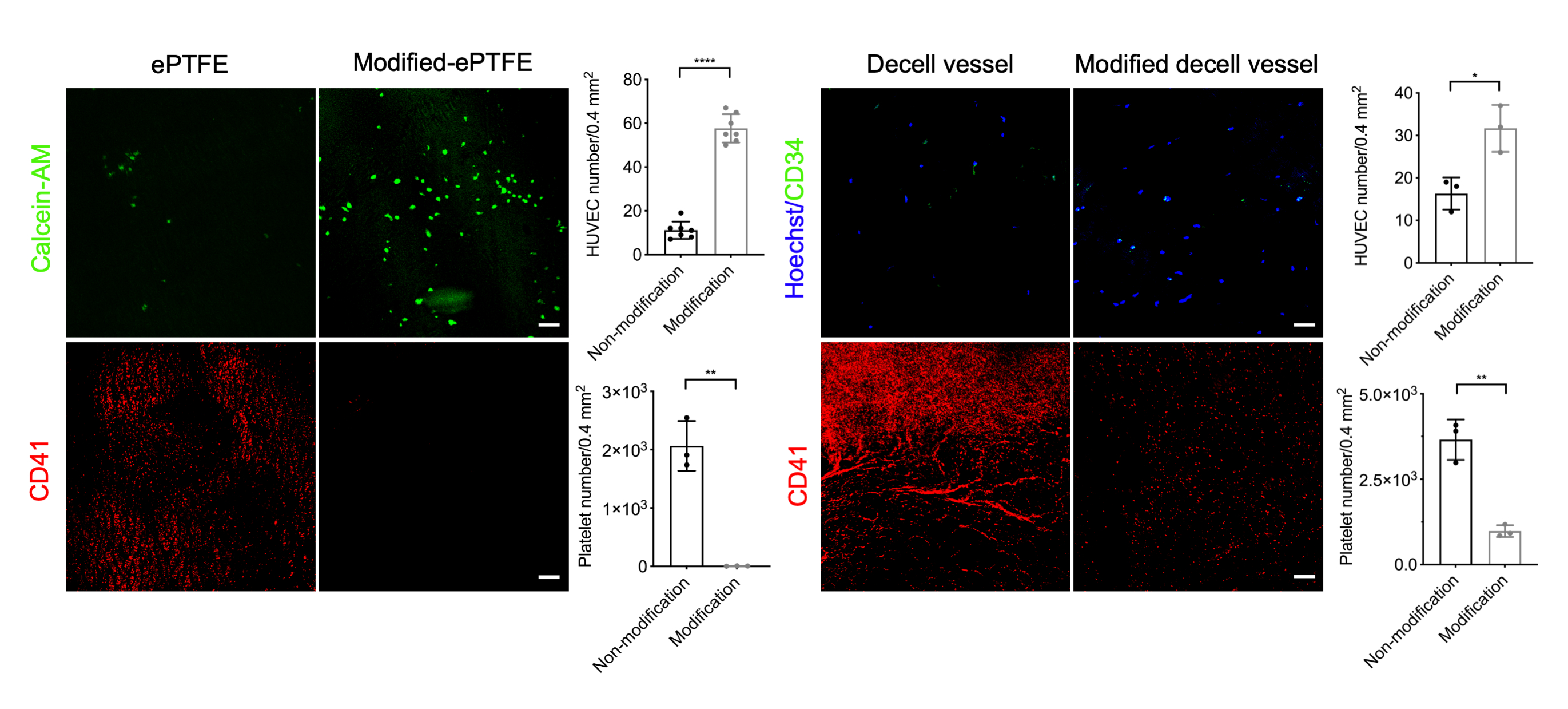
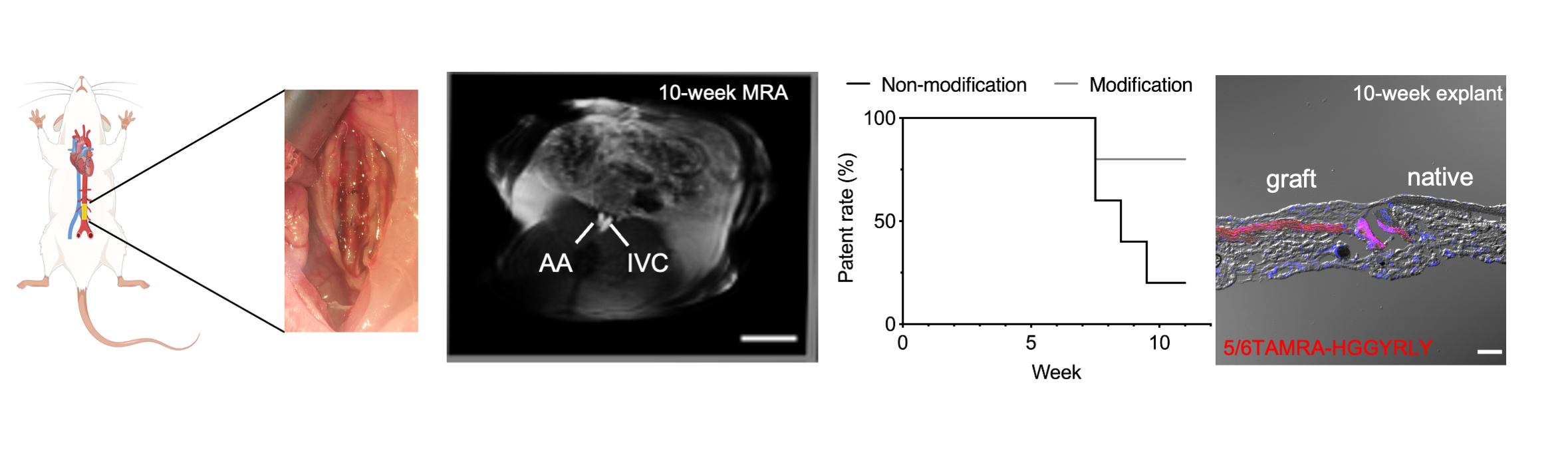
The photoreactive peptide demonstrated efficient and stable modification onto native and decellularized vessels as well as ePTFE, highlighting its universal photo-induced properties (Fig. 1). The modification process, involving immersion in the peptide solution followed by a 2-minute UV exposure, was completed within 5 minutes. Endothelial cell binding on vessels and ePTFE was significantly enhanced after modification, accompanied by reduced platelet adhesion (Fig. 2). In vivo studies of modified decellularized vascular grafts implanted into rat AA showed a significantly reduced incidence of occlusion during medium-term follow-up. Moreover, the photoreactive peptide remained stable for up to two months post-implantation, confirming the durability of the photoreactive conjugation (Fig. 3).
Conclusions
This photoreactive peptide can be efficiently and stably modified onto a variety of material surfaces, including native tissue and synthetic materials. By promoting endothelial recruitment and reducing platelet adhesion, this peptide has the potential to enhance the performance of autologous native grafts and cardiovascular devices in surgical applications.
  • Zhang, Wei  ( Yale Cardiovascular Research Center , New Haven , Connecticut , United States )
  • Kyoko, Fukazawa  ( National Cerebral and Cardiovascular Research Center , Osaka , Japan )
  • Mahara, Atsushi  ( National Cerebral and Cardiovascular Research Center , Osaka , Japan )
  • Yamaoka, Tetsuji  ( National Cerebral and Cardiovascular Research Center , Osaka , Japan )
  • Author Disclosures:
    Wei Zhang: DO NOT have relevant financial relationships | Fukazawa Kyoko: No Answer | Atsushi Mahara: No Answer | Tetsuji Yamaoka: No Answer
Meeting Info:
Session Info:

15. Poster Session 3 & Reception

Thursday, 04/24/2025 , 05:00PM - 07:00PM

Poster

More abstracts on this topic:
Bismuth Nanoparticle-Infused Bioresorbable Graft Enables Multimodal Computed Tomography and Photoacoustic Imaging-Based Monitoring and Promotes Vascular Regeneration

Barcena Allan John, Fowlkes Natalie, Bouchard Richard, Huang Steven, Melancon Marites, Bernardino Marvin, Mishra Archana, Bolinas Dominic Karl, Marco Kitz Paul, Fernandez Kim Claudette, San Valentin Erin Marie, Court Karem, Godin Biana

FLRT2 silencing enhances endothelial cell retention on synthetic vascular graft materials under fluid shear stress in vitro.

Rao Shashanka, Tefft Brandon

You have to be authorized to contact abstract author. Please, Login
Not Available