
Logo

American Heart Association

  41
  0


Final ID: Su2096

Adherence to Guideline-Directed Oral Anticoagulant Therapy in Patients with Atrial Fibrillation and Atrial Flutter Admitted in a Tertiary Private Hospital: A Retrospective Study

Abstract Body (Do not enter title and authors here): Background:
Atrial fibrillation (AF) is associated with an increased risk of thromboembolism. Atrial Flutter (AFL) has s imilar risk factors as AF and many of these patients eventually develop AF. Both the American Heart Association and European Society of Cardiology guidelines recommend anticoagulation in AF and AFL patients at elevated thromboembolic risk to prevent ischemic stroke and systemic thromboembolism. The objective of this study is to determine the adherence to guideline-directed oral anticoagulation therapy and identify the factors for non-adherence to current guidelines.
Methodology:
This single-center, retrospective cross-sectional study included all adults admitted with a primary or secondary diagnosis of AF and AFL between July 1, 2024, and December 31, 2024, who enrolled in the hospital’s AF Registry. The CHA2DS2VASc and/or CHA2DS2VA and HASBLED scores were recalculated by the primary investigator to ensure accuracy of the scores. Use of anticoagulant or antiplatelet during admission were obtained from electronic medical records.
Results:
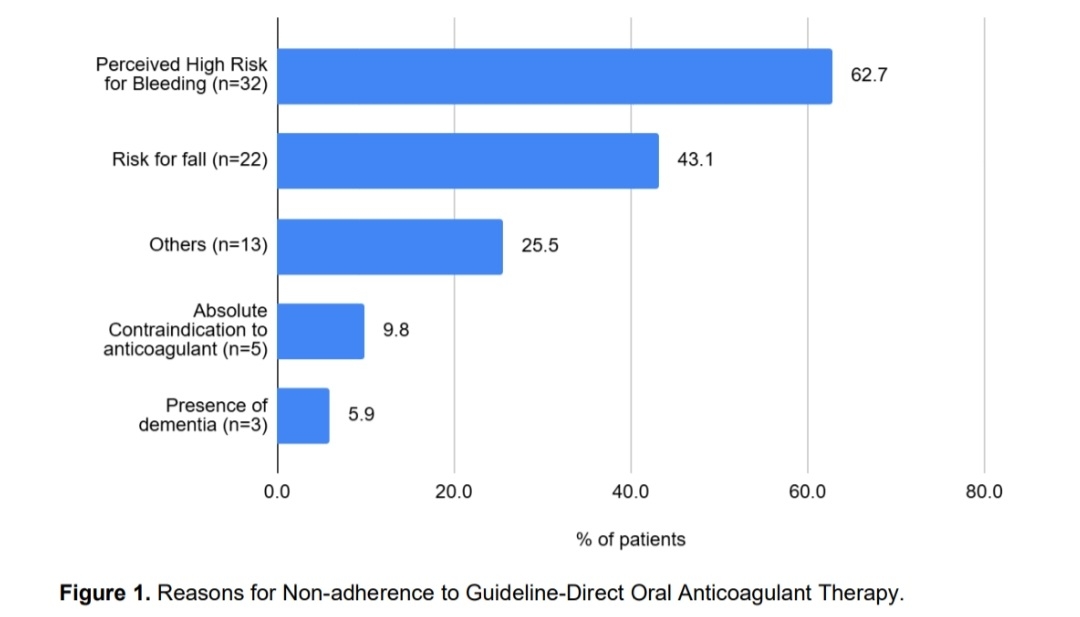
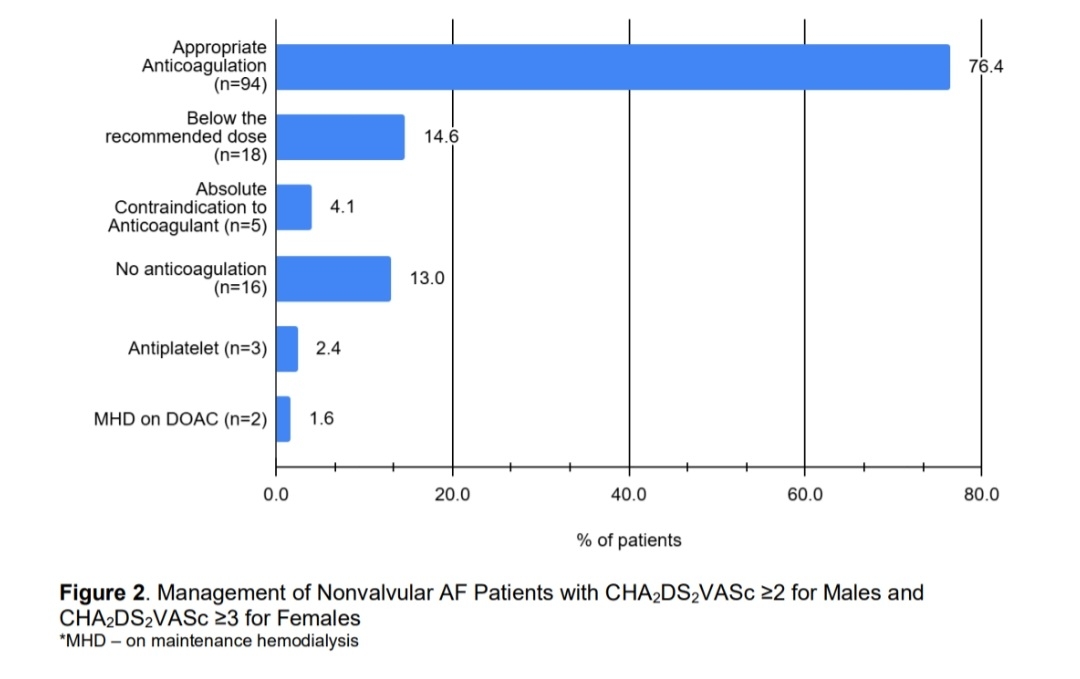
Among the 158 AF and AFL patients (50% male, median age 71 years, mean CHA2DS2VASc for males 3.8 and for females 4.4), 107 (67%) were started on appropriate anticoagulation according to guideline recommendations. Of the remaining 51 patients, only 5 (9.8%) had absolute contraindication to anticoagulants while over half of the patients were not given anticoagulants due to perceived high risk for bleeding (62.75%). A significantly higher proportion of patients with concomitant peripheral arterial disease, coronary artery disease and chronic kidney disease were not managed according to guidelines.
Conclusion:
Despite existing guidelines in the management of atrial fibrillation, only 7 out of 10 patients were managed according to guideline-directed oral anticoagulant therapy. The most common reason for withholding of oral anticoagulants was perceived high risk for bleeding (62.7%)
  • Wong, Jasmine  ( The Medical City , Pasig , Philippines )
  • Carandang, Frances  ( The Medical City , Pasig , Philippines )
  • Segundo, Luigi Pierre  ( The Medical City , Pasig City , Philippines )
  • Author Disclosures:
    Jasmine Wong: DO NOT have relevant financial relationships | Frances Carandang: DO NOT have relevant financial relationships | Luigi Pierre Segundo: No Answer
Meeting Info:

Scientific Sessions 2025

2025

New Orleans, Louisiana

Session Info:

Signals in the Noise: Uncovering Hidden Gaps in Cardiovascular Risk and Care

Sunday, 11/09/2025 , 03:15PM - 04:15PM

Abstract Poster Board Session

More abstracts on this topic:
Among Older Adults With Atrial Fibrillation, First Anticoagulant Prescription Is Not Associated with Reduced Hazard of Ischemic Stroke but Is Associated with Increased Hazard of Major Bleeding: A Nationwide Study

Lusk Jay, Li Fan, Mac Grory Brian, Nalawade Vinit, Wilson Lauren, Yarnell Stephanie, Song Ailin, Schrag Matthew, Poli Sven, Hammill Bradley, Xian Ying

A 3-Year, Pre-Trial, Real-world Data Analysis of Patients Enrolled in VICTORION-INITIATE: Insights Using Tokenization

Rodriguez Fatima, Cosmatos Irene, Desai Nihar, Wright R, Ross Elsie, Ali Yousuf, Kumar Biswajit, Han Guangyang, Cai Beilei, Abbas Cheryl, Ryan Amy

You have to be authorized to contact abstract author. Please, Login
Not Available