Logo

American Heart Association

  106
  0


Final ID: Tu0009

Particulate matter exposure promotes experimental abdominal aortic aneurysm progression

Abstract Body: Background: Environmental pollutants including particulate matter (PM) increase the morbidity and mortality for cardiovascular disorders. Recent study analyzing UK biobank datasets suggested that exposure to PM2.5 or PM10 was associated with the increased risk for abdominal aortic aneurysms (AAA). However, it has not been studied whether PM exposure alters experimental AAA formation and progression.
Methods: Experimental AAAs were induced in 9-10 weeks old male C57BL/6J mice via porcine pancreatic elastase aortic wall painting procedure. Three days following AAA induction, urban particulate matter (NIST1648a, mean particulate diameter (d50): 5.87 µm, 100 µg/mouse/day) or vehicle (saline) was daily administered via intranasal installation for 11 days. Influence on experimental AAAs was assessed via serial measurements of infrarenal aortic diameter via ultrasonography and histopathological analysis at sacrifice.
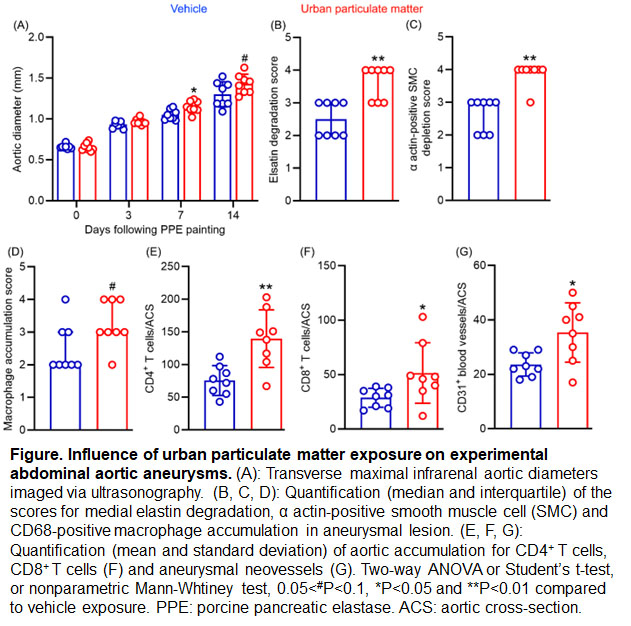
Results: In ultrasound imaging, no difference was noted in the baseline aortic diameter (either prior to AAA induction or PM exposure). However, PM exposure led to marked aneurysm enlargement on days 7 and 14 following AAA induction as compared to vehicle exposure. On histological analysis, PM exposure accelerated medial elastin degradation and smooth muscle cell loss as compared to vehicle exposure. Aortic accumulation of macrophages and lymphocytes were more remarkable in PM-, than those in vehicle-, exposed AAA mice. Additionally, PM exposure also substantially increased the density of CD31-positive neovessels in aneurysmal lesion as compared to vehicle exposure.
Conclusion: Particulate matter exposure worsens experimental AAA progression in associated with augmented aneurysmal wall inflammation.
  • Xu, Baohui  ( STANFORD UNIVERSITY SCHOOL OF MEDIC , Stanford , California , United States )
  • Ye, Jiayu  ( VA Palo Alto Health Care Systems , Palo Alto , California , United States )
  • Han, Shuling  ( STANFORD UNIVERSITY SCHOOL OF MEDIC , Stanford , California , United States )
  • Ai, Wenjia  ( STANFORD UNIVERSITY SCHOOL OF MEDIC , Stanford , California , United States )
  • Samura, Makoto  ( Stanford University , Palo Alto , California , United States )
  • Ju, Junjie  ( STANFORD UNIVERSITY MEDICAL CE , Palo Alto , California , United States )
  • Martinez, Olivia  ( STANFORD UNIVERSITY SCHOOL OF MEDIC , Stanford , California , United States )
  • Dalman, Ronald  ( STANFORD UNIVERSITY MEDICAL CE , Palo Alto , California , United States )
  • Tsao, Philip  ( Stanford University-VAPAHCS , Los Altos , California , United States )
  • Author Disclosures:
    Baohui Xu: DO NOT have relevant financial relationships | jiayu ye: DO NOT have relevant financial relationships | SHULING Han: No Answer | Wenjia Ai: No Answer | Makoto Samura: DO NOT have relevant financial relationships | Junjie Ju: No Answer | Olivia Martinez: No Answer | Ronald Dalman: No Answer | Philip Tsao: DO NOT have relevant financial relationships
Meeting Info:
Session Info:

01. Poster Session 1 & Reception

Tuesday, 04/22/2025 , 06:00PM - 08:00PM

Poster

More abstracts on this topic:
AI-Measured Thoracic Ascending Aortic Calcification in CAC Scans Predicts Cardiovascular Events: An AI-CVD study in the FHS Offspring Cohort

Naghavi Morteza, Atlas Kyle, Zhang Chenyu, Reeves Anthony, Atlas Thomas, Wasserthal Jakob, Wong Nathan, Benjamin Emelia, Levy Daniel

Accelerometer-derived physical activity, long-term exposure to ambient PM2.5 and risk of cardiovascular disease mortality

Yuan Sheng, Lin Zhangyu, Song Yanjun, Dou Kefei

More abstracts from these authors:
Time-restricted feeding attenuates experimental abdominal aortic aneurysms

Samura Makoto, Ye Jiayu, Xu Baohui, Tsao Philip, Dalman Ronald

Myeloid cell TRIM59 deficiency promotes experimental abdominal aortic aneurysms

Xu Baohui, Tsao Philip, Dalman Ronald, Yan Dongmei, Ikezoe Toru, Samura Makoto, Ye Jiayu, Jin Zheng, Ai Wenjia, Ju Junjie, Fang Weirong

You have to be authorized to contact abstract author. Please, Login
Not Available