Logo

American Heart Association

  108
  0


Final ID: We0050

CCR4 Deficiency Decreases Arteriovenous Fistula Patency and Increases Venous Wall Thickness

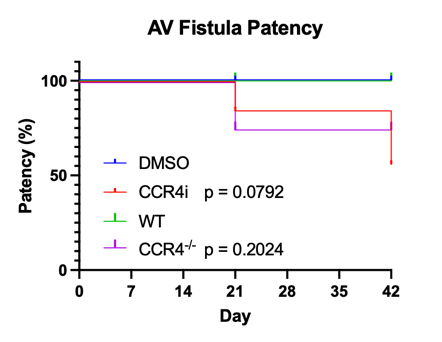
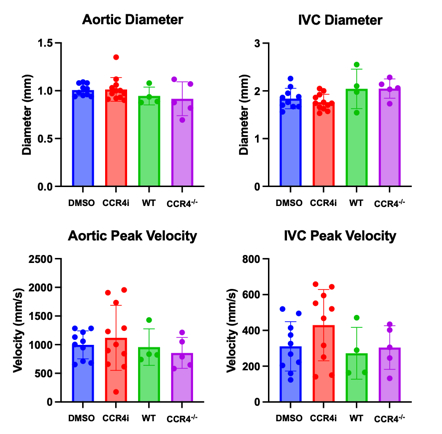
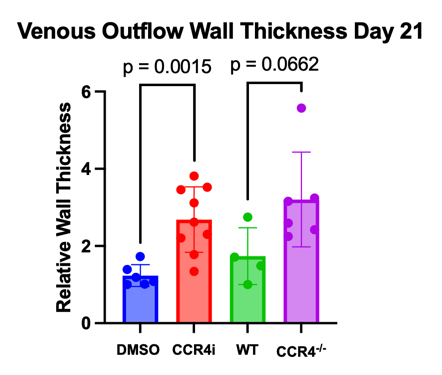
Abstract Body: Regulatory T cells (Treg) help regulate vascular biology and inflammation including in aneurysmal disease, atherosclerosis, and angiogenesis. While the roles of some immune cells such as the helper T cell, M1, and M2 macrophage have been shown to have an impact on arteriovenous (AV) fistula maturation and remodeling, the role of Tregs has not been as well studied during AV fistula maturation. C-C chemokine receptor type 4 (CCR4) is a chemokine receptor on Tregs responsive to CCL17 and CCL22 and is required for tissue recruitment and cellular interaction with dendritic cells. We hypothesized that inhibition of Treg function via inhibition of CCR4 leads to increased neointimal hyperplasia and thus impairs AV fistula maturation and remodeling. Aorto-caval fistulae were created in mice treated with the CCR4 inhibitor AF399/420/18 025 (n=13) or with DMSO as control (n=13) as well as in CCR4-/- (n=8) and WT littermate controls (n=6). Aortic diameter, inferior vena cava (IVC) diameter, aortic peak velocity, and IVC peak velocity were measured at day 21 using duplex ultrasound. Venous wall thickness was measured using paraffin-embedded sections stained with Elastin van Gieson’s stain. There was reduced patency in the CCR4 inhibitor-treated mice while all 13 fistulae created in the control group remained patent (p=0.0792; day 42; Figure 1). Similarly, all 6 fistulae created in WT mice were patent by day 42 whereas 2 of 6 fistulae created in CCR4-/- mice were not patent at day 21; the remaining 2 fistulae remained patent by day 42 (p=0.2024). There was no statistically significant difference among control mice and CCR4 inhibited or knockout mice in aortic diameter, IVC diameter, aortic peak velocity, and IVC peak velocity at day 21 (Figure 2). However, the relative thickness of the venous wall was increased in the fistulae of CCR4 inhibitor-treated mice compared to control (p=0.0015) and in CCR4-/- compared to WT mice (p=0.0662; Figure 3). These results suggest that CCR4 deficiency results in decreased AV fistula patency and increased venous outflow wall thickness and imply that immunomodulation of Treg may be a novel approach to improve AVF patency.
  • Ho, Bryan  ( Yale University , New Haven , Connecticut , United States )
  • Thaxton, Carly  ( Yale University , New Haven , Connecticut , United States )
  • Gonzalez, Luis  ( Yale University , New Haven , Connecticut , United States )
  • Bai, Hualong  ( Yale University , New Haven , Connecticut , United States )
  • Dardik, Alan  ( Yale University , New Haven , Connecticut , United States )
  • Author Disclosures:
    Bryan Ho: DO NOT have relevant financial relationships | Carly Thaxton: DO NOT have relevant financial relationships | Luis Gonzalez: No Answer | hualong bai: No Answer | Alan Dardik: DO NOT have relevant financial relationships
Meeting Info:
Session Info:

08. Poster Session 2 & Reception Sponsored by the ATVB Journal

Wednesday, 04/23/2025 , 05:00PM - 07:00PM

Poster

More abstracts on this topic:
Dual Pathway Inhibition prescription after percutaneous vascular intervention is low, and dependent on physician and treating facility practice patterns

Jarosinski Marissa, Lowenkamp Mikayla, Madigan Michael, Reitz Katherine, Chaer Rabih, Sridharan Natalie

A Potential Role for NKG2D, an NK cell receptor, in Accelerated CVD risk in African American Women Living in More Adverse Neighborhood Conditions: Data From the Step It Up Physical Activity Digital Health-Enabled, Community-Engaged Intervention

Baez Andrew, Andrews Marcus, Sandler Dana, Aquino Peterson Elizabeth, Sharda Sonal, Tolentino Katherine Joy, Lopez De Leon Shirley, Seo Jein Eleanor, Cintron Manuel, Pita Mario, Tarfa Hannatu, Baumer Yvonne, Reger Robert, Childs Richard, Powell-wiley Tiffany, Dave Ayushi, Saurabh Abhinav, Mendelsohnl Laurel, Chen Long, Igboko Muna, Wells Ayanna, Marah Marie

More abstracts from these authors:
Single cell and spatial multi-Omics show the Regulation and Therapeutic Potential of Venous Smooth Muscle Cell Reprogramming during Arteriovenous Fistula Remodeling

Dong Shuilin, Dong Kunzhe, Zhu Yanfang, Chiang Wantien, Singer Harold, Dardik Alan, Vazquez-padron Roberto, Long Xiaochun, Wang Chunhui, Thaxton Carly, Lowery Austin, Liu Lily, Wu Xiaoliang, Bryant William, Xzhangx Xweix, Martinez Laisel

Matrix metalloproteinases-3 promotes arteriovenous fistula failure by regulating FAK-AKT signaling

Xie Yangzhouyun, Cai Yujun, Zhang Weichang, Thaxton Carly, Jin Ying, Yatsula Bogdan, Davis Sean, Exsted Tobias, Dardik Alan, Guzman Raul

You have to be authorized to contact abstract author. Please, Login
Not Available