
Carotid Body Paraganglioma Causing Arterial Splaying: A Case Report and Surgical Management of a Vascular Neck Mass
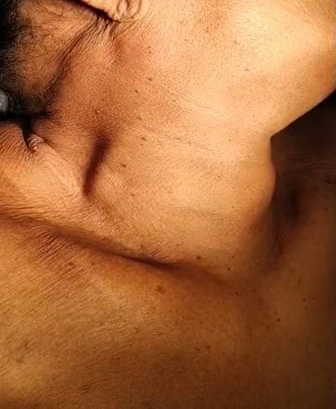
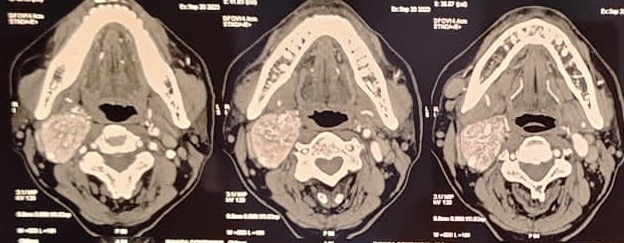
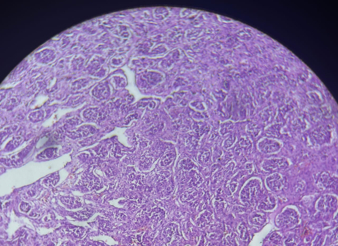
Abstract Body (Do not enter title and authors here): Background: Carotid body tumors (CBTs), or paragangliomas, are rare, highly vascular neuroendocrine neoplasms arising at the carotid bifurcation. Though generally benign and slow-growing, their close association with critical neurovascular structures, including the carotid arteries, presents complex diagnostic and therapeutic challenges with significant cardiovascular implications. Case Presentation: A 66-year-old female presented with a right-sided neck swelling of 3 months’ duration, accompanied by intermittent dull headaches and episodic sweating. Physical examination revealed a 7×4 cm firm, expansile mass in the right carotid triangle, mobile horizontally, with palpable pulsations and intact cranial nerve function. Imaging with CT angiography, contrast-enhanced MRI, and digital subtraction angiography demonstrated a highly vascular, enhancing mass at the carotid bifurcation causing splaying of the internal and external carotid arteries—characteristic of a carotid body tumor. Additionally, enlarged right cervical lymph nodes suggestive of paragangliomas were noted. Intervention: The patient underwent successful surgical excision of the tumor via a transcervical approach. Intraoperative vascular control was critical to prevent hemorrhage and preserve cerebral perfusion. Histopathology revealed nests of round to oval cells with eosinophilic cytoplasm arranged in a “zellballen” pattern, confirming paraganglioma. Outcome: Postoperative recovery was uneventful without neurological deficits. The patient remains under close follow-up for surveillance. Conclusion: This case underscores the significance of early vascular imaging and a multidisciplinary approach in managing carotid body tumors. Given the tumor’s direct involvement with carotid arteries and the potential for vascular complications, cardiovascular specialists must be engaged in diagnosis, surgical planning, and perioperative care. Surgical resection remains the definitive treatment, with histopathology confirming diagnosis. Vigilant long-term follow-up is essential due to the tumor’s proximity to critical neurovascular structures and potential syndromic associations.
Kumar, Nishal
( ANDHRA MEDICAL COLLEGE
, Visakhapatnam
, India
)
Garlapati, Sameer Krishna Prasad
( Howard University
, Washington D.C
, District of Columbia
, United States
)
Konakanchi, Venkata Sai Bhargav Pradeep
( ANDHRA MEDICAL COLLEGE
, Visakhapatnam
, India
)
Author Disclosures:
NISHAL KUMAR:DO NOT have relevant financial relationships
| Sameer Krishna Prasad Garlapati:DO NOT have relevant financial relationships
| Venkata Sai Bhargav Pradeep Konakanchi:DO NOT have relevant financial relationships