Sex Differences in Mouse Aortic Contractility and Protein Expressions in Response to Lipopolysaccharide Exposure
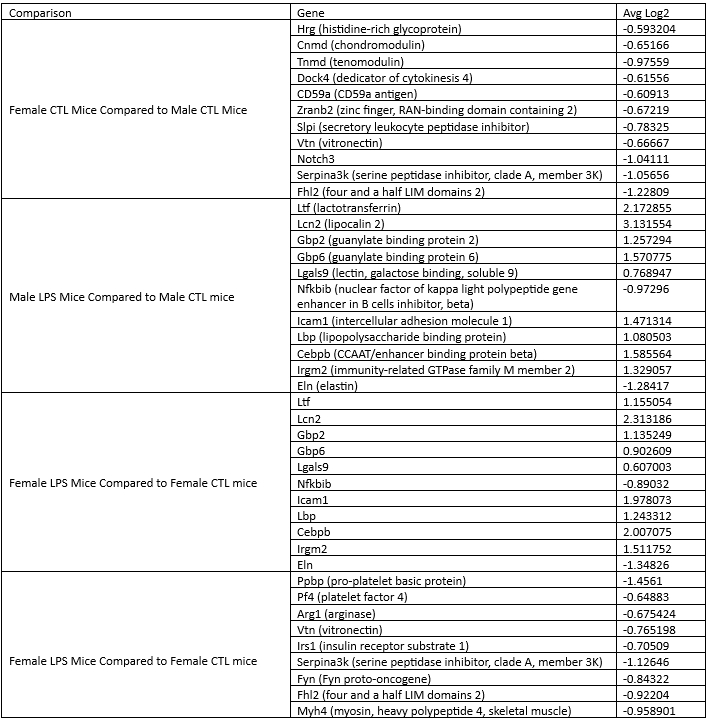
Abstract Body: Background: Sepsis causes multi-organ damage, including cardiovascular dysfunction. Studies suggest males may have worse outcomes than females with sepsis, but the mechanisms are not well understood. Gram-negative bacteremia is a frequent cause of sepsis, and lipopolysaccharide (LPS) is a key factor in sepsis with gram-negative bacteria. Hypothesis: We hypothesized a significant sex difference exists in vascular function and protein expressions in vasculature of mice in response to LPS exposure. Methods: Male and age-matched female C57BL/6 mice (8-12 weeks) were injected intraperitoneally with LPS (20 mg/kg) in saline or saline as a control. Blood pressure (BP) and heart rate (HR) were recorded at baseline and after 6 hours. Aortas were collected to determine contractility to phenylephrine and relaxation to acetylcholine and nitroglycerin, and for proteomic analysis. Results: Both sexes exhibited decreases in BP and HR after LPS treatment. LPS treatment decreased aortic contraction to phenylephrine and attenuated aortic relaxation responses to acetylcholine and nitroglycerin ex vivo in both sexes. No significant sex differences were observed in BP, HR, aortic contractility and relaxation responses at baseline and post LPS treatment. However, proteomic analysis showed that expressions of many proteins involved in LPS response and vascular function including Hrg, Cnmd, Tnmd, Dock4, CD59a, Zranb2, Slpi, Vtn, Notch3, Serpina3k, and Fhl2 were decreased in female controls compared to male controls. LPS treatment increased the expressions of Ppbp, Pf4, Arg1, Vtn, Irs1, Serpina3k, Fyn, Fhl2, Ltf, Lcn2, Gbp2, Lgals9, and Gbp6 in male aortas, while expression of Nfkbib was decreased when compared to females. LPS treatment enhanced the expressions of Icam1, Lbp, Cebpb, and Irgm2, and decreased the level of Eln in aortas of females compared to males. These findings are shown in Table 1. Interestingly, expressions of contractile proteins Acta2, Myh11, Mylk, and Prkg1 were unchanged except Myh4 which was more abundant in males with LPS treatment than females. Conclusion: LPS treatment resulted in a reduction in BP, HR, aortic contractility and relaxation in mice without significant sex differences. However, there are substantial sex differences in the expressions of proteins in mouse aortas with and without LPS treatment. Further studies are needed to define the implications of sex differences in aortic protein expressions on vascular dysfunction in response to LPS exposure.
Omer, Bwaar
(
MU School of Medicine
, Columbia , Missouri , United States )
Chi, Jingshu
(
University of Missouri
, Columbia , Missouri , United States )
Chen, Feng
(
university of Missouri
, Columbia , Missouri , United States )
Hao, Hong
(
THE UNIVERSITY OF MISSOURI-COLUMBIA
, Columbia , Missouri , United States )
Liu, Zhenguo
(
UNIVERSITY OF MISSOURI SCH OF MED
, Columbia , Missouri , United States )
Author Disclosures:
Bwaar Omer:DO NOT have relevant financial relationships
| Jingshu Chi:No Answer
| Feng Chen:No Answer
| Hong Hao:No Answer
| Zhenguo Liu:No Answer