
Logo

American Heart Association

  89
  0


Final ID: Th0068

Lenvatinib Disrupts Endothelial Function by Reducing Endothelial Nitric Oxide Synthase Levels

Abstract Body: Background: Lenvatinib, a type of tyrosine kinase inhibitor (TKI), has become a standard molecularly targeted therapy for liver cancer. Lenvatinib targets multiple receptors and inhibits the kinase activity of vascular endothelial growth factor receptors, fibroblast growth factor receptors and platelet-derived growth factor receptor alpha. Numerous case reports and clinical trials have shown that Lenvatinib intake can increase the incidence of cardiovascular diseases, the most of which is hypertension. However, the mechanism by which Lenvatinib causes various vascular diseases is still unclear. In our hospital, we attended to a patient who had suffered from hypertension, acute coronary artery dissection and carotid artery stenosis after Lenvatinib therapy due to primary liver carcinoma in his fifties. Considering he had no risk factor and all these conditions were concerned with endothelial function, we proposed a hypothesis that Lenvatinib can directly influence the functions of endothelium, which plays an important role in maintaining vascular homeostasis, causing all kinds of vascular conditions.

Methods: We collected the patient's medical history and performed carotid endarterectomy for him. After being reviewed and approved by the hospital ethics committee, we performed immunofluorescence staining on the pathological specimen obtained during surgery and a specimen from another patient with carotid artery stenosis who did not take Lenvatinib, and compared the expression levels of some important endothelial function markers. Both patients had similar medical histories except history of liver cancer, intake of Lenvatinib and onset of acute coronary artery dissection.

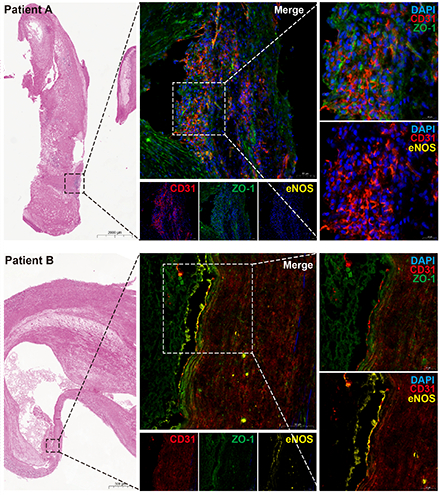
Results: The plaques from both patients had intact CD31-positive endothelial layers. The levels of zonula occludens-1 (ZO-1), which is a critical component of tight junctions between cells, were comparable in both patients’ endothelium. However, the expression of endothelial nitric oxide synthase (eNOS), which is crucial for regulating vasodilation and maintaining vascular permeability, was markedly lower in the endothelium of the patient who took Lenvatinib.

Conclusions: Lenvatinib intake can disrupt the endothelial function by reducing the expression level of eNOS, leading to a series of vascular diseases. This finding provides a new direction for detailed basic research and clinical prevention exploration in vascular adverse reaction of Lenvatinib and other TKIs.
  • Zuo, Ziang  ( Zhongshan Hospital , Shanghai, China , China )
  • Zhao, Yufei  ( Zhongshan Hospital , Shanghai, China , China )
  • Kan, Yuanqing  ( Zhongshan Hospital , Shanghai, China , China )
  • Fu, Weiguo  ( Zhongshan Hospital , Shanghai, China , China )
  • Wang, Lixin  ( Zhongshan Hospital , Shanghai, China , China )
  • Author Disclosures:
    Ziang Zuo: DO NOT have relevant financial relationships | Yufei Zhao: No Answer | Yuanqing Kan: No Answer | Weiguo Fu: No Answer | Lixin Wang: No Answer
Meeting Info:
Session Info:

15. Poster Session 3 & Reception

Thursday, 04/24/2025 , 05:00PM - 07:00PM

Poster

More abstracts on this topic:
Association of hypertonic saline treatment with change in cerebral oxygen extraction after cardiac arrest

Faiver Laura, Coppler Patrick, Ratay Cecelia, Chae Minjung, Flickinger Kate, Eun Lee, Kang Changshin, Tam Jonathan, Elmer Jonathan

Assessing blood-nerve barrier permeability to nanoparticles over the course of experimental autoimmune neuritis

Kaur Chanpreet, Cabe Maleen, Langert Kelly

More abstracts from these authors:
You have to be authorized to contact abstract author. Please, Login
Not Available