
Logo

American Heart Association

  108
  0


Final ID: Th0076

First-in-Animal Validation of a Fenestrated Balloon-Expandable Stent for Management of Aortoiliac Occlusive Disease

Abstract Body: Background: Endovascular treatment of aortoiliac occlusive disease is currently limited to kissing iliac stents with poor long-term outcomes. We developed an AortoIliac Fenestrated (AIFEN) balloon-expandable covered stent for managing this condition, and evaluated its feasibility and preliminary efficacy in first-in-animal trials.
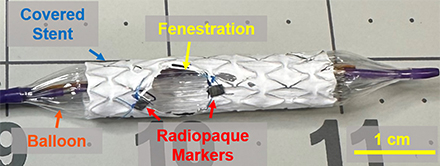
Methods: AIFEN stents were fabricated by cutting 7 mm fenestrations into from 10×55 mm balloon-expandable covered stents, suturing on radiopaque markers, and re-crimping using a 3D-printed crimper (Figure 1). In vivo feasibility was assessed in 3 anesthetized pigs (two non-survival, one 10-week survival). Right femoral access obtained with a 12 Fr sheath enabled AIFEN deployment from aorta to proximal right common iliac. A 7 Fr sheath in the left femoral artery enabled delivery of a 7×15 mm balloon-expandable covered stent into the left common iliac artery and AIFEN fenestration. The survival pig received daily dual antiplatelet therapy and underwent weekly femoral artery duplex ultrasounds for patency assessment.
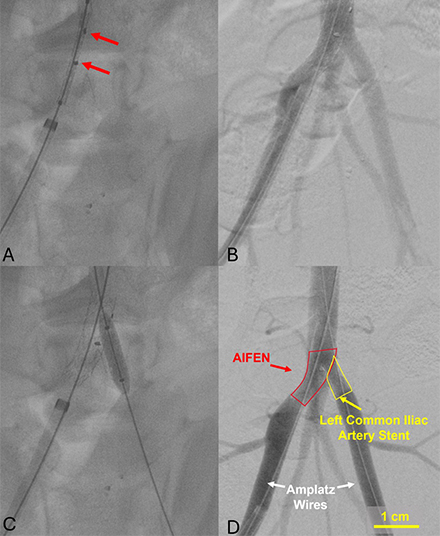
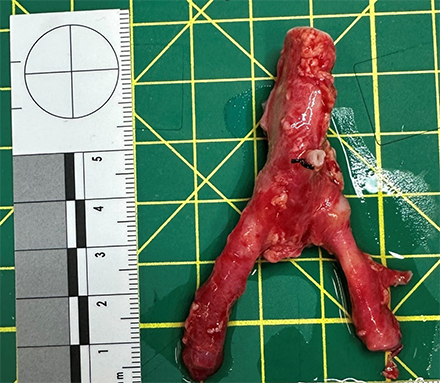
Results: AIFEN stent deployment was successful in all three pigs, with demonstrated patency through both AIFEN and contralateral iliac artery stents (Figure 2). Explant analysis showed the AIFEN device and left iliac stent remained in situ without retroperitoneal bleeding or injury (Figure 3). In the survival pig, serial femoral ultrasounds confirmed device patency through week 4, with stable arterial peak systolic velocities (right femoral: 84-90 cm/s; left femoral: 81-90 cm/s).
Conclusions: This first-in-animal study demonstrated successful fabrication, deployment, and preliminary patency of the AIFEN stent system in the aortoiliac bifurcation. The system offers significant advantages over traditional kissing stents, potentially reducing known complications such as thrombosis and restenosis by preserving natural bifurcation anatomy. 10-week survival data, supported by consistent ultrasound velocities and clean explant findings, suggest biocompatibility and maintained patency. While long-term studies are needed, initial results suggest promise for treating aortoiliac occlusive disease, addressing the limitations of current therapeutic options. The simplified deployment technique and anatomically-oriented design may translate to improved clinical outcomes and expanded treatment options for patients with complex aortoiliac disease.
  • Roberts, Sophia  ( Washington University in St. Louis , St. Louis , Missouri , United States )
  • Zayed, Mohamed  ( Washington University in St. Louis , St. Louis , Missouri , United States )
  • Braasch, Maxwell  ( Washington University in St. Louis , St. Louis , Missouri , United States )
  • Cashin, John  ( Washington University in St. Louis , St. Louis , Missouri , United States )
  • Zaghloul, Mohamed  ( Washington University in St. Louis , St. Louis , Missouri , United States )
  • Elizondo Benedetto, Santiago  ( Washington University in St. Louis , St. Louis , Missouri , United States )
  • Rucker, Devaughn  ( Washington University in St. Louis , St. Louis , Missouri , United States )
  • Hafezi, Shahab  ( Washington University in St. Louis , St. Louis , Missouri , United States )
  • Arif, Batool  ( Washington University in St. Louis , St. Louis , Missouri , United States )
  • Genin, Guy  ( Washington University in St. Louis , St. Louis , Missouri , United States )
  • Author Disclosures:
    Sophia Roberts: No Answer | Mohamed Zayed: No Answer | Maxwell Braasch: DO NOT have relevant financial relationships | John Cashin: No Answer | Mohamed Zaghloul: No Answer | Santiago Elizondo Benedetto: DO NOT have relevant financial relationships | DeVaughn Rucker: No Answer | Shahab Hafezi: DO NOT have relevant financial relationships | Batool Arif: No Answer | Guy Genin: No Answer
Meeting Info:
Session Info:

15. Poster Session 3 & Reception

Thursday, 04/24/2025 , 05:00PM - 07:00PM

Poster

More abstracts on this topic:
Aortic Arch Calcification Among Cigarette Smokers: Results from the Multi-Ethnic Study of Atherosclerosis (MESA)

Ansari Salman, Trujillo Robert, Mcclelland Robyn, Budoff Matthew

AI-Measured Thoracic Ascending Aortic Calcification in CAC Scans Predicts Cardiovascular Events: An AI-CVD study in the FHS Offspring Cohort

Naghavi Morteza, Atlas Kyle, Zhang Chenyu, Reeves Anthony, Atlas Thomas, Wasserthal Jakob, Wong Nathan, Benjamin Emelia, Levy Daniel

More abstracts from these authors:
CC-Chemokine Receptor 2 Inhibition Prevents Monocyte/Macrophages Recruitment in Abdominal Aortic Aneurysms

Elizondo Benedetto Santiago, Zaghloul Mohamed, Arif Batool, Bredemeyer Andrea, Lavine Kory, Gropler Robert, Liu Yongjian, Zayed Mohamed

Novel Elastase-Papain Model for Induction of Infrarenal Abdominal Aortic Aneurysm Rupture in Mice

Elizondo Benedetto Santiago, Zaghloul Mohamed, Arif Batool, Zayed Mohamed

You have to be authorized to contact abstract author. Please, Login
Not Available