
Logo

American Heart Association

  114
  0


Final ID: WP180

Carotid Web Diagnostic Pitfalls

Abstract Body: Introduction: Carotid webs (CW) are rare shelf-like filling defects arising from the posterior wall of the internal carotid artery (ICA) bulb and are reportedly associated with a high risk of recurrent stroke, particularly in young patients. Limited awareness and understanding of CW make diagnosis and clinical research challenging.
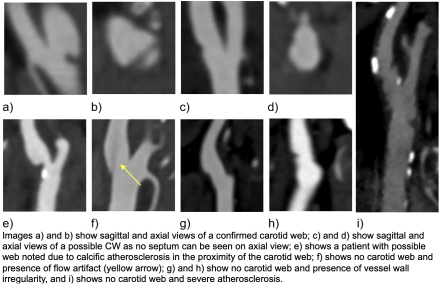
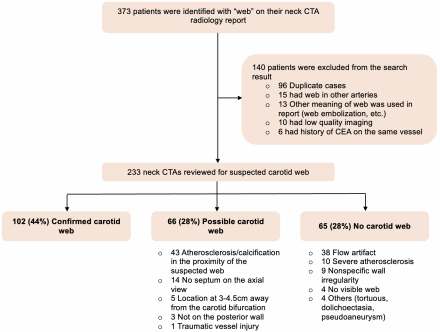
Methods: We searched the radiology database from 6 hospitals within a health system between January 2021 and June 2024 for reports that included “web” in the diagnostic impression. These were reviewed by two experienced raters to determine whether a CW was present based on previously published criteria. Discrepancies were resolved by consensus with a third rater (a neuroradiologist or a stroke neurologist). Cases were categorized as confirmed, possible, or no CW (Figure 1). Confirmed CWs were defined as a shelf-like, thin, linear filling defect on the posterior wall of the ICA bulb within 3cm of the bifurcation, visible as a septum on axial view, and without calcification/atherosclerotic plaque adjacent to the filling defect on multiplanar reconstruction view. Possible CWs were defined as filling defects 3-4.5cm from the bifurcation, not on the posterior wall, not seen on the axial view, or accompanied by atherosclerotic plaque/calcification in the proximity of the suspected web. The remaining cases were classified as no CW. Baseline characteristics of those with confirmed CWs were compared to the remainder.
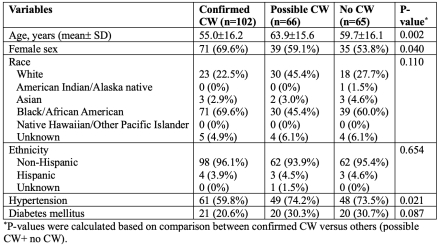
Results: Of the 373 patients screened, 233 were reviewed. Of these, 102 (44%) were classified as confirmed CW, 66 (28%) as possible CW, and 65 (28%) as no CW (Figure 2). Patients with confirmed CW were younger, predominantly female, and they were less likely to have history of hypertension and diabetes mellitus compared to those in the possible CW and no CW groups (Table 1). Confirmed webs were numerically most commonly associated with Black/African American race.
Conclusions: Our findings underscore the need for standardized definitions for the diagnosis of carotid webs, as less than half of the webs suspected on radiology reports met the criteria established in the literature. Establishing consistent criteria is essential for further investigating the natural history and designing clinical trials for this reportedly high-risk disorder.
  • Balali, Pargol  ( University of Pennsylvania , Philadelphia , Pennsylvania , United States )
  • Guggenberger, Konstanze  ( University Hospital Würzburg , Würzburg , Germany )
  • Shakibajahromi, Banafsheh  ( University of Pennsylvania , Philadelphia , Pennsylvania , United States )
  • Sakai, Yu  ( University of Pennsylvania , Philadelphia , Pennsylvania , United States )
  • Voleti, Sriharsha  ( University of Pennsylvania , Philadelphia , Pennsylvania , United States )
  • Song, Jae  ( University of Pennsylvania , Philadelphia , Pennsylvania , United States )
  • Kasner, Scott  ( University of Pennsylvania , Philadelphia , Pennsylvania , United States )
  • Messe, Steven  ( University of Pennsylvania , Philadelphia , Pennsylvania , United States )
  • Author Disclosures:
    Pargol Balali: DO NOT have relevant financial relationships | Konstanze Guggenberger: DO NOT have relevant financial relationships | Banafsheh Shakibajahromi: No Answer | Yu Sakai: DO NOT have relevant financial relationships | Sriharsha Voleti: DO NOT have relevant financial relationships | Jae Song: DO have relevant financial relationships ; Advisor:JLK:Active (exists now) | Scott Kasner: DO have relevant financial relationships ; Researcher:WL Gore:Active (exists now) ; Consultant:Bristol-Myers Squibb:Active (exists now) ; Researcher:DiaMedica:Active (exists now) ; Researcher:Bayer:Active (exists now) ; Royalties/Patent Beneficiary:UpToDate:Active (exists now) | Steven Messe: DO NOT have relevant financial relationships
Meeting Info:
Session Info:

Imaging Posters I

Wednesday, 02/05/2025 , 07:00PM - 07:30PM

Poster Abstract Session

More abstracts on this topic:
A distinct clot transcriptomic signature is associated with atrial fibrillation-derived ischemic stroke in the INSIGHT Registry

Seah Carina, Rivet Dennis, Fraser Justin, Kellner Christopher, Devarajan Alex, Vicari James, Dabney Alan, Baltan Selva, Sohrabji Farida, Pennypacker Keith, Nanda Ashish, Woodward Britton

Associations Between Absolute Blood Eosinophil Count and Subclinical Atherosclerotic Plaque in the Multi-Ethnic Study of Atherosclerosis

Mathis Nyla, Mcclelland Robyn, Stein James, Johansson Mats, Tattersall Matthew, Hansen Spencer, Dasiewicz Alison, Esnault Stephane, Siddiqui Salman, Mathur Sameer, Jarjour Nizar, Denlinger Loren

More abstracts from these authors:
Machine-learning Approach To Classify Vulnerable Calcified Plaque In Embolic Stroke Of Undetermined Source

Sakai Yu, Saba Luca, Huang Zhi, Haehn Daniel, Song Jae, Kim Jiehyun, Phi Huy, Hu Andrew, Balali Pargol, Guggenberger Konstanze, Woo John, Kasner Scott, Cucchiara Brett

Value of Vessel Wall Imaging in Differentiating Inflammatory from Non-Inflammatory Vasculopathies

Song Jae, Mossa-basha Mahmud

You have to be authorized to contact abstract author. Please, Login
Not Available

Readers' Comments

We encourage you to enter the discussion by posting your comments and questions below.

Presenters will be notified of your post so that they can respond as appropriate.

This discussion platform is provided to foster engagement, and simulate conversation and knowledge sharing.


You have to be authorized to post a comment. Please, Login or Signup.


   Rate this abstract  (Maximum characters: 500)