
Carotid Plaque Score by Ultrasound and its Prediction of Carotid Plaque Burden by MRI and Cardiovascular Events
Abstract Body (Do not enter title and authors here): Introduction Imaging modalities are crucial for enhancing atherosclerotic cardiovascular disease (ASCVD) risk assessment. With total plaque burden recently recognized as perhaps a superior predictor for ASCVD, there has been a shift toward measuring carotid plaque burden rather than only stenosis on carotid artery ultrasound (CA US). We aimed to assess the association between carotid plaque burden detected by CA US and carotid artery magnetic resonance imaging (CA MRI) and their predictions for ASCVD events.
Methods Participants free of known ASCVD who underwent CA US at Visit 4 and/or CA MRI within the ARIC cohort were included. A composite carotid plaque score (CPS, ranging 0-6) was derived from CA US based on plaque presence in the left and right common, bifurcation, and internal carotid arteries. CA MRI measures included total wall volume, maximum wall thickness, maximum stenosis, and lipid core area. Adjusted linear regression was used to identify prospective associations between the CPS and natural log-transformed CA MRI measures. Proportional hazard Cox analyses were used to determine the associations between the CPS/CA MRI measures and ASCVD events.
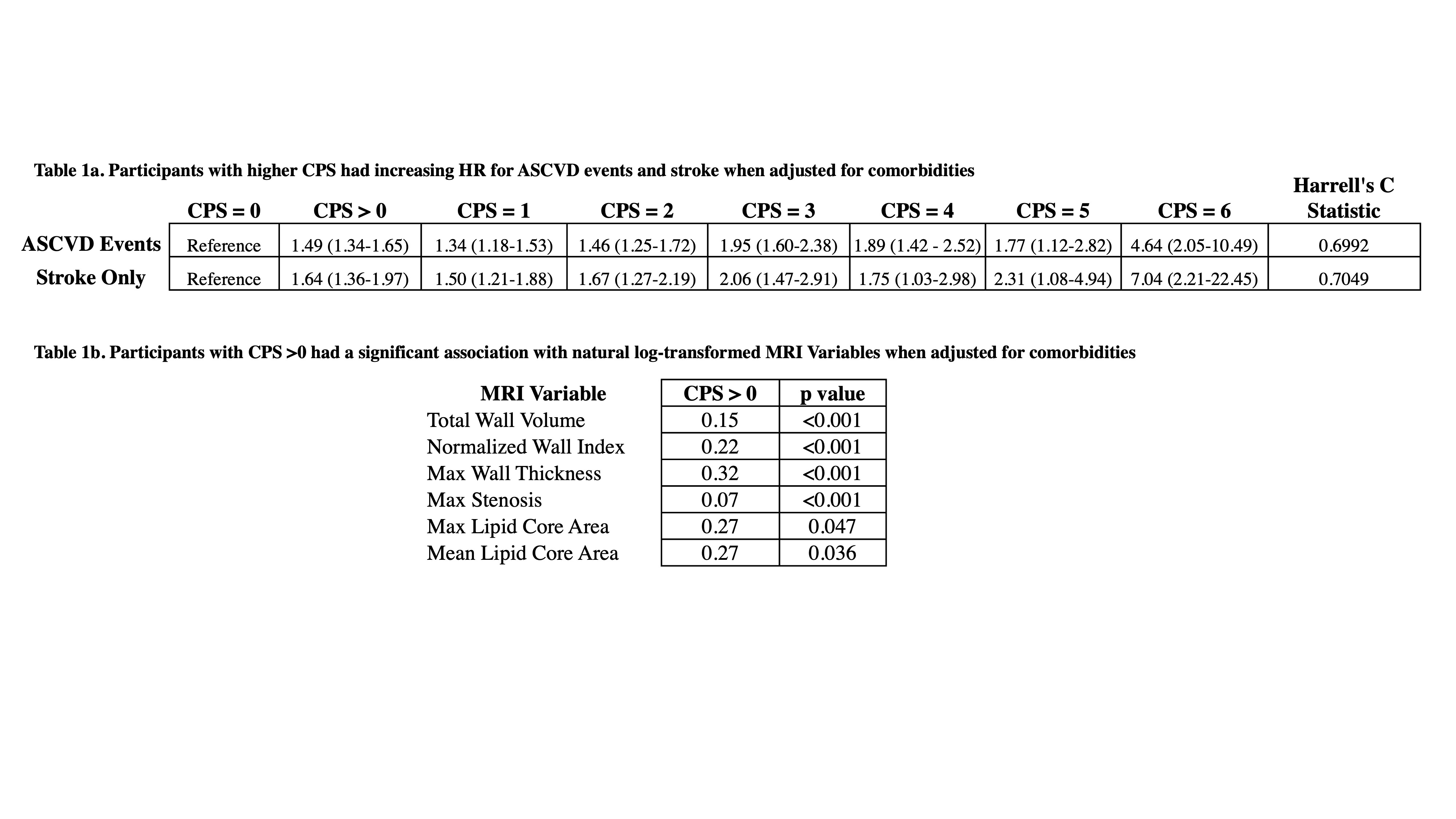
Results In this analysis, 6,149 participants had CA US data available, 1,456 participants had CA MRI data available, and 877 had both. The mean time between CA US and CA MRI was 9 years. The mean age at CA US was 63 years old, 58% were women, and 1,568 participants had an ASCVD event with a median follow up time of 20 years. The presence of carotid plaque on CA US was significantly associated with composite ASCVD events and stroke only. The CPS had stepwise higher HRs across increasing intervals (Table 1a) and was significantly associated with natural log-transformed CA MRI measures after adjustment (Table 1b). C-statistics for models predicting composite ASCVD events and stroke were similar for both CA US and CA MRI.
Conclusion The CPS had an independent association with both ASCVD events and stroke alone. It had a similar significant association with key CA MRI measures, suggesting that the CPS may predict future carotid plaque on CA MRI. Thus, the CPS may be a simpler yet effective method to quantify subclinical carotid plaque and improve ASCVD risk assessment.
Chew, Christopher
( Johns Hopkins Hospital
, Baltimore
, Maryland
, United States
)