
Logo

American Heart Association

  107
  0


Final ID: TMP108

Incidence and Characteristics of Acute Ischemic Stroke after Cardiac Arrest

Abstract Body: Introduction: Brain injury is the main cause of death and disability post-cardiac arrest, and hypoxic-ischemic brain injury (HIBI) severity is associated with poor outcomes. There is limited information about the co-occurrence of acute ischemic stroke with HIBI post-cardiac arrest and its impact on outcome.
Methods: We performed a retrospective analysis of brain MRI reports from patients with cardiac arrest in a multicenter cohort to evaluate the incidence of acute ischemic stroke and HIBI. Patients with MRI in the first 7 days after cardiac arrest were included. Patients with traumatic brain injury, intracranial hemorrhage, recent neurosurgical procedures, or ischemic stroke at admission were excluded. A secondary manual review by a board-certified vascular neurologist was pursued if the MRI report did not specify the absence of ischemic stroke. Univariate and multivariable analysis was performed to explore the characteristics of the ischemic lesions and to evaluate if it was related to poor functional outcomes (i.e., Cerebral Performance Category of 4-5).
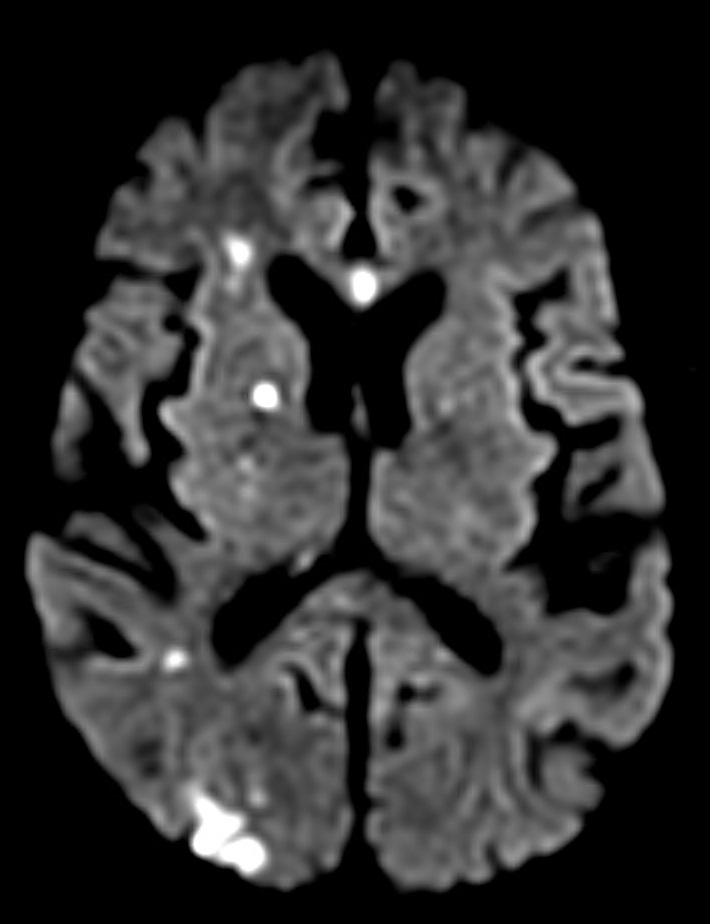
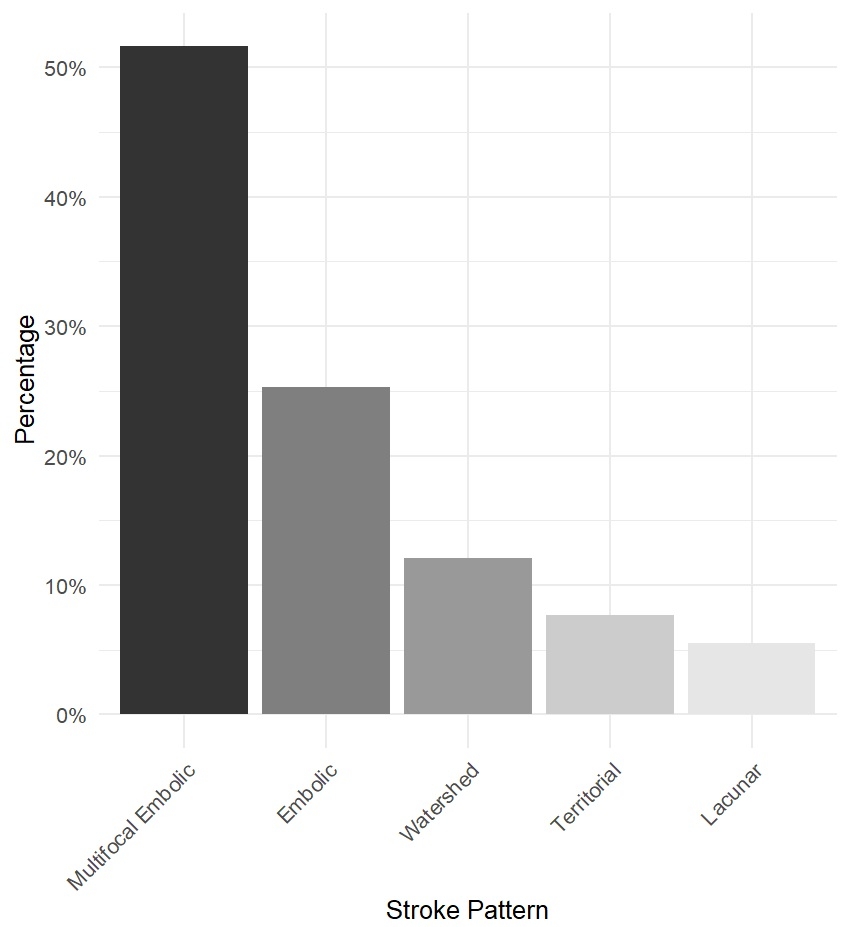
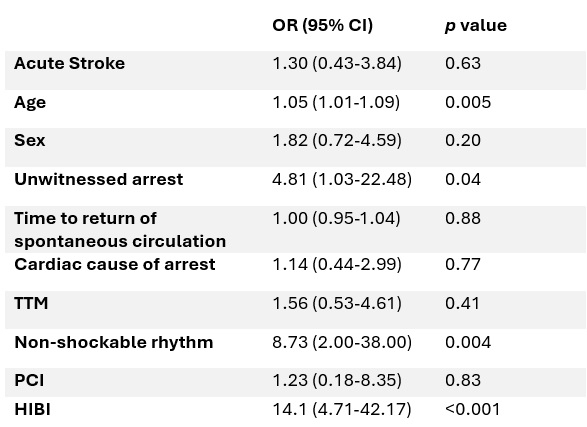
Results: Among 396 patients who met the inclusion criteria, 91 had cerebral infarction based on MRI (22.9%). The most common pattern of stroke was multifocal small embolic (51.6%), followed by single embolic (25.3%), watershed (12.1%), territorial (7%), and lacunar (5%). The patients with acute ischemic stroke were older (p<0.01). In the logistic regression, older age, non-witnessed cardiac arrest, and non-shockable rhythm were associated with worse prognosis (p<0.05). The presence of acute ischemic stroke was not significantly associated with the cause of arrest, percutaneous coronary intervention (PCI), or the use of targeted temperature management (TTM). Individuals with acute ischemic stroke had lower rates of HIBI (odds ratio [OR] 0,55 [0.34-0.87], p<0.01). In univariate and multivariate analysis, the presence of acute ischemic stroke was not associated with outcome, as opposed to the presence of HIBI (p<0.01).
Conclusion: More than one-fifth of the comatose patients after cardiac arrest present acute ischemic stroke on MRI. The most common pattern is multifocal embolic, which may be related to cardiac embolism and hypercoagulable state after the arrest and not from PCI or cardiac arrest rhythm. The detection of acute ischemic stroke is higher among individuals without HIBI and is not associated with worse outcomes.
  • Trombin Marques, Marina  ( University of California San Francisco , San Francisco , California , United States )
  • Lee, Jong Woo  ( Harvard Medical School , Boston , Massachusetts , United States )
  • Amorimde Cerqueira, Edilberto  ( University of California San Francisco , San Francisco , California , United States )
  • Bao, Kevin  ( University of California San Francisco , San Francisco , California , United States )
  • Otero, Matheus  ( University of California San Francisco , San Francisco , California , United States )
  • Velasquez, Gerardo  ( University of California San Francisco , San Francisco , California , United States )
  • Peterson, Katherine  ( University of California San Francisco , San Francisco , California , United States )
  • Hemphill, Claude  ( University of California San Francisco , San Francisco , California , United States )
  • Hu, Xiao  ( Emory , Atlanta , Georgia , United States )
  • Sampaio, Gisele  ( UNIFESP and ALBERT EINSTEIN , Sao Paulo , Brazil )
  • Westover, Brandon  ( Harvard Medical School , Boston , Massachusetts , United States )
  • Author Disclosures:
    Marina Trombin Marques: DO have relevant financial relationships ; Research Funding (PI or named investigator):American Heart Association:Active (exists now) | Jong Woo Lee: No Answer | Edilberto AmorimDe Cerqueira: DO NOT have relevant financial relationships | Kevin Bao: DO NOT have relevant financial relationships | Matheus Otero: DO NOT have relevant financial relationships | Gerardo Velasquez: DO NOT have relevant financial relationships | Katherine Peterson: DO NOT have relevant financial relationships | Claude Hemphill: DO have relevant financial relationships ; Consultant:Zoll:Past (completed) | Xiao Hu: No Answer | Gisele Sampaio: DO have relevant financial relationships ; Researcher:Biogen, Charm Trial:Past (completed) | Brandon Westover: No Answer
Meeting Info:
Session Info:

Risk Factors and Prevention Moderated Poster Tour II

Thursday, 02/06/2025 , 06:00PM - 07:00PM

Moderated Poster Abstract Session

More abstracts on this topic:
10-Year Trends in Last Known Well to Arrival Time in Acute Ischemic Stroke Patients: 2014-2023

Ferrone Nicholas, Sanmartin Maria, O'hara Joseph, Jimenez Jean, Ferrone Sophia, Wang Jason, Katz Jeffrey, Sanelli Pina

A Fat Chance: Paradoxical Embolic Stroke from Lipomatous Hypertrophy of the Interatrial Septum

Kalathoor Abraham

More abstracts from these authors:
AI for neuroprognosis

Amorimde Cerqueira Edilberto

Prognostic Factors in Craniocervical Artery Dissection: A Latin American Cohort Study.

Reges Danyelle, Miranda Maramelia, Sampaio Gisele, Navarro Borba Adissy Erica, Lopes Ronney, Trombin Marques Marina, Gabas Miglioli Fernanda, Lessa Vanessa, Pinheiro Modolo Gabriel, Bazan Rodrigo, Gagliardi Rubens

You have to be authorized to contact abstract author. Please, Login
Not Available

Readers' Comments

We encourage you to enter the discussion by posting your comments and questions below.

Presenters will be notified of your post so that they can respond as appropriate.

This discussion platform is provided to foster engagement, and simulate conversation and knowledge sharing.


You have to be authorized to post a comment. Please, Login or Signup.


   Rate this abstract  (Maximum characters: 500)