Logo

American Heart Association

  239
  0


Final ID: 10

Does the use of CT perfusion (CTP) increase treatment rate of endovascular thrombectomy (EVT) in acute ischemic stroke patients?

Abstract Body: Introduction: CTP is used to distinguish core infarct from penumbral tissue in the 6-24 hour time window from last known well time (LKW). In addition, routine use of CTP inside of 6 hours may increase the sensitivity of detecting medium vessel occlusion (MeVO) as compared with CTA alone. Therefore, some centers apply a strategy of using CTP/CTA routinely in the first 6 hours from LKW while others reserve CTP for the 6-24 hour delayed time window. We hypothesized that use of CTP/CTA inside of 6 hours from LKW is associated with increased EVT especially for MeVO.
Methods: This is a retrospective analysis of acute ischemic stroke (AIS) patients from a multi-state stroke registry between Jan 2018 and Mar 2024 who presented within 6 hours of LKW. The incidence of EVT by triage imaging modality (CTA or CTA/CTP) was analyzed overall and also by occlusion location (Large vessel occlusion (LVO), MeVO) through linear mixed models (LMM). Multivariable models were used to adjust for confounding factors. A two-tailed p value of <0.05 was considered statistically significant. Statistical analyses were performed using the statistical software R (version 4.2.3).
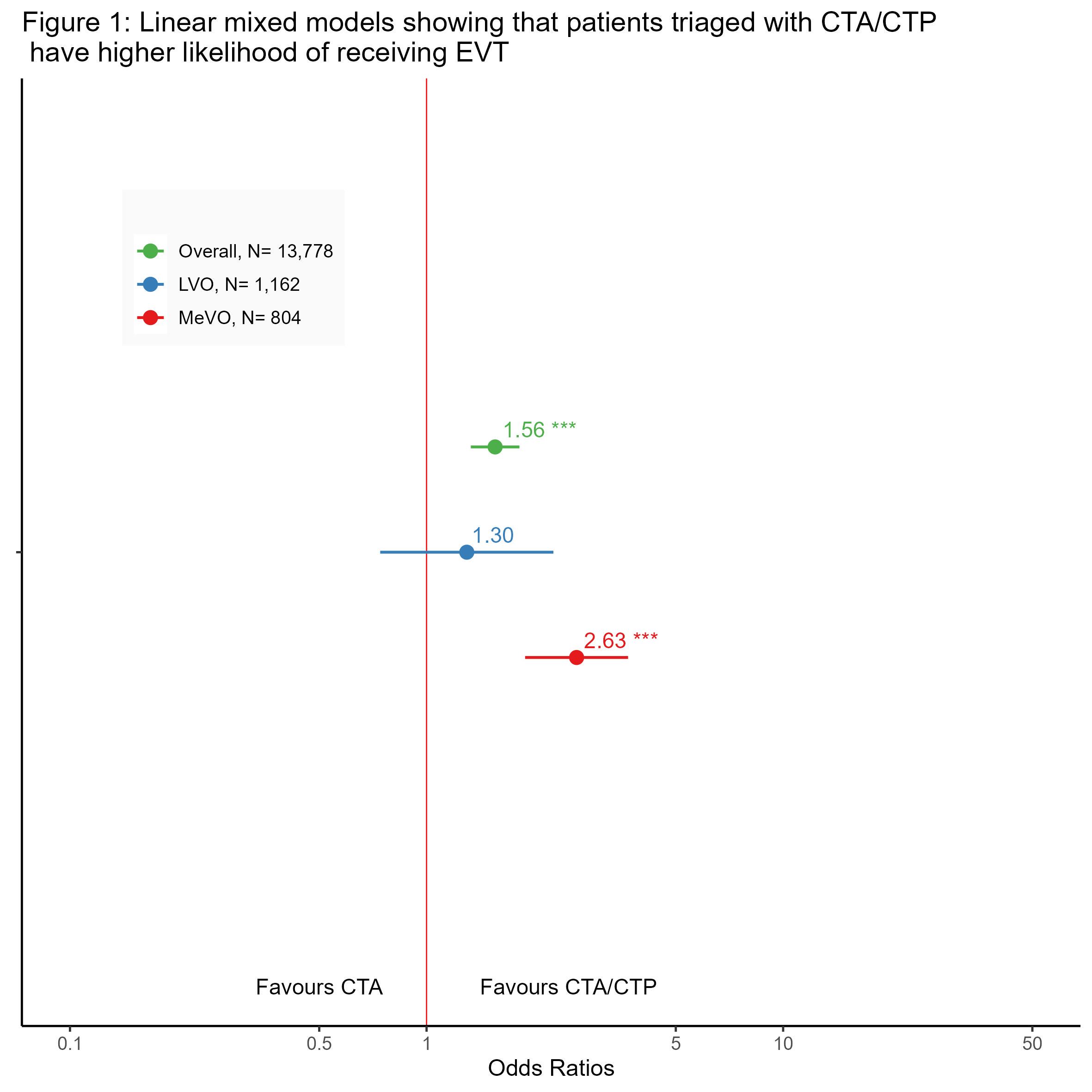
Results: Of the 13,778 AIS patients analyzed, 43% were triaged with CTP/CTA and CTA alone was used for 57%. The unadjusted EVT treatment rate was 9.8% in patients triaged with CTA alone and 22% for patients triaged with CTP/CTA. LMMs adjusted for age at diagnosis, sex, race and ethnicity, NIHSS at admit and comorbidities show a higher statistically significant likelihood of receiving EVT in the CTA/CTP triaged patients (OR 1.6, 95%CI 1.3 to 1.8, p <0.001). For LVO, there was no difference in the likelihood of receiving EVT in the CTA/CTP triaged patients (OR 1.3, 95%CI 0.7 to 2.3, p = .4). However, for MeVO there was a higher likelihood of receiving EVT in the CTA/CTP triaged patients (OR 3.2, 95%CI 2.0 to 5.0, p <0.001) (Fig 1)
Conclusions: The results here show that in a large system of stroke hospitals that AIS patients presenting within 6 hours of LKWT who received CTP/CTA were more likely to undergo EVT than those who received CTA alone. This increased utilization of EVT was accounted for by increased EVT for MEVO but not for LVO. The increased utilization of EVT in MEVO may reflect increased sensitivity of detecting MeVO with the addition of CTP. If MEVO EVT treatment proves effective in ongoing randomized clinical trials, our data argue for more routine use of CTP as a “MEVO detector” in the early time window.
  • Marginean, Horia  ( Providence Brain and Spine , Portland , Oregon , United States )
  • Stuchiner, Tamela  ( PROVIDENCE BRAIN AND SPINE INS , Portland , Oregon , United States )
  • Hallak, Patrice  ( Providence Health and Services , Los Angeles , California , United States )
  • Tarpley, Jason  ( Providence Health and Services , Los Angeles , California , United States )
  • Author Disclosures:
    Horia Marginean: No Answer | Tamela Stuchiner: DO NOT have relevant financial relationships | Patrice Hallak: DO NOT have relevant financial relationships | Jason Tarpley: DO NOT have relevant financial relationships
Meeting Info:
Session Info:

Neuroendovascular Oral Abstracts I

Wednesday, 02/05/2025 , 07:30AM - 09:00AM

Oral Abstract Session

More abstracts on this topic:
Bridging thrombolysis prior to thrombectomy does not modify the association between Direct-to-angiography vs Repeat Imaging approaches and functional outcomes after EVT in transferred patients

Shafiq Ameena, Elijovich Lucas, Dannenbaum Mark, Mir Osman, Tekle Wondwossen, Maali Laith, Narangoli Adeeb, Yaghmoor Bassam, Al-shaibi Faisal, Saidi Yazid, Al Mostaneer Alhassin, Pujara Deep, Albedaiwi Mohammed, Montgomery Kelly, Sundararajan Sophia, Opaskar Amanda, Xiong Wei, Degeorgia Michael, Duncan Kelsey, Ray Abhishek, Hu Yin, Sunshine Jeffrey, Goyal Nitin, Alenzi Bader, Abdulrazzak Mohammad, Hoit Daniel, Martin-schild Sheryl, Song Sarah, Sitton Clark, Tsivgoulis Georgios, Arthur Adam, Sila Cathy, Bambakidis Nicholas, Chen Michael, Hassan Ameer, Ribo Marc, Sarraj Amrou, Grotta James, Blackburn Spiros, Requena Manuel, Kamal Haris, Abraham Michael

Acute Ischemic Stroke Patient Factors Associated with Poor Outcomes in Patients with Favorable Collaterals and Successful Thrombectomy

Kesten Jamie, Mlynash Michael, Yuen Nicole, Seners Pierre, Wouters Anke, Schwartz Maya, Lansberg Maarten, Albers Gregory, Heit Jeremy

More abstracts from these authors:
You have to be authorized to contact abstract author. Please, Login
Not Available

Readers' Comments

We encourage you to enter the discussion by posting your comments and questions below.

Presenters will be notified of your post so that they can respond as appropriate.

This discussion platform is provided to foster engagement, and simulate conversation and knowledge sharing.


You have to be authorized to post a comment. Please, Login or Signup.


   Rate this abstract  (Maximum characters: 500)