
Logo

American Heart Association

  123
  0


Final ID: WMP112

Elimination of Senescent Cells with Immune Checkpoint Inhibitor Prevents Intracranial Aneurysm Rupture

Abstract Body: Introduction: Clinical studies have shown an association between aging and the risk of intracranial aneurysm rupture. Aging leads to various changes in cellular homeostasis, including the onset of cellular senescence. Senescent cells secrete senescence-associated secretory phenotypes that leads to chronic vascular inflammation and abnormal vascular remodeling. Our preliminary data showed the accumulation of senescent cells in both human and mouse intracranial aneurysms, suggesting their potential role in the pathophysiology of intracranial aneurysms. We also confirmed that genetic elimination of senescent cells prevented aneurysm rupture. The immune system plays a critical role in eliminating senescent cells. However, in the pathological state, senescent cells can interfere with innate and adaptive immune responses through mechanisms known as immune checkpoints. Senescent cells express programmed cell death ligand 1 (PD-L1), which can bind to the programmed cell death protein 1 (PD-1) on immune cells. PD-L1-expressing senescent cells then evade clearance by immune cells. We investigated the effect of an immune checkpoint inhibitor on the development of intracranial aneurysm rupture.
Methods: We used 15-month-old male C57BL/6J mice (n = 29). We induced intracranial aneurysms by a combination of elastase injection and hypertension. After aneurysm induction, we started treatment with anti-PD-1 antibody as an immune checkpoint inhibitor or IgG2 as a vehicle. We compared the aneurysm formation and rupture rates, and the survival curve between the two groups. We also assessed the effects of anti-PD-1 antibody on the mRNA expression of p16 as a senescent cell marker in cerebral arteries.
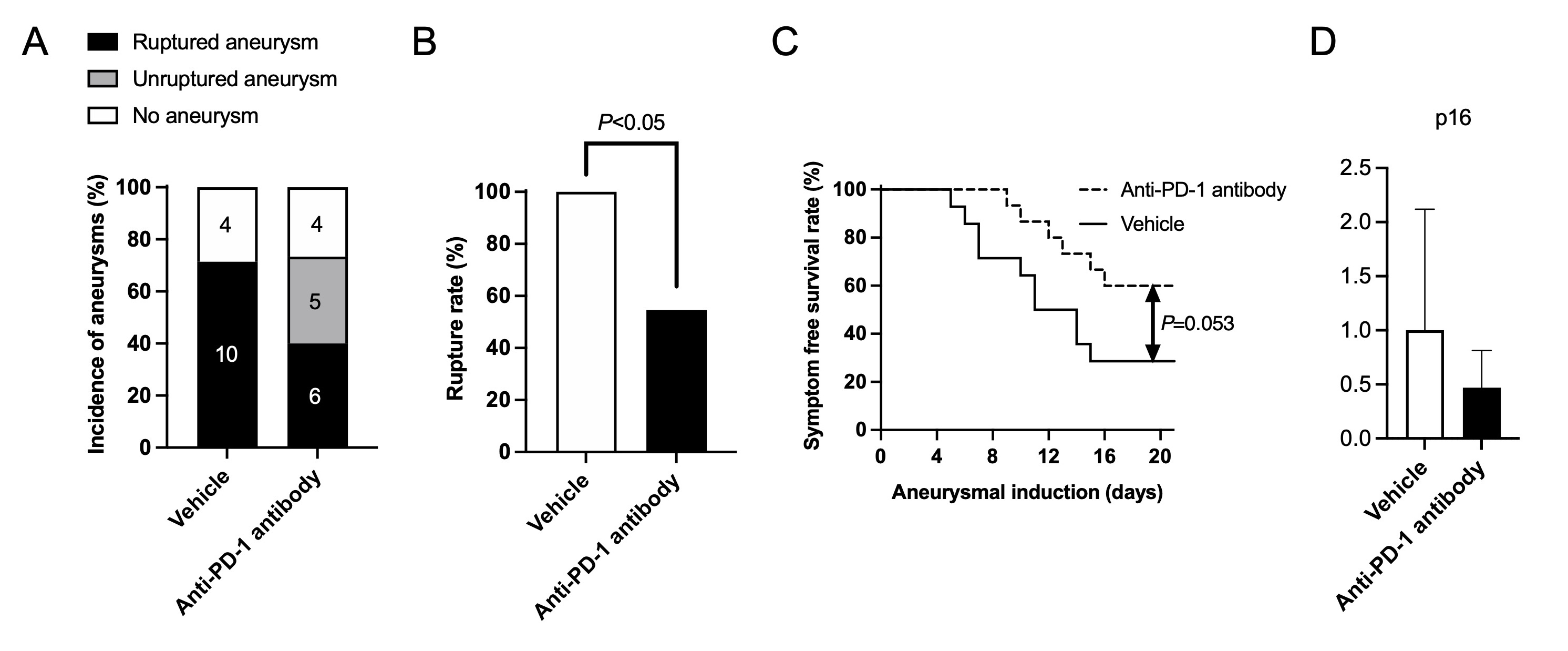
Results: The aneurysm rupture rate was significantly lower in the treatment group than in the vehicle group (54.5% vs. 100%, P<0.05, Fig. A and B). There was no statistical difference in the aneurysm formation rate between the two groups (78.6% vs. 71.4%, P>0.99, Fig. A). Mice treated with anti-PD-1 antibody had a better survival rate than the control group (P=0.053, Fig. C). Treatment with anti-PD-1 antibody significantly reduced the mRNA expression of p16 in cerebral arteries (P<0.05, Fig. D).
Conclusions: Treatment with immune checkpoint inhibitor prevented intracranial aneurysm rupture. Our findings suggest that cellular senescence and immune checkpoint may serve as novel therapeutic targets for the prevention of aneurysm rupture.
  • Maeda, Takuma  ( Barrow Neurological Institute , Phoenix , Arizona , United States )
  • Hashimoto, Tomoki  ( Barrow Neurological Institute , Phoenix , Arizona , United States )
  • Take, Yushiro  ( Barrow Neurological Institute , Phoenix , Arizona , United States )
  • Uchikawa, Hiroki  ( Barrow Neurological Institute , Phoenix , Arizona , United States )
  • Nisson, Peyton  ( Barrow Neurological Institute , Phoenix , Arizona , United States )
  • Cisneros, Oscar  ( Barrow Neurological Institute , Phoenix , Arizona , United States )
  • Ishiguro, Taichi  ( Barrow Neurological Institute , Phoenix , Arizona , United States )
  • Sato, Hiroki  ( Barrow Neurological Institute , Phoenix , Arizona , United States )
  • Ai, Jinglu  ( Barrow Neurological Institute , Phoenix , Arizona , United States )
  • Lawton, Michael  ( Barrow Neurological Institute , Phoenix , Arizona , United States )
  • Author Disclosures:
    Takuma Maeda: DO NOT have relevant financial relationships | Tomoki Hashimoto: DO NOT have relevant financial relationships | Yushiro Take: No Answer | Hiroki Uchikawa: DO NOT have relevant financial relationships | Peyton Nisson: DO NOT have relevant financial relationships | Oscar Cisneros: DO have relevant financial relationships ; Individual Stocks/Stock Options:Catalyst Pharmaceuticals:Active (exists now) ; Individual Stocks/Stock Options:Abbvie:Active (exists now) ; Individual Stocks/Stock Options:Pfizer:Active (exists now) | Taichi Ishiguro: No Answer | Hiroki Sato: No Answer | Jinglu Ai: No Answer | Michael Lawton: DO NOT have relevant financial relationships
Meeting Info:
Session Info:

Translational Basic Science Moderated Poster Tour I

Wednesday, 02/05/2025 , 06:00PM - 07:00PM

Moderated Poster Abstract Session

More abstracts on this topic:
Cerebrospinal Fluid Proinflammatory Cytokines are Associated with Poor Outcome following Hemorrhagic Stroke

Sorensen Gracey, Gilmore Emily, Matouk Charles, Sheth Kevin, Kim Jennifer, Petersen Nils, Sansing Lauren, Magid-bernstein Jessica, Grychowski Lauren, Yan Jennifer, Herman Alison, He Zili, Johnson Conor, Beatty Hannah, Jayasundara Sithmi, Falcone Guido

Assessing Effects of Nimodipine-Associated Blood Pressure Reductions on Cerebral Autoregulation and Cortical Activity in Aneurysmal Subarachnoid Hemorrhage

Jayasundara Sithmi, Magid-bernstein Jessica, Amllay Abdelaziz, Okeefe Lena, Hebert Ryan, Bahrassa Farhad, Sheth Kevin, Beekman Rachel, Gilmore Emily, Matouk Charles, Kim Jennifer, Choi Rachel, Petersen Nils, Rapuano Amedeo, Chen Yilun, Top Ilayda, Olexa Madelynne, Maarek Rafael, Yan Jennifer, Vargas David

More abstracts from these authors:
Clonal hematopoiesis of indeterminate potential promotes the development of intracranial aneurysm rupture

Uchikawa Hiroki, Maeda Takuma, Cisneros Oscar, Nisson Peyton, Fraser Claire, Bowen Sara, Ai Jinglu, Lawton Michael, Hashimoto Tomoki

Impact of Microplastics and Nanoplastics on Ischemic Stroke in Mice

Maeda Takuma, Nisson Peyton, Cisneros Oscar, Lawton Michael, Hashimoto Tomoki

You have to be authorized to contact abstract author. Please, Login
Not Available

Readers' Comments

We encourage you to enter the discussion by posting your comments and questions below.

Presenters will be notified of your post so that they can respond as appropriate.

This discussion platform is provided to foster engagement, and simulate conversation and knowledge sharing.


You have to be authorized to post a comment. Please, Login or Signup.


   Rate this abstract  (Maximum characters: 500)