Cognitive impairment in patients with intracranial atherosclerosis at different stages: an observational study
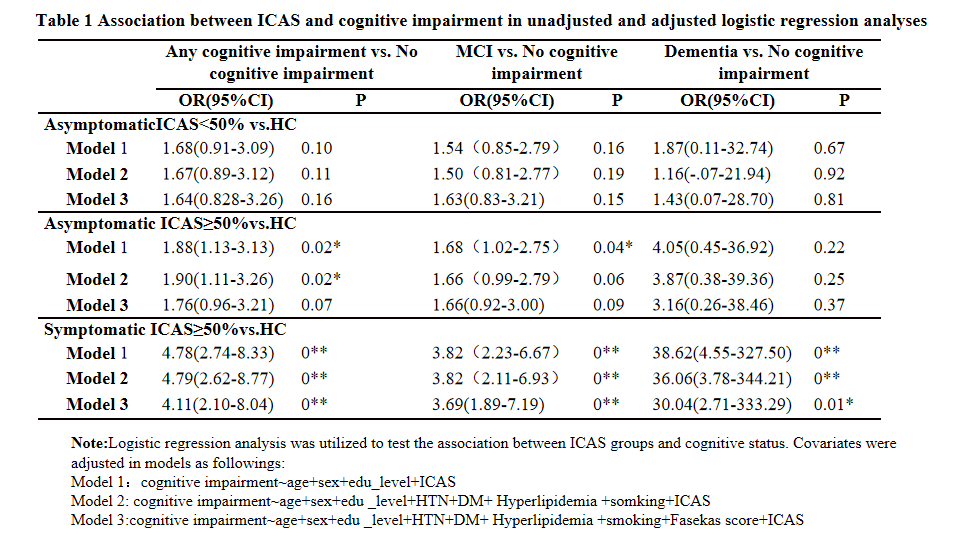
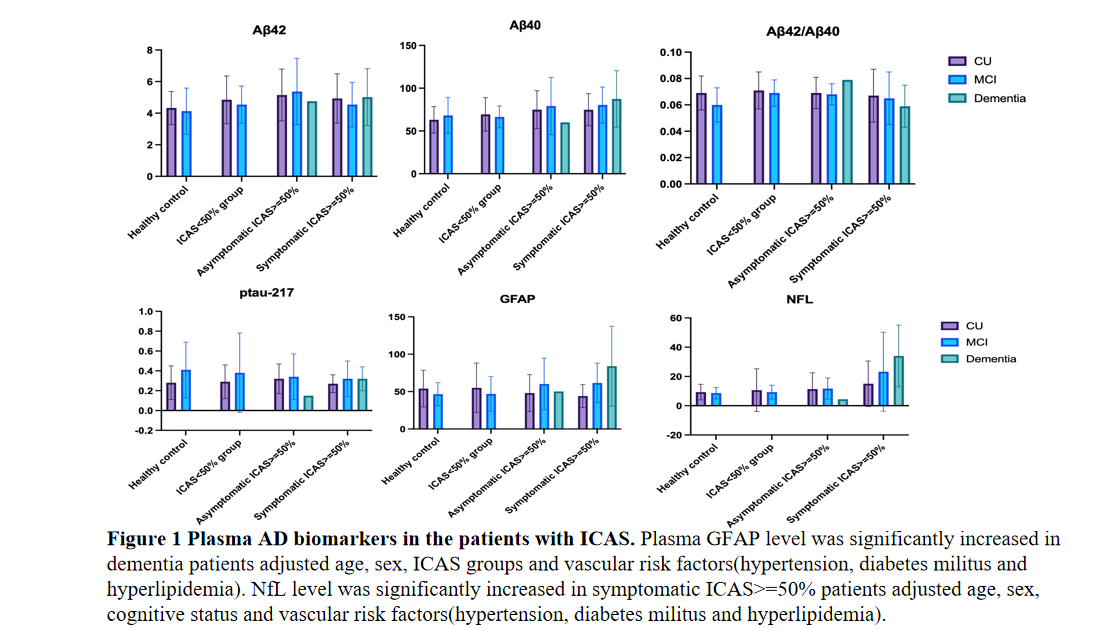
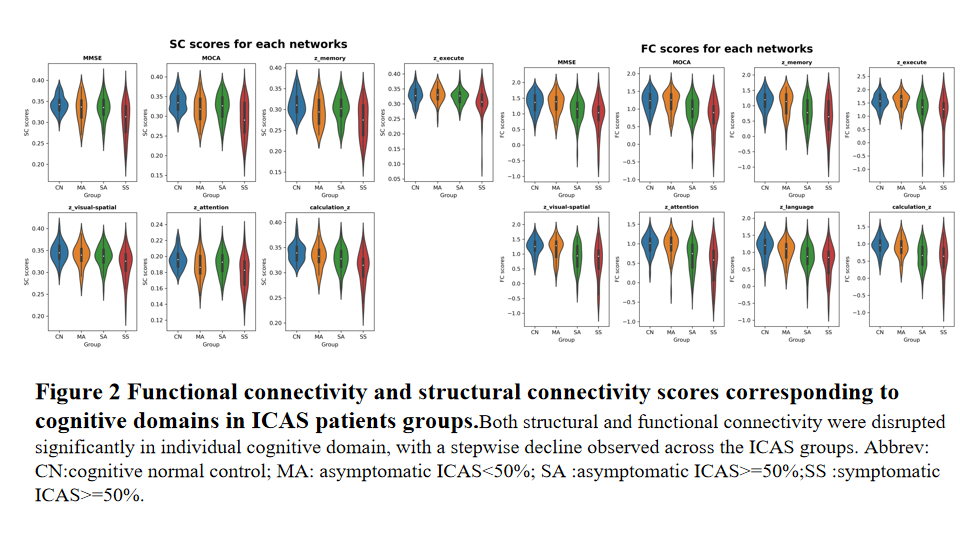
Abstract Body: Background Emerging evidence suggests intracranial atherosclerosis (ICAS) is associated with an increased risk of dementia. However, few data have focused on the cognitive impairment in patients with ICAS at different stages. Methods Consecutive patients with ICAS at different stages (asymptomatic ICAS <50%, asymptomatic ICAS ≥50%, symptomatic ICAS ≥50%) and age-sex matched normal controls, diagnosed by magnetic resonance angiography and vessel wall imaging, were recruited. Cognitive status was assessed with a neuropsychological battery and daily life ability evaluations. Plasma biomarkers were measured, including Aβ42, Aβ40, p-tau217, GFAP and NfL. Conventional MRI, diffusion tensor imaging, and resting-state functional MRI were conducted. Compared to the normal control group, we developed personalized and interpretable scores for brain circuit dysfunction, applying a theoretical taxonomy to describe the abnormal structural and functional neural networks linked to cognitive domains in ICAS patients. Results We enrolled 455 patients with ICAS (age 56.0 ± 13.0 years, 60% male) and 158 controls (age 58.30 ± 11.14 years, 50% male). The prevalence of dementia and mild cognitive impairment was 0.6% and 22.1% in the control group, 1.0% and 29.1% in patients with asymptomatic ICAS <50% (n=103), 2.4% and 30.2% in those with asymptomatic ICAS ≥50% (n=212), and 10.6% and 42.1% in individuals with symptomatic ICAS ≥50% (n=140), respectively. Compared to controls, only patients with symptomatic ICAS showed a significant decrease in the Aβ42/Aβ40 ratio (p<0.05) and an increase in NFL level (p<0.05). In contrast, the P-tau 217 and GFAP levels were similar across ICAS groups and control groups. The burden of cerebral small vascular disease (CSVD) increased progressively across ICAS stages, with the frequency of a CSVD score ≥ 4 being 9.8%, 9.6%, and 33.4%, respectively, compared to 5.4% in the control group. However, this did not affect the independent impact of ICAS on cognition (β =0.54, P=0.035). Disruptions in both structural and functional connectivity were evident in brain networks, with an increasingly pronounced decline observed by brain circus score, especially in the memory network (-1.22, -5.88, -6.74, vs. control) across ICAS stages . Conclusion Cognitive impairment can occur at the early stage of patients with ICAS and varies in severity and mechanisms across stages. Treatment and prevention strategies should be specifically tailored.
Liu, Caiyan
(
Peking Union Medical College Hospital
, Beijing , China )
Cheng, An-qi
(
Peking Union Medical College Hospital
, Beijing , China )
Zou, Yinxi
(
Peking Union Medical College Hospital
, Beijing , China )
Liu, Linwen
(
Peking Union Medical College Hospital
, Beijing , China )
Li, Mingli
(
Peking Union Medical College Hospital
, Beijing , China )
Liu, Yiyang
(
Peking Union Medical College Hospital
, Beijing , China )
Wang, Zijue
(
Peking Union Medical College Hospital
, Beijing , China )
Si, Qianqian
(
The First Affiliated Hospital of Nanjing Medical University
, Nanjing , China )
Yu, Qiuyu
(
Peking Union Medical College Hospital
, Beijing , China )
Xu, Weihai
(
Peking Union Medical College Hospital
, Beijing , China )
Author Disclosures:
Caiyan Liu:DO NOT have relevant financial relationships
| Weihai Xu:No Answer
| An-Qi Cheng:DO have relevant financial relationships
;
Research Funding (PI or named investigator):the National Science Fund for Distinguished Young Scholars:Active (exists now)
| Yinxi Zou:DO NOT have relevant financial relationships
| Linwen Liu:No Answer
| MingLi LI:DO NOT have relevant financial relationships
| Yiyang Liu:DO NOT have relevant financial relationships
| Zijue Wang:DO NOT have relevant financial relationships
| Qianqian Si:DO NOT have relevant financial relationships
| Qiuyu Yu:No Answer