
Logo

American Heart Association

  99
  0


Final ID: WMP16

Impaired Neurocognitive Domains Related To Quantitative Brain Functional Abnormalities In Patients With Unilateral Asymptomatic Middle Cerebral Artery Stenotic-occlusive Disease

Abstract Body: Background: The patterns of neural functional changes induced by chronic hypoperfusion resulting from intracranial arterial stenosis and their relationship to cognitive performance are not yet fully understood, with unilateral asymptomatic middle cerebral artery stenotic-occlusive disease (MCAs/o) serving as an ideal model for investigation.
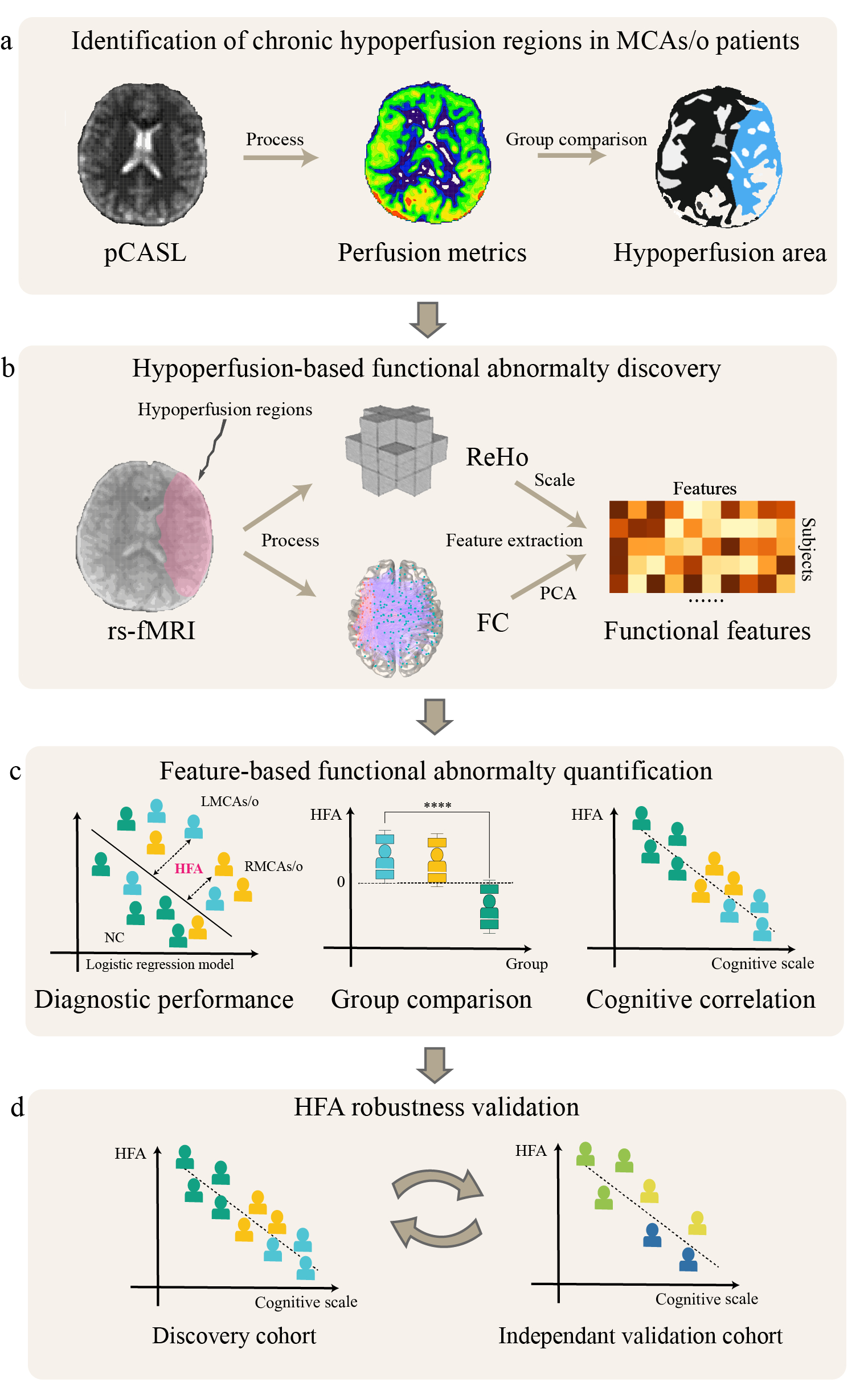
Methods: We established a discovery-validation research pipeline to identify functional abnormalities in the hypoperfused regions of MCAs/o patients and quantify them into a machine learning-based data-driven biomarker, i.e. hypoperfusion-based functional abnormalities (HFA). Pseudocontinuous arterial spin labeling imaging was used to identify hypoperfused regions (HypoR) in the discovery cohort. Functional changes within HypoR, including regional homogeneity (ReHo) and functional connectivity, were analyzed and quantitatively integrated using a logistic regression machine learning model to calculate the HFA after feature extraction. The correlation between HFA and cognitive scores was then assessed, and the findings were validated in the independent cohort (Figure 1).
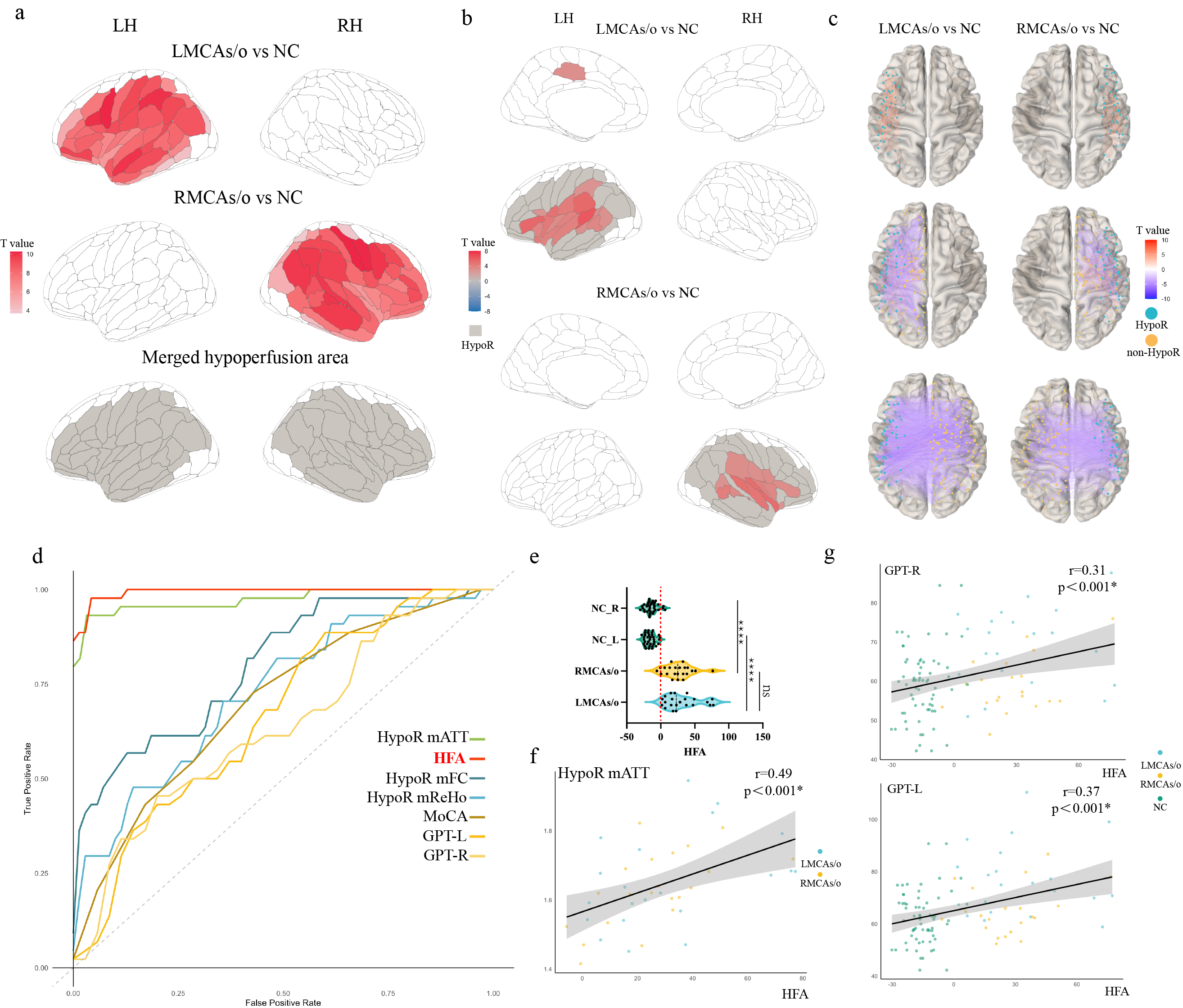
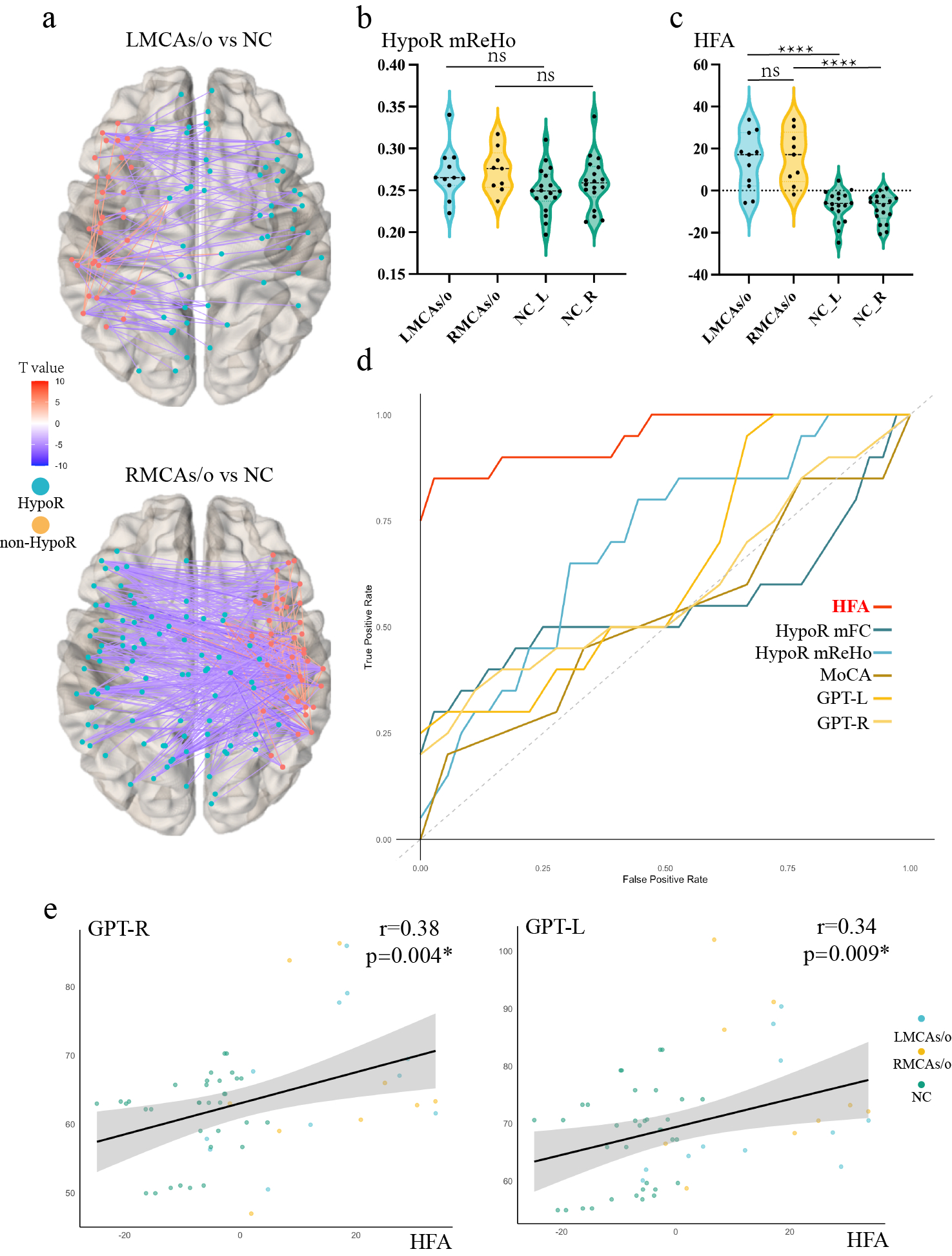
Results: The discovery cohort included 44 MCAs/o patients (LMCAs/o: n=22, age 56±11 years, 13 male; RMCAs/o: n=22, age 49±14 years, 16 male) and 35 matched normal controls (age 52±11 years, 15 male), in which MCAs/o patients showed poorer performance on bilateral hand-grooved pegboard tests (GPT) compared to controls (p<0.05). We identified 45 regions of interest (ROIs) in the stenotic hemisphere with significantly elevated arterial transit time, defining them as hypoperfused areas. We found that MCAs/o patients had increased ReHo(FDR-p<0.05) and reductions in HypoR~non-HypoR connections(FDR-p<0.05), coupled with increased HypoR~HypoR connections(FDR-p<0.05). HFA was then calculated based on functional features, which effectively identified early functional changes in MCAs/o patients(AUC=0.994) and correlated with bilateral GPT(p<0.001) (Figure 2). Validation in an independent cohort(20 MCAs/o, 16 controls) confirmed these findings(AUC=0.948; HFA~bilateral GPT p<0.01, Figure 3).
Conclusions: Chronic hypoperfusion caused by unilateral MCAs/o can lead to a specific pattern of functional changes characterized by increased local neural activity. The quantified biomarker of this pattern can be used to monitor the decline in cognitive function. Our study provides a foundation for further research into the neural damage caused by chronic hypoperfusion.
  • Zou, Yinxi  ( Peking Union Medical College Hospital , Beijing , China )
  • Liu, Caiyan  ( Peking Union Medical College Hospital , Beijing , China )
  • Liu, Linwen  ( Peking Union Medical College Hospital , Beijing , China )
  • Li, Mingli  ( Peking Union Medical College Hospital , Beijing , China )
  • Xu, Wei-hai  ( Peking Union Medical College Hospital , Beijing , China )
  • Author Disclosures:
    Yinxi Zou: DO NOT have relevant financial relationships | Caiyan Liu: DO NOT have relevant financial relationships | Linwen Liu: No Answer | Mingli Li: DO NOT have relevant financial relationships | Wei-hai Xu: No Answer
Meeting Info:
Session Info:

Brain Health Moderated Poster Tour

Wednesday, 02/05/2025 , 06:00PM - 07:00PM

Moderated Poster Abstract Session

More abstracts from these authors:
Nighttime Blood Pressure and Intracranial Atherosclerotic Stenosis: Dose-Response Associations With Atherosclerotic Burden and Symptomatic Status

Zhou Huanyu, Xu Yan, Liu Caiyan, Xu Wei-hai, Zou Yinxi, Cheng An-qi, Liu Yiyang, Liu Niyuan, Guo Haoyao, Li Mingli, Wang Yining, Zhang Yuelun

The Obesity Paradox in Asymptomatic Intracranial Arterial Stenosis: Implications for Stroke Risk and Prognosis

Yuan Weizhuang, Ding Manqiu, Liu Yiyang, Cao Yufan, Zhou Huanyu, Zou Yinxi, Liu Caiyan, Xu Wei-hai

You have to be authorized to contact abstract author. Please, Login
Not Available

Readers' Comments

We encourage you to enter the discussion by posting your comments and questions below.

Presenters will be notified of your post so that they can respond as appropriate.

This discussion platform is provided to foster engagement, and simulate conversation and knowledge sharing.


You have to be authorized to post a comment. Please, Login or Signup.


   Rate this abstract  (Maximum characters: 500)