Logo

American Heart Association

  115
  0


Final ID: WP330

Pre-Existing Depression and Increased Risk of Stroke and Mortality Following Percutaneous Coronary Intervention: A Nationwide Cohort Study

Abstract Body: Background: Limited evidence exists on the role of depression in the risk of developing stroke and other cardiovascular outcomes in post-percutaneous coronary interventions (PCI) patients. We investigated this relationship using data from the Korean National Health Insurance Service database.

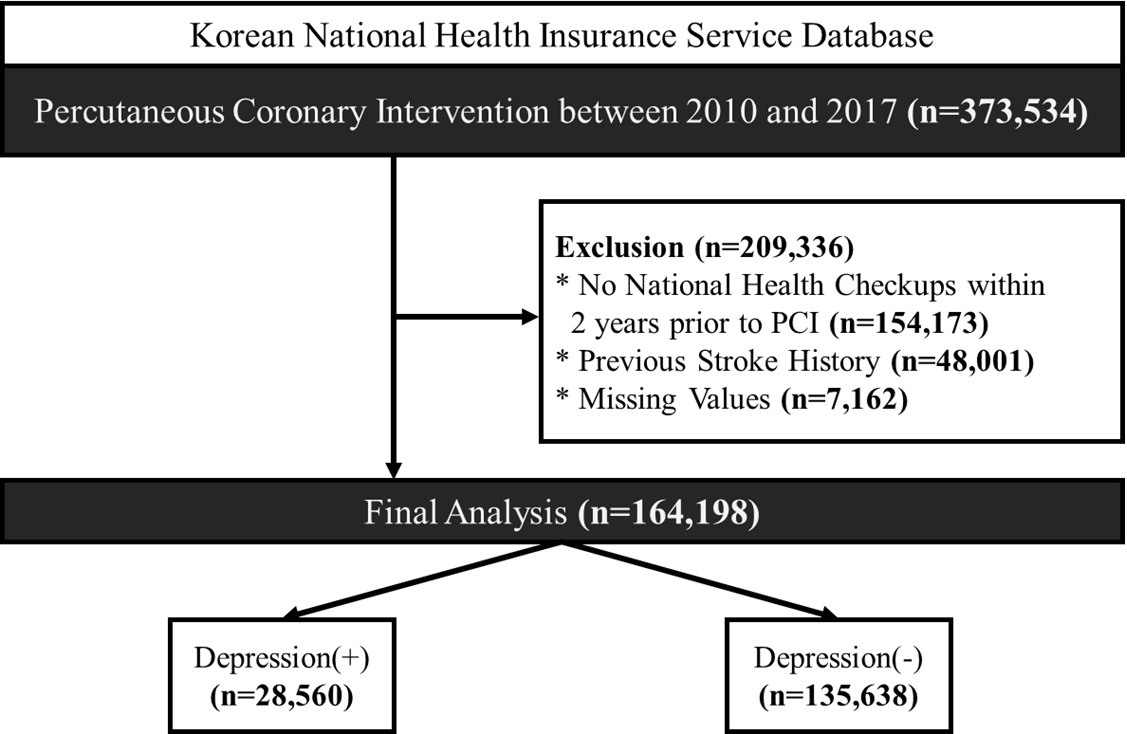
Methods: Our nationwide retrospective cohort study included 164,198 patients who underwent PCI between 2010-2017. Depression was defined using the ICD-10 codes recorded prior to the PCI event. The primary outcome was a new-onset stroke following the PCI. Secondary outcomes included PCI with myocardial infarction, revascularization (PCI or coronary artery bypass grafting), and all-cause mortality. A multivariable Cox proportional hazards regression analysis was employed to calculate adjusted hazard ratios (aHRs) and 95% confidence intervals (CIs), adjusting for potential confounders, including sociodemographic and lifestyle factors, comorbidities, and myocardial infarction at the index PCI.

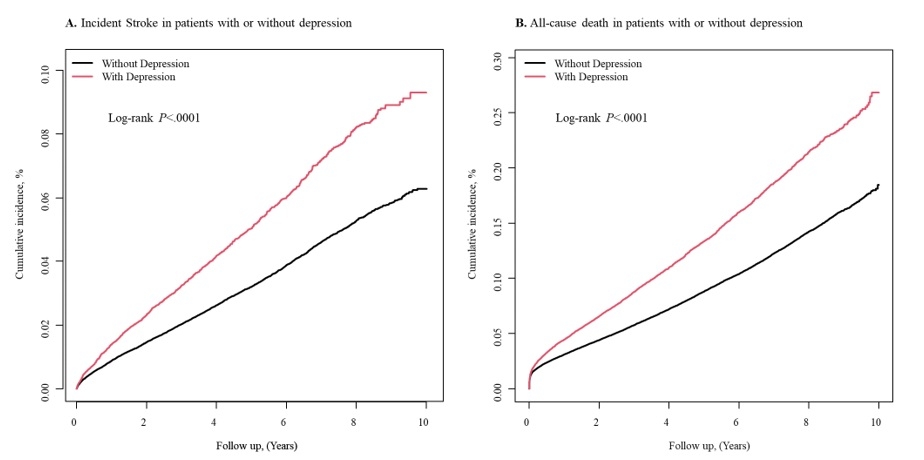
Results: Over a median follow-up of 5.0 years, acute stroke occurred in 5.7% of patients with a pre-existing depression (17.4% of the study population), compared to 3.5% of those without depression. Depression was associated with a 27% increased risk of acute stroke (aHR 1.27, 95% CI 1.20-1.35). Additionally, depression was linked with a 25% elevated risk of all-cause death (aHR 1.25, 95% CI, 1.21-1.29) and an 8% increased risk of revascularization (aHR 1.08, 95% CI 1.04-1.11). The associations with the risk of stroke and all-cause mortality were stronger in those under 65 years.

Conclusions: Our findings suggest that pre-existing depression may increase the risk of stroke and all-cause mortality after PCI, particularly in individuals under 65 years. Additionally, depression was significantly associated with an increased need for revascularization. This underscores the potential benefits of managing depression to reduce stroke risk and overall cardiovascular outcomes following PCI.
  • Cheon, Dae Young  ( Hallym University Dongtan Sacred Hospital , Suwon , Korea (the Republic of) )
  • Lee, Minwoo  ( Hallym University Sacred Heart Hospital , Anyang , Korea (the Republic of) )
  • Author Disclosures:
    Dae Young Cheon: DO NOT have relevant financial relationships | Minwoo Lee: DO NOT have relevant financial relationships
Meeting Info:
Session Info:

Risk Factors and Prevention Posters I

Wednesday, 02/05/2025 , 07:00PM - 07:30PM

Poster Abstract Session

More abstracts on this topic:
1-Year Outcomes After Cardioversion With and Without Anticoagulation in Patients With Left Atrial Appendage Occlusion: A Propensity-Matched Analysis

Thangjui Sittinun, Trongtorsak Angkawipa, Kewcharoen Jakrin, Thyagaturu Harshith, Watson Hangyu, Mensah Samuel, Balla Sudarshan, Navaravong Leenhapong

Application and Outcomes of Coronary Atherectomy in Patients with Acute Coronary Syndrome: A Report from the Nationwide J-PCI Registry

Aikawa Tadao, Minamino Tohru, Mori Yuichiro, Kohsaka Shun, Matsue Yuya, Kuno Toshiki, Yamaji Kyohei, Ozaki Dai, Tokano Takashi, Kozuma Ken

More abstracts from these authors:
Physical Activity Change After Myocardial Infarction and Subsequent Risk of Cardiovascular Events

Shin Sojung, Cheon Dae Young, Khil Jaewon, Lee Jaeyong, Ha Kyoung Hwa, Lee Hyeok-hee, Kim Hyeon Chang, Lee Hokyou

Association between Acute Stage Blood Pressure Variability and Post-Stroke Cognitive Impairment in Atrial Fibrillation-Related Acute Ischemic Stroke

Lee Minwoo, Cheon Dae Young, Choi Sang Won, Kim Yerim

You have to be authorized to contact abstract author. Please, Login
Not Available

Readers' Comments

We encourage you to enter the discussion by posting your comments and questions below.

Presenters will be notified of your post so that they can respond as appropriate.

This discussion platform is provided to foster engagement, and simulate conversation and knowledge sharing.


You have to be authorized to post a comment. Please, Login or Signup.


   Rate this abstract  (Maximum characters: 500)